

Summary
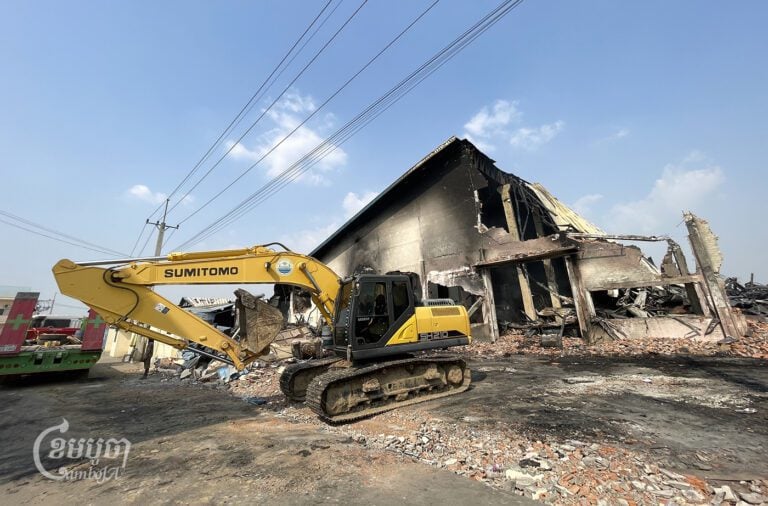
- Nearly five months after its reinstatement, Cambodia’s flagship Southern Cardamom REDD+ project (SCRP) is under fire again. Carbon market watchdogs and indigenous communities say its remediation efforts are inadequate, symbolic, and riddled with conflicts of interest.
- Every party Verra, the entity that certifies the SCRP, enlisted to review abuse allegations against project implementer Wildlife Alliance – before re-validating the REDD+ project – had a stake in the outcome. Upholding the claims could have meant financial or reputational fallout, skirting grievance standards set by a carbon market integrity council that Verra itself is approved by.
- Disputed land titles and confusing maps remain a legacy issue that still appears unresolved.
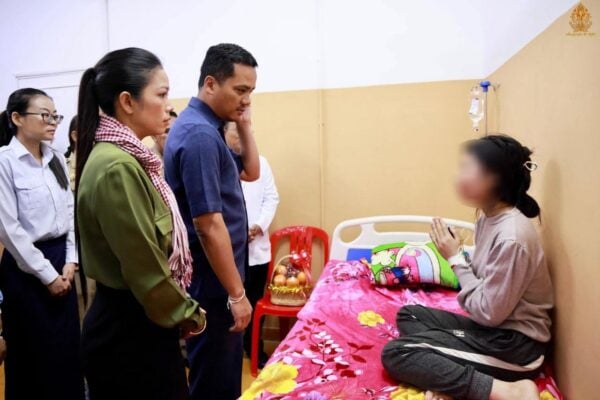
Sitting beside her recently jailed husband and their seven-year-old son in their stilt house near Koh Kong’s protected forests, Chey Nov fought back tears. Since her husband’s arrest last summer for allegedly encroaching on land his family had rotationally farmed for decades, money had dried up, and their children’s health had worsened.
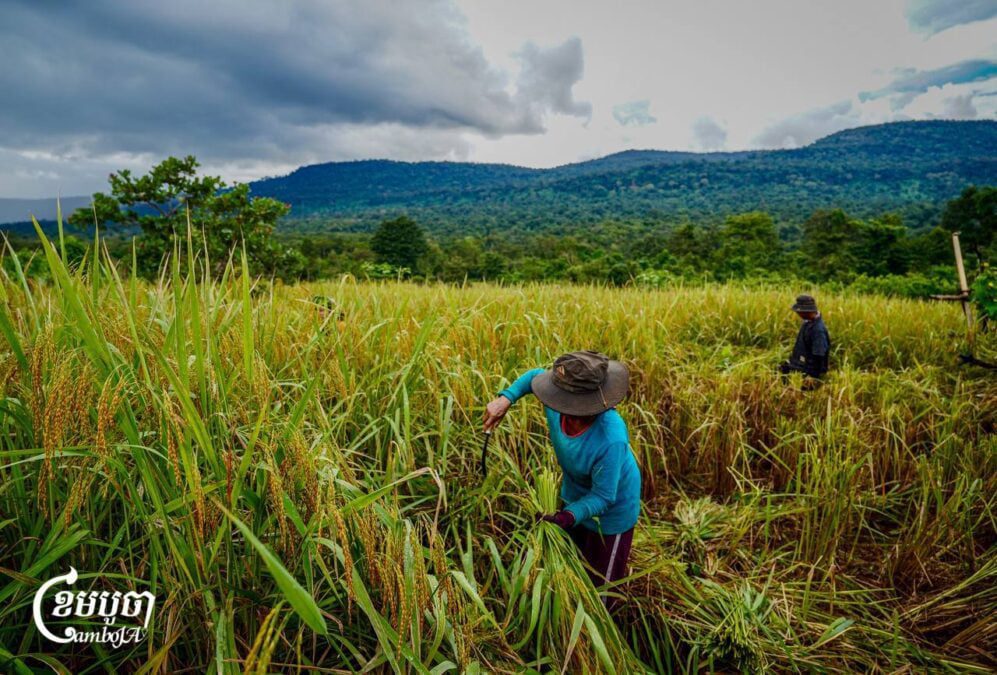
On June 27, 2024, Nov, 39, said she was cultivating a family plot recognized by commune authorities with her husband, Pork Nget, and their kids. Less than three km from their home in Thmar Dounpov commune, deep in Koh Kong’s Thmar Baing District, the farmland is encircled by the demarcated boundaries of a carbon credit project covering over a third of the province and which its issuance of new credits was suspended a year earlier amid human rights abuse allegations.
While they weeded, forest rangers arrived. Nov, who, along with her family, is part of the indigenous Chorng community, said they were from the Environment Ministry and Wildlife Alliance (WA), a U.S.-headquartered nonprofit that runs the Southern Cardamom REDD+ Project (SCRP) – the same carbon credit scheme whose issuance of new credits was halted, supposedly under investigation and in talks with affected indigenous communities, before being reinstated in Sept. 2024.
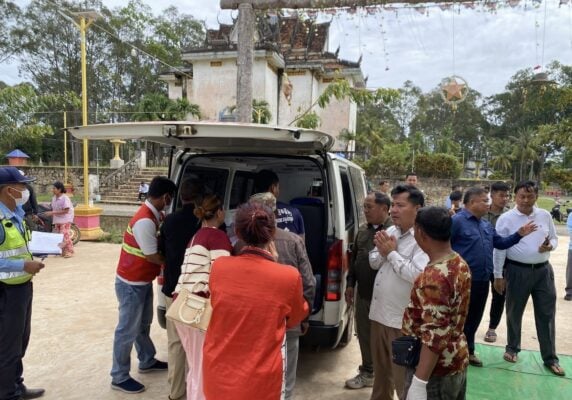
The patrol team claimed the plot lay on protected forest land under the SCRP before rangers from the ministry arrested Nget and handed him over to the provincial court, where he was charged with encroachment. He received a five-year prison sentence, later suspended, though the charges remained.
I do not dare enter the farm because the organization [Wildlife Alliance] does not allow it. If I go back, I fear they [forest rangers] will arrest me again, said Nget.
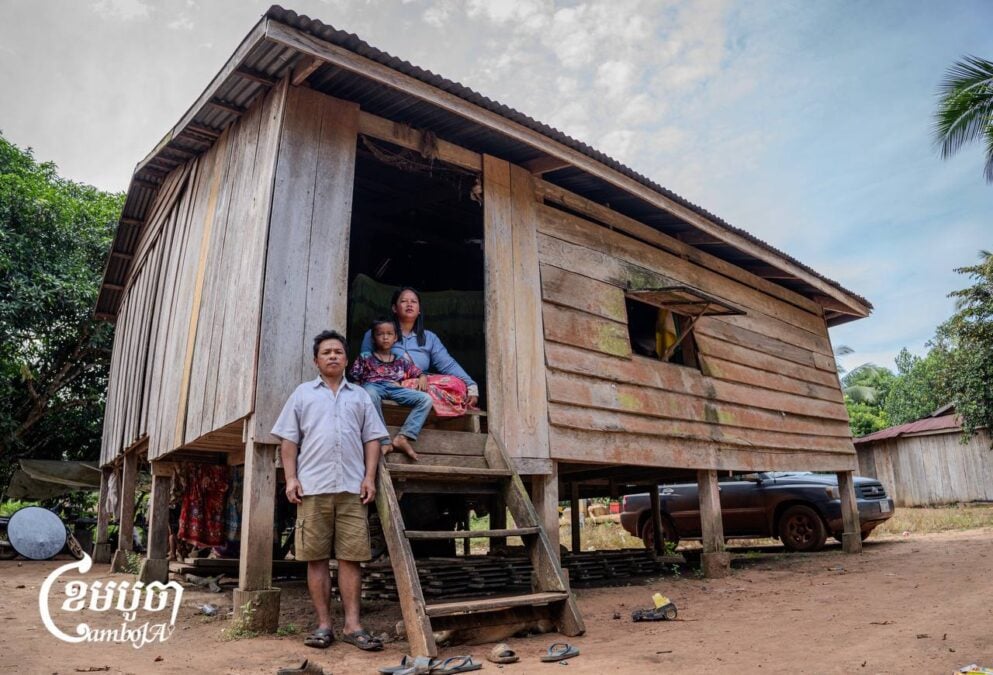
While local authorities assert that Nget was chopping down protected trees to clear land for rice farming and that his family lacks proper ownership titles, his detention came during a period when SCRP partners were supposedly addressing alleged past grievances and ensuring its methods for balancing the protection of the Southern Cardamoms with the rights and livelihoods of the area’s generational communities.
But more than five months after its reinstatement following a damning 118-page report from Human Rights Watch (HRW) detailing abuses, the SCRP’s promised restitution looks more like damage control.
During the review period, investigations and remediation efforts appear to have largely come from the very groups accused of wrongdoing or those with deep conflicts of interest. Indigenous communities near or within the project zone say little has changed – ancestral lands remain restricted, arrests and intimidation persist, and transparency is still lacking.
The project’s nominal review period, which ran from June 2023 to September 2024, they say, did little more than uphold the status quo or lead to tokenistic investments in the community.
Conflicted Interests and Skirting Compliance
The 465,000-hectare (1.15-million-acre) SCRP in the dense rainforest in southwest Cambodia receives its carbon credit certification from Verra, a certifier of voluntary carbon offsets for 97 REDD+ projects across the world.
After Verra suspended the project in June 2023 for an “impartial” review of the grievances raised, it turned to several Validation/Verification Bodies (VVBs) – including SCS Global Services, Aster Global, and Aenor — whom had previously provided verification services for SCRP. They were tasked with reviewing the project’s earlier work in light of the allegations.

Notably, every party Verra engaged to review HRW’s allegations stood to face financial or reputational fallout if the allegations were confirmed.
No Verra staff traveled to Cambodia for a fact-finding mission, instead relying on self-audits and progress reports filed by WA or the VVBs, according to a report from conservation news outlet Mongabay, as well as a carbon pricing watchdog.
A Verra spokesperson also confirmed that the organization’s project reviews are entirely desk-based.
“As a certification body, Verra does not conduct on-site investigations or directly validate projects,” they said.
After being presented details of Nget’s arrest and his testimony, the organization said it was unaware of the incident which took place during the review period.
But despite these many conflicts of interests, Verra relied on its grievance mechanisms and reinstated the SCRP, which experts in the carbon credit market say does not meet professional standards.
Verra is approved by the Integrity Council for Voluntary Carbon Market (ICVCM), an independent governance body that helps maintain a global standard for high integrity in the voluntary carbon market.
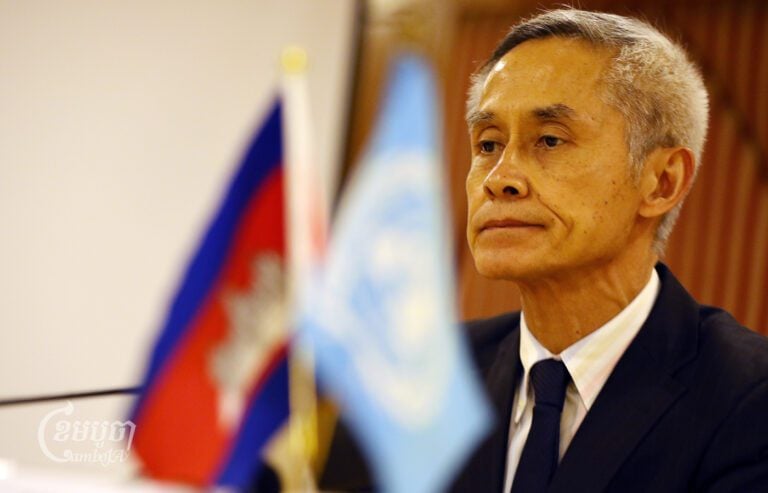
”Verra’s review of HRW’s allegations of indigenous Chorng rights abuses tied to SCRP wasn’t impartial – violating ICVCM’s Core Carbon Principles,” said Lindsay Otis, a global carbon markets expert at Carbon Market Watch. Otis, who filed a complaint to ICVCM, said Verra failed to meet the framework’s grievance mechanism rules.
“Verra did not employ an impartial third party – such as an external auditor not involved in any of the prior validation or verifications,” she said. “This situation creates an inherent conflict of interest since it’s in their reputational and financial interest to ‘overlook’ any problems.”
Otis questions whether Verra will face consequences for skirting ICVCM rules or if it will keep its approval and carry on as usual.
“If Verra is not held accountable for its actions in this regard, it can set a troubling precedent that VCM actors do not need to follow these rules because accountability and enforcement is lacking,” she said.
This could lead to weakened safeguards for indigenous peoples and local communities, erode trust in the system, and drag down credit quality, Otis warned.
WA, Close with Environment Ministry, Defends Its Role
When asked for comment on its policy revisions for implementing the SCRP since being reinstated and the alleged injustices that occurred during the review period, WA – long criticized for taking aggressive conservation methods – pushed back on three points.
It stressed that WA has no law enforcement authority, claimed communities “overwhelmingly” support SCRP, and insisted the project has significantly improved local livelihoods. WA put it in bold during email correspondence.
The conservation group insists it has addressed all accusations in full – both in a nearly 10,000-word open letter to stakeholders in Dec. 2023 and in a public statement after Verra lifted its hold on the project.
The Environment Ministry and its bureau in Koh Kong did not immediately confirm, but WA’s claim that it has no law enforcement authority is blurred by its frequent presence at arrests.
Like the patrol team present during Nget’s arrest, his brother Pork Chuon was also caught up in an enforcement action that allegedly included WA staff members.
Chuon said he broke his leg while fleeing military police and WA members near the disputed farmland in Thmar Dounpov commune in June 2024, just weeks before Nget’s arrest.
Chuon claimed a “foreigner” WA staff member and military police chased him while he was fishing. As he tried to escape by jumping across a stream, he fell, hitting his knee on a rock and fracturing his patella. He added that military police fired a shot into the air to intimidate him.

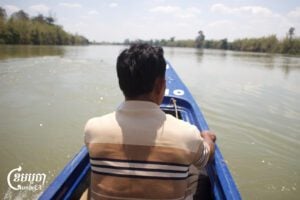
On the way back from meeting the Chorng community, CamboJA News stopped at an Environment Ministry bureau, about 53 km from Thmar Dounpov commune, to seek an interview with WA staff reportedly operating out of the government building. Rangers and military police questioned the team before allowing a brief exchange with a foreign WA staff member, who declined to comment and referred them to WA’s Phnom Penh office.
Chhi, Chuon’s wife, claimed forest rangers and WA staff destroyed their rice storehouse after chasing her husband. She showed CamboJA News reporters the ruins.
But WA denied the claim, saying they were unaware of any property destruction or confiscation in Chhay Areng district, where the family lives.
WA said it was only aware of Nget’s arrest during the project’s review period and had not received any request from the family to help with psychological or financial challenges. However, it said Nget’s family sought its support in court proceedings.
“As we do in all such cases, project staff contacted the family to offer access to pro bono legal representation,” WA said.

At the heart of these contested enforcement actions is Cambodia’s precarious land tenure system, mired in bureaucratic red tape – particularly for indigenous communities – and the country’s struggle with one of the highest deforestation rates in the world.
WA, meanwhile, argues that many farmers in the project area, where more than a third of the population relies on agriculture, whose land cultivation has been brought into question, are not practicing sustainable shifting cultivation but ecologically damaging slash-and-burn farming in protected areas.
“Nget has done nothing wrong,” said Hoeug Pov, president of the Chorng community, when asked about his farming practices.
He was simply practicing traditional farming, as our people have always done.
Disputed Land, Confusing Maps
Beyond disputes over their farming methods – which they also say follow a cyclical system with fallow periods – Nov and Nget provided CamboJA News with an “Order 01BB” document, issued under a 2013 national decree that surveyed land and was meant to title it for rural residents, with local commune chiefs determining authorization.
The document recognized the plot where they planned to farm rice in 2024, which had been assigned to Nget’s brother and granted to them for cultivation.
However, a 2013 map of Order 01BB surveyed plots in Thmar Dounpov commune, published by HRW, highlights 571 “contested” parcels marked in red, overlapping forested land – including the farmland used by Nov and Nget. It wasn’t until October 2015 – the same year the SCRP was being surveyed – that government officials, in partnership with WA, finalized a second map that removed most of the previously contested plots, which many indigenous farmers believed they were entitled to.

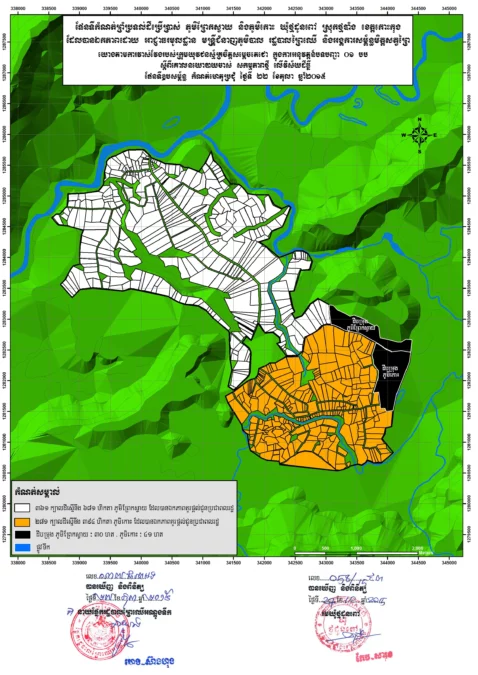
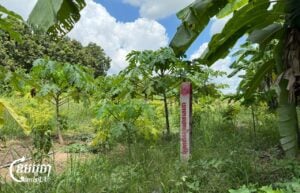
Nget asserted that on the day of his arrest, there were no clear signs marking the land as within the SCRP’s boundaries. Photographs from the day of his arrest show no signs prohibiting farming or indicating a protected area. But in October, CamboJA News found a prohibition sign posted near the parceled area, suggesting it was added after his detention.
Since the SCRP implementation, WA claims to have installed 1,349 demarcation posts to distinguish forest and community areas, while acknowledging it has difficulty marking the boundaries of a 450,000-hectare protected area.
Many villagers CamboJA News spoke with – including Chorng and Thmar Dounpov commune chiefs and other community leaders – said the maps WA provided to outline the SCRP’s boundaries were either too low-resolution or too complex for illiterate residents. That, they said, fueled fears about where they could still practice rotational farming.
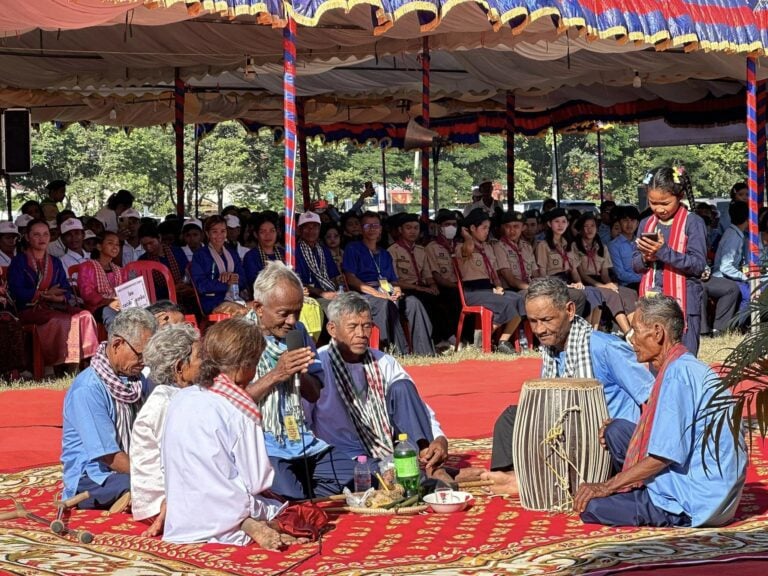
These concerns were reportedly raised during Free, Prior and Informed Consent (FPIC) meetings over the past year. The sessions, meant to update residents on project policies, address HRW allegations, and gauge community support for the SCRP, are a key requirement for project validation.
Nov attended the 2024 FPIC meeting just weeks before her husband’s arrest. She even initially voted in favor of the SCRP, saying WA’s maps were too vague for her to tell if the land she planned to farm that year would fall inside the protected zone.
Community Approval and Alternative Livelihoods
As seen in Nov’s case, the reported outcomes of this meeting appear misleading, if not outright skewed.
In a self-reported progress update filed to Verra in August 2024, WA pointed to improvements in its handling of community concerns, highlighting the expansion of “grievance boxes” across the project zone. It also emphasized that the FPIC session held that year showed over 80% support from 15 communities in the carbon credit zone.
For the most impacted indigenous communes – Pralay, Chumneap, and Thmar Dounpov – WA reported support levels between 81% and 88%. The figures came from a binary yes-or-no consent survey, a method HRW has criticized since February 2024 but one that cleared audits by Verra and the VVBs.
But WA’s own documents detailing population surveys conducted in the communes in 2018, reveal a stark gap between the number of residents attending annual consent consultations and the total commune population. For example, just 240 Pralay villagers attended the June session – less than a third of the commune’s 763 residents. The figures are similar for the Chumneap and Thmar Dounpov communes as well.
In an email, WA defended this, calling the attendees “household representatives” and claiming the process was verified by “third-party auditors” – the VVBs.
However, in its August progress report, WA does not seem to clarify this point or the data.
In March, WA is expected to submit another progress update, according to Verra.
But for many residents, paperwork and progress reports do little to ease the uncertainty.
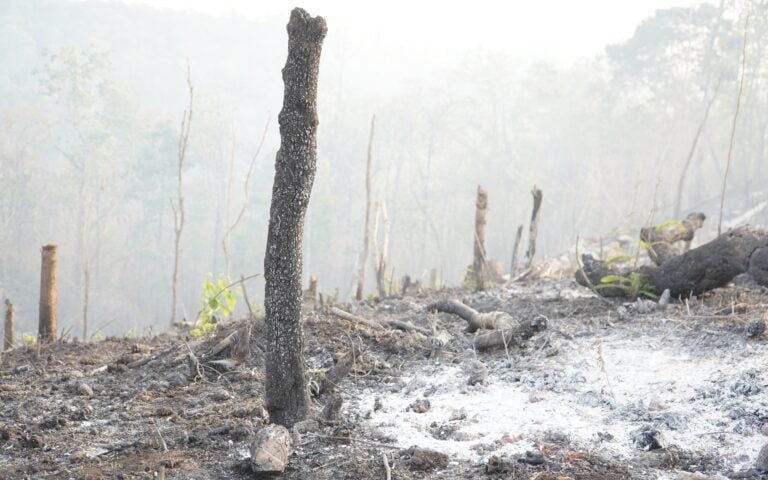
Farmers like Nget, his family, and others who have lived in the Cardamoms for generations say past run-ins with WA and forest rangers – several of whom had their crops burned – along with ongoing land title hurdles, have cast a long shadow over their rotational farming practices, central to their way of life.

For WA, the solution to their trouble is in “alternative livelihood” programs which it says the project has invested over $3 million in between 2023 and 2024 – in addition to water wells, healthcare and education facilities across the communities impacted by the controversial REDD+ project.
“Their project helps us very little,” said Nheok Chhoeun, another Chorng community member.
“They provide wells, hospitals, schools, and solar energy, but there are still many shortcomings, such as a lack of land for agriculture or building community housing. I wanted them to set aside land, especially for rotational farming, for the people,” she said.
These ongoing shortcomings come as other REDD+ projects make headway in Cambodia, including the neighboring Samkos REDD+ project. Open questions remain about whether validators and implementers can balance forest conservation with the protection of livelihoods for indigenous communities in Cambodia and across other carbon credit schemes in the global south. This has become an existential question for the carbon market, whose confidence and value have steadily eroded in recent years.
Note: This story was updated on March 18 to clarify that the suspension applied to the issuance of new carbon credits for the SCRP, not to the conservation project itself. It was also updated to include a reference and link to an open letter from WA to its stakeholders and a public statement.