
Cambodia has exported 12 metric tonnes of nuts and dried fruit to Australia for the first time, with a larger and more diverse second shipment already planned. While the milestone signals a boost for the country’s agricultural products, farmers warn that unstable prices and a lack of domestic processing capacity remain a challenge, calling for more local processors with flexible terms to ensure fair competition.
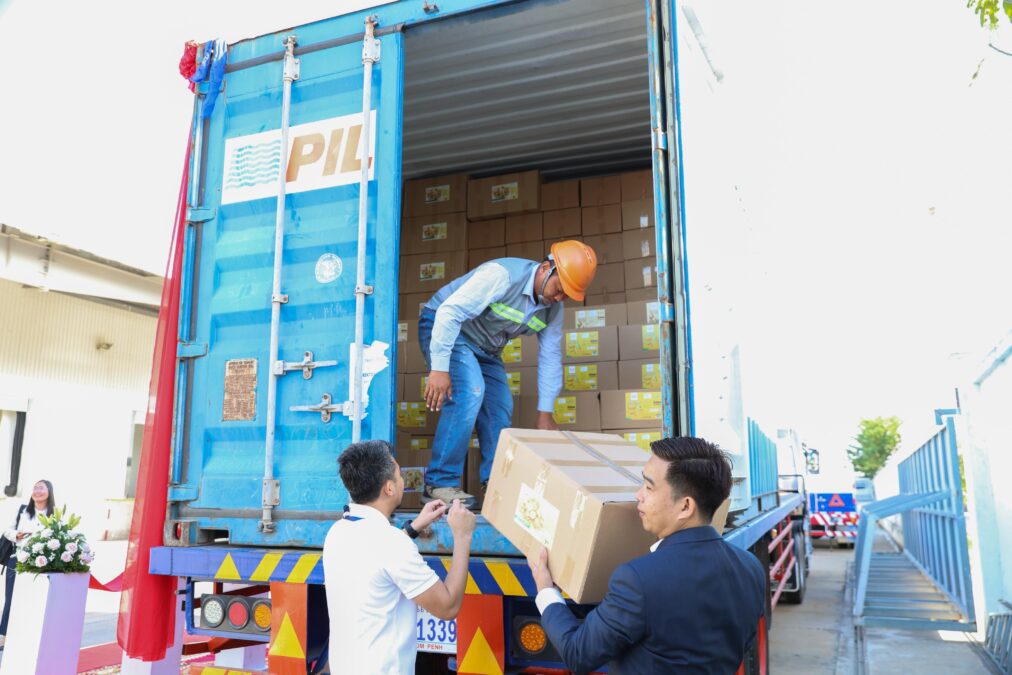
Cambodia has expanded its dried fruit exports to new markets, with Royal Trust Trading (RTT) sending its first shipment of cashew nuts, dried mangoes, dried jackfruit, banana and taro chips to Australia, according to a joint statement.
For this first shipment, RTT is shipping over 12 tonnes of nuts and dried fruit to Australia and a second shipment is already being planned, with an expanded product range and increased volume.
The shipment was made possible through support from the Cambodia Australia Partnership for Resilient Economic Development (CAPRED), which provided export readiness training and market linkage assistance.
Derek Yip, Ambassador of Australia to Cambodia, said in a statement that Australia is committed to deepening the economic partnership with Cambodia and facilitating Cambodian’s integration into regional and global value chains.
“These efforts will help support Cambodia’s ambitions to successfully graduate from Least Developed Country status. They will also increase bilateral trade between our nations,” he said.
RTT Chairman Chhin Sophal said the shipment demonstrates the growing capability of local enterprises to meet global demand.
“We are confident that this is just the start, and that more Cambodian products will soon find their way onto Australian shelves and beyond,” he stated.
Secretary of State for the Ministry of Commerce, Samheng Bora, said the effort is key to boosting the export of Cambodian products while advancing agro-processing sectors.
Hong Vannak, an economic analyst at the Royal Academy of Cambodia, said Australia is a promising market because it is part of the Regional Comprehensive Economic Partnership (RCEP). Recognition of Cambodian product quality by Australia could encourage other RCEP members to import as well.
He noted the move could boost investment in agricultural processing, but said Cambodia’s processing capacity remains limited compared to its neighbors. He urged greater promotion and investment in the sector, along with improved cultivation, high hygiene and sustainability standards, and more efficient export procedures.
“We need to ensure our crops are of high quality, our production systems meet strict hygiene and sustainability standards, and public agencies coordinate export procedures more efficiently without adding unnecessary complexity,” he said.
Bilateral trade between Cambodia and Australia reached $1.1 billion in 2024, with over 70% of the total represented by exports to Australia.
Even though the rising trade is a good move for Cambodia to export their Cambodian products in the agro-processing sector, farmers are wary of the setbacks in the agriculture sector.

Nok Bunthorn, a cashew farmer in Kampong Thom for nearly seven years, told CamboJA News that he is pleased to see a Cambodian company successfully exporting cashew nuts to Australia.
However, he said local farmers still struggle with unstable prices. Although this year’s price improved to 5,200 riel per kilo from middlemen selling to Vietnam, he urged the establishment of more Cambodian processing companies to create competition and push prices up.
Bunthorn also called on local companies to simplify contract procedures, which he said would make it easier for farmers to sell directly to them.
“Most companies buy from communities, so farmers have to form groups or cooperatives to sell to them. Selling to middlemen is easier because they come directly to buy,” he explained. “Companies require contracts because they need a specific number of cashews, but this requirement can be difficult for farmers to meet.”
He noted that prices offered by companies are often slightly lower than those from middlemen. While middlemen currently offer better rates, Bunthorn warned that if local companies go out of business, middlemen could dominate the market and drive prices down. For this reason, he stressed the need for more processing companies with flexible terms for farmers to foster healthy market competition.
Similarly, Oum Sophea, president of the Samaki Dambe farming community and a mango farmer in Tbong Khmum province for four years, raised concerns over unstable prices.
“The price of mangoes is not stable in the open market. In August and September 2024, one kilo of mangoes was 1,200 riel, but by the end of September it dropped to 300 to 400 riel. Farmers are taking risks every day because there is no set price,” he said.
The lack of market for mangoes earlier this year led residents to dump tons of the mangos.
Sophea noted that about 80% of their mangoes are sold to middlemen and exported to Vietnam. While some local factories have approached farmers, most are located far away in provinces like Battambang and Kampong Speu, making transport costly and price negotiations difficult.
“If a company comes to process local products, I am very happy to supply mangoes. It would help increase farmers’ incomes, expand markets, and promote Khmer products,” he said. “We look forward to cooperating with companies and hope local processors will grow and bring our products abroad.”