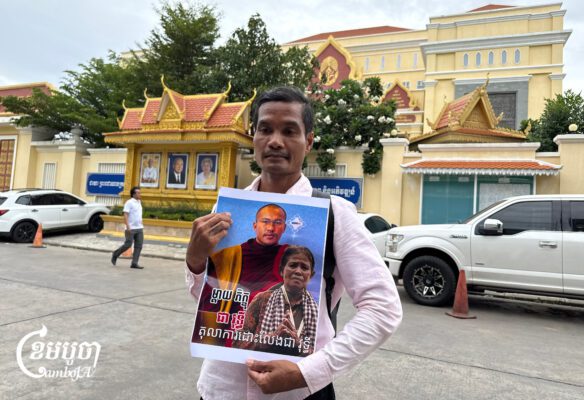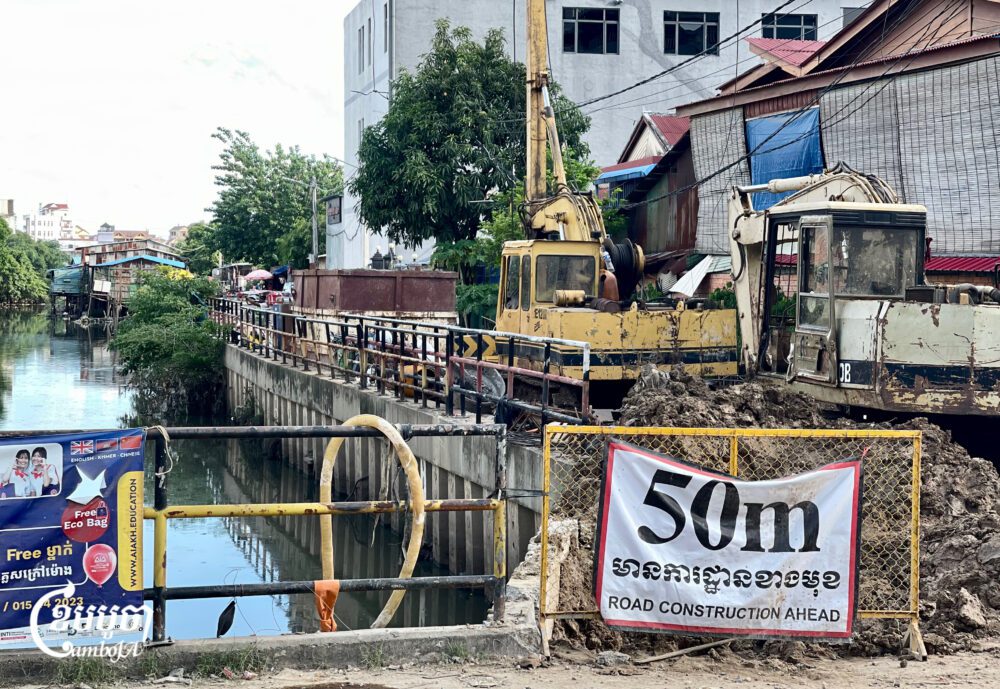
Some 14 Samaki Rong Roeurng households who live along Boeung Trabek canal in Phsar Deum Thkov commune, Chamkar Mon district, protested again to demand fair compensation or a new place for resettlement.
According to the Phnom Penh Capital Hall, 131 households in Boeung Trabek will be affected by the development project, noting that settlement was already completed as of August 2024. It added that residents accepted compensation from the Ministry of Economy and Finance in exchange for moving out “voluntarily” to avoid impacts of the project.
However, data from Sahmakum Teang Tnaut (STT) said that so far, 14 households among 64 households are still waiting to hear from the authorities regarding compensation as they seek a reasonable solution from the canal project. About 70 households in Village 4 and Village 5 are also affected by the canal project, and have yet to reach an agreement with the authorities.
The development in the community is related to a flood mitigation project to improve the drainage system in Phnom Penh. In April 2024, Phnom Penh Capital Administration measured villagers’ homes and invited them to a meeting on compensation.
The Phnom Penh authority offered compensation of $1,000 to $3,000 for small houses, and $6,000 for big ones, based on the size of their homes.
However, on the morning of May 23, 2025, approximately 30 Samaki Rong Roeurng community residents from Village 4 and 5 protested in front of the Phsar Deum Thkov commune office to demand proper compensation or a new location to build their homes similar to those from other communities.
“Where should the residents live? ‘Father’ Hun Sen, please help us. If the development on the site is not possible, please find a new location for us,” a resident said during the protest in front of Phsar Deum Thkov commune.
In response to the request for land, the Chamkar Mon district administration explained that they cannot provide land titles in the Boeung Trabek reservoir because it is public property. Instead, they asked the residents to accept the cash compensation.

A resident in Village 5 since 2007, Ry Chenda lauded the sewerage project which benefits the public and improves the image of Phnom Penh. However, the government should also think about the people who live along the canal and provide appropriate compensation or a new location so that people can build decent homes.
Chenda has not decided to demolish her house, measuring five meters by 10 meters, which she built for nearly $5,000 because the compensation given by the authorities is not enough to buy a plot of land to build a new house. She believes that development should benefit everyone, not make people suffer.
“The compensation is too little. We don’t want anything extra, but the amount they are giving is very little. The authorities only gave me about $4,000 for my house. I am also worried that they will demolish my house. Where will we get a new house to live [with that amount]?” she said.
Recalling a previous meeting with the authorities, Chenda mentioned that the authorities “promised” that the residents would have a new place near the city when the development project starts in the area. However, the residents face the risk of being evicted from their homes without adequate compensation.
“The authorities are not saying anything now. Building our house on the site is good because $4,000 will temporarily cover the rental of a house only,” she added.
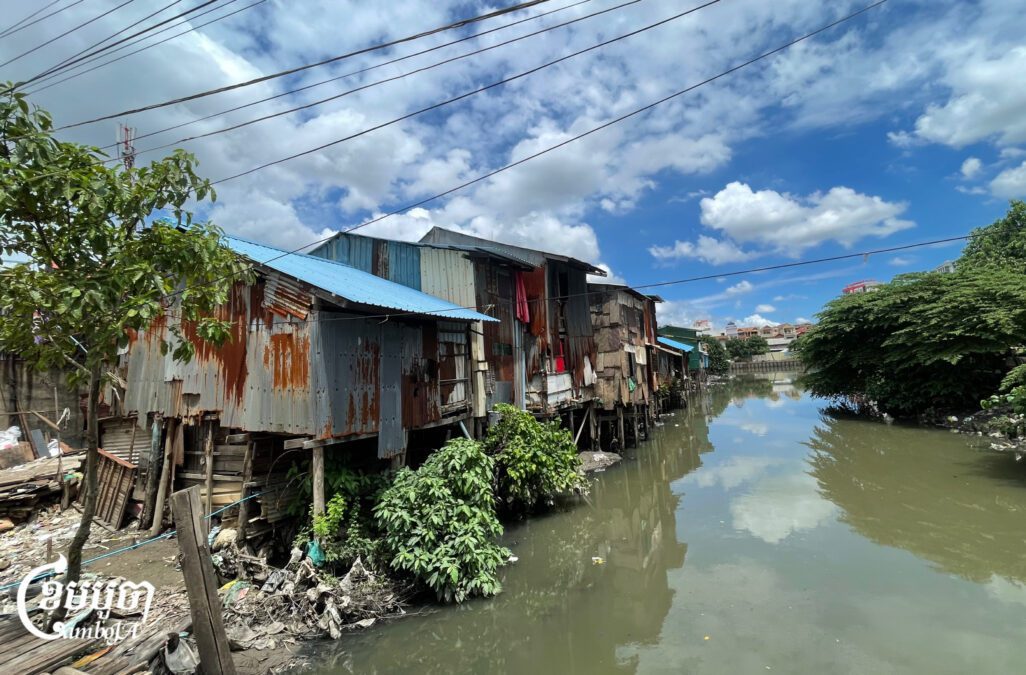
Another villager, Duong Phalla, who joined the protest told CamboJA News that her family has been living in the area since 1980. She swore that she is not an illegal immigrant as she has a residence permit, voter identification card, and recognition from local authorities.
She added that the community never opposed development and were enthusiastic about urban development, but developments should benefit everyone, and take into account the impact on the people.
The government should come up with a solution package for the people, instead of giving them a small amount of money which is not enough to build a new life, she remarked.
While their houses have not been demolished yet as they still wait for better compensation, Phalla said the local authorities often came by to persuade her to accept compensation. They tell her to “take the compensation and live in a new place to change the environment”.
“The authorities offered compensation based on the size of the house, for instance, I only got $3,500 for mine. This amount won’t help us settle down anywhere. The state should find a new place for us to live because I have been living there since the 1980s,” Phalla said.
She hopes the government will provide a solution to nearly 100 families in Village 4 and Village 5, similar to the amicable settlement of the land issue in Boeung Tomok and other areas.
Village 4 chief Kov Hong said the canal restoration project is under the Phnom Penh Municipal Hall, sharing that the people in his area have not received full compensation. He said according to the people, the compensation is small.
Hong said he too has a house in the project site, so he dared not to comment much, but felt that the villagers’ views about a suitable compensation is good. “I do not dare say much, but what villagers did is good to secure a solution. I also live in Village 4,” he added.
However, to date, there is no response from the higher-ups to the protest to negotiate the compensation sum, he claimed.

Hem Sophat, Phsar Deum Thkov commune chief, declined to answer CamboJA News’ questions about the residents’ protests.
Sun Sithy, Chamkar Mon district administration head, also declined to reply to questions on the status of the canal development in Boeung Trabek and compensation.
STT Right to the City program manager Seang Muoylay said the community possesses the same rights as the public, meaning the government should respect and protect them as they would other citizens who want to live near schools and hospitals. So, when the government wants the land to develop a project, the people should be offered a suitable solution so that they can also enjoy development.
Muoylay stated that for a development to be successful, the government must deeply study the impact on the affected people’s livelihood and ensure that compensation will make their lives better, not worse.
Citing a common example, he said, when a development is planned on a piece of land, the state “does not think about people’s rights”, although they are entitled to proper compensation which allows them to buy a house or live in a new location.
“I think that is an unreasonable solution. It burdens people economically and affects their children’s education,” Muoylay said.
On World Habitat Day 2021, LICADHO urged the government and stakeholders to ensure inclusive development by protecting the rights of poor communities. They called for an end to forced evictions while demanding respect for basic rights, such as housing and freedom of expression.
It also called for proper environmental and social impact assessments to be done with the involvement of affected communities before the start of any development project.