Opposition parties, Candlelight Party and Khmer Will Party, on Monday called on the Interior Ministry to explain its refusal to recognise their alliance to enable them to make the changes to comply with the law and the ministry’s requirements.
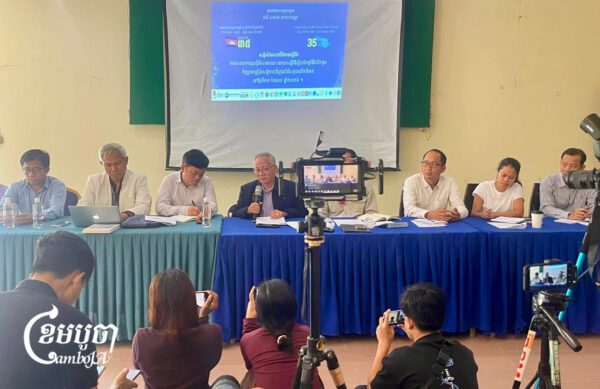
At a press conference on the “Current Status of the Alliance Towards the Future” at Khmer Will Party’s headquarters in Sen Sok district, Phnom Penh, the two parties expressed concern about the democratic space and political rights in Cambodia.
Their call follows the ministry’s letter to both parties on October 22, stating that it would not recognise the alliance, known as the Alliance Towards the Future, as the agreement that brings together the two parties does comply with the ministry’s guidelines and is inconsistent with the Law on Political Parties.
The following day, the ministry issued another letter revoking a June decision that recognized Seng Mardy as president of Khmer Will Party, stating that it recognized Sok Hach as the official president, instead.
The ministry said it made the decision after learning about a meeting by Khmer Will Party’s Executive Committee on March 15, 2026, which voted to remove Hach as the party president and appoint Mardy as the new president. The ministry pointed out that the process was not in accordance with the Law on Political Parties, the party’s statute, and internal regulations filed with the ministry.
However, the ministry said that if Khmer Will Party wishes to replace its party president, it must organise a party congress or convention in accordance with the law and the party’s statute registered with the ministry.
At yesterday’s press conference, Kong Monika, Secretary-General of Khmer Will Party, said he was concerned about the country’s democratic space and political rights, adding that both parties complied with all the legal procedures. “Yet, the ministry refused to recognize the alliance agreement.”

Monika, a senator, urged the ministry to specify the deficiencies in the alliance agreement or the submitted documents so they could make the necessary corrections.
Notwithstanding that, he said, practical cooperation between the parties under the alliance would remain and that the alliance would stay open to other political parties that wanted to join.
“We followed all the procedures, yet the agreement and documents of our Alliance Towards the Future are still not being recognised. Therefore, we are concerned about the state of democracy and the ability of political parties to carry out political activities aimed at promoting democracy in Cambodia,” he added. “The ministry has not specified the shortcomings our two parties need to correct. This raises questions about what exactly constitutes legal compliance.”
He said that his party is preparing to hold a congress to change its party leadership, following the ministry’s recommendation. The move is intended to further strengthen the party’s effectiveness, he added.
Deputy Interior Ministry spokesperson Touch Sokhak did not pick up telephone calls by CamboJA News, and questions sent via Telegram were not answered at the time of publication.
Hach, whose removal as president was voted on by the party’s Executive Committee, declined to comment on the matter. Meanwhile, his replacement, Mardy, could not be reached for comment.
Ny Sokha, president of the Cambodian Human Rights and Development Association (ADHOC), said the ministry should clearly explain why it refused to recognize the political-party alliance to avoid suspicions that political space was being restricted.
“If they simply say there are shortcomings or that it does not comply with the regulations but do not specify what would make it compliant, it will inevitably lead to suspicions that political activities and political space are being restricted.”
Political analyst Em Sovannara said that the parties concerned are entitled to a
clarification from the ministry regarding deficiencies in their submission so that they can make corrections. He added that the ministry should respond promptly to avoid suspicion among the public.
“The Ministry of Interior is an institution that is responsible for political parties. It is the body that determines whether a political party’s alliance is lawful or unlawful. If no explanation is provided, the public may conclude that the ministry is failing to fulfil its responsibilities […] This is a matter that requires a timely and proactive response from the Ministry of Interior.”