Listen to the audio version of this article (generated by AI).
The Phnom Penh Municipal Court sentenced Hy Kimhong, president of Piphup Deimeas Investment company, and several associates to 15 years in prison in three separate criminal cases involving “aggravated fraud” as well as an order to compensate 1,115 victim families a total of $33.5 million.
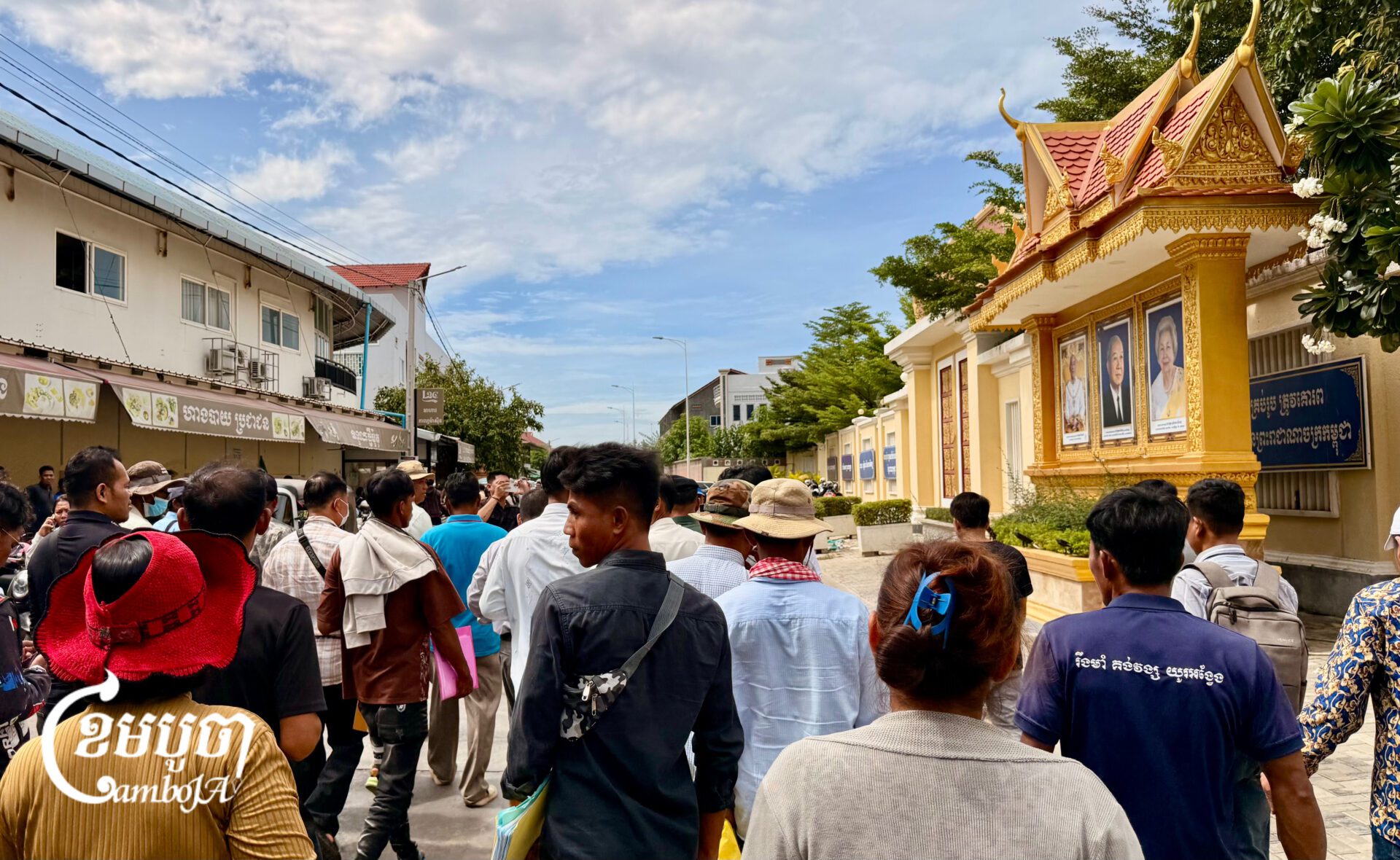
Around 250 plaintiffs traveled from several provinces to attend the verdict hearing of the investment fraud case which affected thousands across the country. Investors of the scheme lost a cumulative sum of $26 million after Piphup Deimeas failed to deliver promised monthly returns or land in a few gated community projects.
Many complainants stated that they are now struggling to repay loans taken from banks and microfinance institutions to finance their investment.
Kimhong, a former “oknha” – an honorary title granted to individuals who donate at least $500,000 to the government – was arrested in August 2023 and charged with fraud in multiple schemes. He denied wrongdoing and was released on bail two months later. The trial made little progress since then.
A tearful Mao Rany, 46, a resident of Svay Teab district in Svay Rieng province, said she was pleased with the court’s decision to sentence those responsible and order compensation for the victims. However, she urged the court to speed up the compensation by setting a clear timeline because she and about 30 of her relatives are struggling with bank debts.
For more than three years, she has lived in despair and struggled to find money to repay about $30,000 in bank loans after investing in the land scheme.
Rany said she earns a modest salary as a factory worker. She is also a widow with two children. When she initially borrowed money to invest in the land, she thought it would improve her family’s living conditions. But it failed.
She was forced to sell a piece of land and her house to repay the bank, while her son dropped out of school to work in a factory.
“After I sold my land and house, I came to live with my mother. My son dropped out of school in eighth grade and went to work in a factory. About 30 of my relatives are also victims of the same scheme. I trust the court, but I do not trust the company.”
“The court has imposed restrictions to prevent Hy Kimhong from fleeing, but how will he pay us back? So I ask the court to arrest him again.”
Seng Han, a representative of the plaintiffs, said the court sentenced Kimhong, Prak Pin, and Chey Sienghak, the company’s leaders, to five years in prison each for three separate cases involving more than 1,000 families. Nearly 20 other associates were sentenced to six years in prison.
Han said he and the affected residents accepted the court’s decision regarding compensation and punishment of the owner for defrauding the people. However, the victims are still not happy because there is no arrest warrant issued for Kimhong.
“We, the people, want the court to arrest him in accordance with the court judgment because he remains outside prison and continues to threaten the victims and even file counter-lawsuits against their representatives,” he said.

According to Han, Kimhong has transferred all his assets to his relatives, including villas, a school and a microfinance institution. Hence, the reason why the victims have asked the court to take action on this matter.
Kimhong and his associates are believed to have collected around $200 million from 8,000 investors, Han said, adding that the court should speed up the seizure of assets so the money can be returned to the victims, allowing them to repay their bank loans.
Moeurn Kunthea, another representative of the victims, said the court should expedite arrest warrants for Kimhong and all his associates. As long as they are out free, she said, they will continue to threaten the victims and spread misinformation which causes them psychological problems.
“Only by detaining them can we believe that compensation would be given to the victims quickly. If they continue to live outside prison, they will remain free while living off the sweat and hard work of people in debt. Some victims have even become ill and lost their lives.”
Phnom Penh Municipal Court spokesperson Y Rin did not immediately respond to a request for comment.
Several people who spoke with CamboJA News said they have sold their property to repay loans. Some said the debt burden has driven a few people to suicide.
Taing Sinhong, a lawyer representing the plaintiffs, said the court imposed a five-year sentence for each case, meaning the three cases amount to a total of 15 years.
She said the compensation process can only be expedited in accordance with legal procedures because the court has already meted out sentences and ordered compensation.
However, the victims want the process to move faster because they are facing severe financial pressure from bank debt.
“The court has already imposed the punishment and issued what we believe is a fair ruling. The judgment has a one-month period during which either party that is dissatisfied can appeal to the Court of Appeal,” said Sinhong.
She added that if the case goes to the Court of Appeal, she will ask the court’s president to expedite the compensation process.
Kimhong could not be reached at the number listed in the company website. A person who picked up the phone said she did not know the company and had no links with them.
Am Sam Ath, operations director of Licadho said authorities must ensure that the seized assets are not retransferred or sold, so they can eventually be used to compensate affected people.
Although the court has sentenced Kimhong, the case has not been fully resolved, as it could proceed to a higher court if the company appeals against the latest decision, he said.
“The legal process is lengthy. Given the scale of the harm suffered by the people, even though the court has ordered compensation, the judgment is not final. So people have to continue waiting, and problems would continue to emerge,” Am Sam Ath said.
It would be better if the matter is settled out of court as it is faster. Most of the victims borrowed money from private banks and invested it in the company, he said.
Relevant authorities should also intervene and help resolve their debt problems, Sam Ath said, adding that the debt could burden the government if there is a delay in resolving it.
“Relevant parties, including banks and microfinance institutions, should intervene and provide relief to the people because they have lost their money to fraud, suffered psychological distress, and in some cases, died. Their household economies, land and other property have also been affected,” he said.
“If there is no relief, people will face severe livelihood problems, especially children who may lose access to education because they have to stop studying to repay debts. This could become a social problem and a burden on the government.”