Listen to the audio version of this article (generated by AI).
Public criticism over a newly-constructed concrete road in Kandal province, which impacted residents’ access, has led to questions about a breakdown in governance and accountability amid the discovery of commune fund misuse nationwide.
Although the road problem was resolved swiftly after an intervention by the Rural Development Minister, a civil society leader and social analyst raised concerns about “weak” local governance and accountability often requiring orders from the top-level before local officers act.
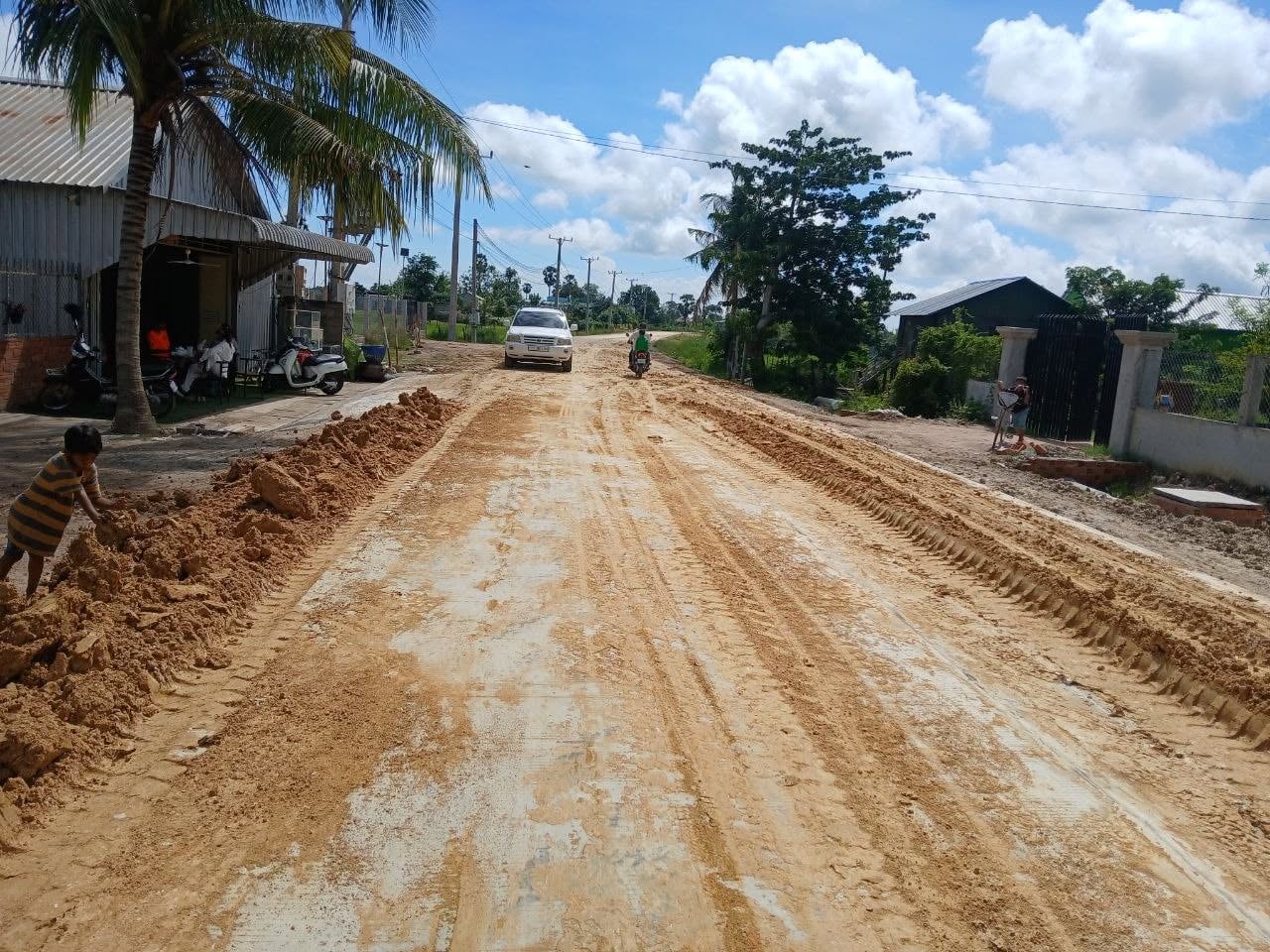
On Sunday, a video showing people complaining about soil being dumped on the new road, measuring 1,000 meters, in Chhvaing commune, Ponhea Leu district, went viral as their access was limited.
The video comes amid public scrutiny of government projects in the provincial and district levels.
Earlier this month, the Interior Ministry discovered funding irregularities in development projects in communes nationwide, calling them a “systematic collusion and misuse of commune funds”. It followed the demotion of three senior officials for their alleged involvement in a solar-street-light procurement scandal.
In Chhvaing commune’s concrete road issue, Prime Minister Hun Manet ordered Rural Development Minister Chhay Rithisen to look into the matter, who visited the site. He instructed the department in charge to clean up the road. Workers worked until 8:30 pm that day so that people could travel with ease, according to the Kandal administration in a statement.
“Overall progress has reached about 90%, with the carriageway base 100% complete. However, road shoulder construction has been delayed, with heavy rainfall causing saturation and damage, affecting [a] section above, disrupting residents’ travel,” the Rural Development Ministry posted.
Kin Phea, director-general of the International Relations Institute at the Royal Academy of Cambodia, expressed similar frustration as the villagers in the area and criticized the local government for waiting for orders from the top.
“Looking [at the situation] as of today, our governance system seems like a machine or an AI [artificial intelligence]. It waits for commands from the top leadership to act,” he said.
He called on the administration to “punish” officers in charge of development projects, stressing that it cannot allow them to keep making excuses.
Lam Socheat, director of Advocacy and Policy Institute, also expressed skepticism about the newly-constructed concrete road where soil was dumped and blocked public access.
“We do not understand this technical issue. Usually, they have to complete all the layers before the final road construction,” he said.
He called on local authorities to put up notice boards to inform the public in advance, especially those who do not live in the villages along the road.
Socheat said that public accountability should not be limited to people living along the road. Public roads are also used by other motorists passing through the area, therefore authorities should provide advance notice about any work that could disrupt access.
Meanwhile, Chhvaing commune Chief Seng Chan, who supported the rural development ministry’s explanation that heavy rain delayed road construction, said local authorities had notified residents about the work, including via an information board.
“I informed the villagers about the road construction process, but people from outside the area would not know about the construction,” he said, adding that the information board put up by the ministry is “sometimes knocked down by passing vehicles”.
“To be honest, we put up the information board, but it falls down sometimes because of passing vehicles,” Chan said.
Responding to criticism over a lack of accountability, he opined that residents have the right to express their views, but maintained that the road construction followed proper standards.
“It is their right to say whatever they want. I do not deny that. But the construction meets standards, and we are accountable to the people,” Chan said.