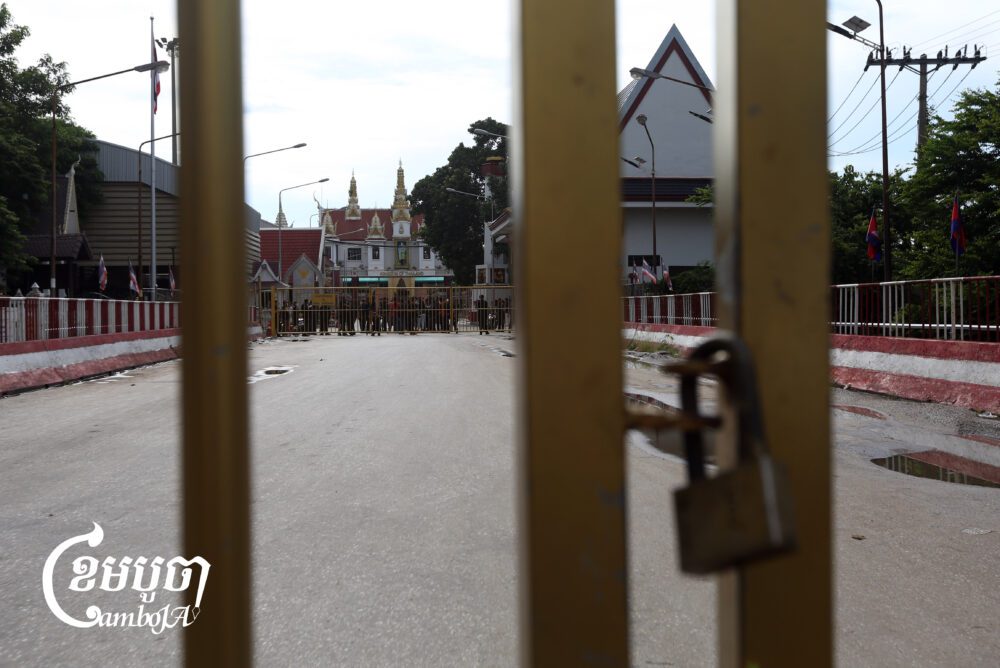
Around 4 p.m on Sunday, about 10 Thai authorities who wore black uniforms walked out from a nearby building to pull an iron gate close at the checkpoint.
At the time, around 30 Cambodian authorities, who stood near the border fence, proceeded to close the gate on the Cambodian checkpoint while Cambodians rushed from Thailand to come home.
Sok Sokny, 67, who lives in Poipet city, Banteay Meanchey province in Cambodia, walked through the Thai border with a big pack. He sells second hand clothes, a trade he has been doing for more than 20 years at Rong Kluea market in Thailand. He only knew about the closing of the Poipet International Checkpoint at 4 p.m by the Thai authorities through word of mouth and not by either countries’ authorities.
“I want both countries’ authorities to officially announce the checkpoint closing so that people are not afraid,” Sokny said. He just heard today (Sunday) that the Thai authorities were closing the checkpoint at 3 p.m, so he hurried to leave the Thai border before 3pm.
Generally, the closing of the checkpoint does not really affect the business of both countries’ people because they are neighbors. “But the reduction of trading hours so that I make it in time to the checkpoint affects my business. It is stressful because I have a short time to sell my clothes,” said Sokny.
Holding the hands of her two young children, and waiting in front of the Poipet checkpoint at 3:30 p.m., Chhit Sreynich, 28, told CamboJA News that the border tension between Cambodia and Thailand affects ordinary citizens like her, especially those working in Thailand.
The Thai authorities require Cambodian citizens to leave or enter Thailand by 4 p.m. and only a seven-day visa stamped for Cambodians with passports or border passes now.
As a shoe polisher in Rong Kluea market, Sreynich, originally from Kampong Thom province, said she only earns 300 baht (approximately 36,000 riel) a day. So, when there is tension at the border, ordinary workers like her risk losing their jobs; this could affect their household income.
“It’s very difficult. Previously, the Thai side closed at 10 p.m., but now I have to rush from work before 4 p.m. The Thai authorities did not inform us about the closure in advance,” Sreynich said.
“The first impact is related to the economy not doing well. We can’t sell anything, and we only have jobs if customers come to us. I’m afraid of losing my job if the border is completely closed,” she lamented.

Workers, tourists face difficulties
Yan, 38, a resident of Poipet who works as a cart puller for domestic and international visitors at the Poipet border crossing, said the change in operating hours by the Thai authorities without informing the Cambodian side has made it difficult for workers and small business owners. Both Cambodians and Thais are faced with problems due to the new rules.
Yan is concerned that if this situation continues, small business owners risk losing money to support their family. They may also face psychological pressure, especially those who rent houses near Rong Kluea Market and have school going children in Cambodia, have to travel back and forth.
“For me, as long as the gates are open and Thais and Cambodians do not fight, workers who earn a living by working near the border will not lose their income. But even then, Cambodians will be affected,” Yan said.
As a Cambodian, she does not want to see any conflict with Thais, and hopes for a peaceful resolution soon.
“We, the people, can only wait and see, and hope that they will not close the border because it will only affect the people,” said Yan, who has been working there for more than 10 years.
Liem Soda, deputy Banteay Meanchey provincial governor who joined control at Poipet checkpoint, told reporters that the change in the opening hours of the border caused some difficulties for tourists and Cambodians who usually travel across the border early morning to do business in Thailand.
“The time change affected our people [vendors in the Thai market],” said Soda, adding that other regional checkpoints changed the opening hours, now between 8 a.m and 12 p.m, meaning half day only.
He said the Thai side did not inform the Cambodian authorities regarding the opening hours in writing, only verbally that the checkpoint will be open from 8 a.m to 4 p.m.
“I met the Cambodian vendors of Rong Kluea market this morning. They were not angry with our authorities because they knew that it was the Thai side which closed the checkpoint first,” said Soda.
When a reporter asked him which country would be more affected in terms of loss of business due to the new border rules, he said he could not provide an answer.

Checkpoints revise operating hours
Poipet International Border Checkpoint chief Van Daran confirmed that the Thai authorities closed their checkpoint unilaterally without informing Cambodia officially.
“I cannot elaborate on this issue because it is a decision from the Thai military side,” he told reporters at the checkpoint.
He did not respond directly to a question regarding the effect of the time change on Cambodians, but that “they are happy and support our government’s action”.
Meanwhile, Cambodia’s Poipet International Border Checkpoint Police Station announced the new opening hours of 9 a.m to 4 p.m starting June 8. Additionally, Cambodian travelers seeking entry into Thailand are being issued seven-day entry stamps only, whether they hold passports or border passes.
Before the border tension, Cambodia was among six newly-added countries whose citizens were eligible for visa-free stays of up to 60 days, according to a Thai cabinet decision to boost tourism.
On the afternoon of June 8, Cambodian authorities closed the O’Smach International Border Checkpoint in response to Thailand’s unilateral decision to restrict operations, local media reported.
The O’Smach, Choam, and Chubkakir border checkpoints in Oddar Meanchey province are now only open three days a week, following the action taken by Thai authorities.
Additionally, Cham Yeam International Border Checkpoint in Koh Kong also closed on Sunday afternoon.
‘Thais will suffer the most’
A wave of public backlash erupted following the unilateral closures by Thailand, with Cambodians suggesting a boycott of Thai products. However, Senate President Hun Sen has urged restraint, reminding them that he and Prime Minister Hun Manet do not want the conflict to expand to the point of racial hatred.
“The Thai military unilaterally closed the Poipet border crossing ahead of schedule. So, Thailand must take full responsibility for this action,” he said. “For Cambodian citizens, it is important to remain mature and composed, and refrain from provoking further incidents.”
He said if Thai products are absent from the Cambodian market, it is not because Cambodians have collectively chosen to boycott them, rather, it is the consequence of a border closure—because when people are blocked, so too are goods.
“If imported goods are no longer entering Cambodia, the Thai people should resolve this matter directly with their own government, because the ones who will suffer most are the Thai people themselves,” he said.
According to Thai media reports, several shops in Thailand have displayed signs barring Cambodians and warning that “they will be harmed if they try to enter”.
Hun Sen pointed out that Cambodia exported more than $1.1 billion worth of goods to Thailand and imported $5.2 billion of goods in 2024, meaning Cambodia’s trade deficit with Thailand was more than $4.1 billion.
In the first five months of this year, Cambodia exported goods valued at over $200 million to Thailand, while imports from Thailand were around $1.5 billion.

ICJ, the only way
Ministry of Foreign Affairs and International Cooperation spokesperson Chum Sounry told CamboJA News that a letter was sent by Deputy Prime Minister Prak Sokhonn to his Thai counterpart on June 6, 2025 explaining that the border dispute has persisted for many decades despite bilateral mechanisms and goodwill efforts to resolve it.
“These unresolved issues have regrettably remained a source of recurring misunderstanding and tension, and led to several unfortunate incidents,” Sounry said, quoting the letter.
The most recent was the May 28 May confrontation in Techo Morokot Village of Morokot Commune in Choam Khsan District, Preah Vihear Province, where Thai military forces opened fire on a Cambodian army position, resulting in the death of a Cambodian soldier.
“This incident has further underscored the urgency of finding a sustainable and peaceful resolution,” the letter said. “Given the complexity, historical nature, and sensitivity of these disputes, it is increasingly evident that bilateral dialogue alone may no longer suffice to bring about a comprehensive and lasting solution.”
In this context, the Cambodian government believes that the most appropriate and peaceful path forward is to file the case relating to Mom Bei, Ta Moan Thom Temple, Ta Moan Tauch Temple, and Ta Krabei Temple areas at the International Court of Justice (ICJ) for adjudication.
“A decision rendered by the ICJ, grounded in international law, would offer a fair, impartial, and durable resolution. It would provide much-needed clarity on our respective territorial boundaries and, more importantly, help foster an environment of lasting peace, stability, and cooperation between our two countries.
“Such a course of action would also affirm our mutual commitment to upholding the rule of law, preserving regional harmony, and advancing the shared prosperity of our peoples within the ASEAN community,” the letter stated.In a latest development, the Ministry of National Defense said Cambodian and Thai military forces met on June 8, deciding to adjust the forces of both sides to return to appropriate areas to reduce the tension and confrontation along the border.