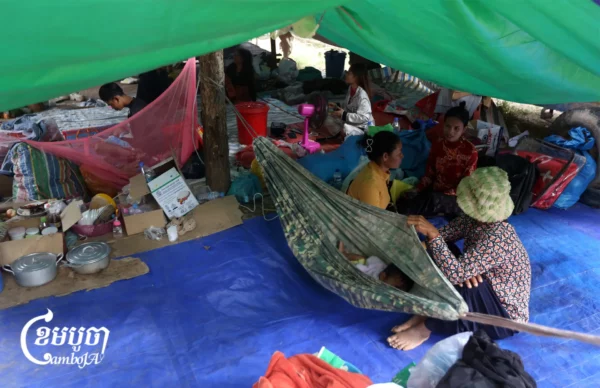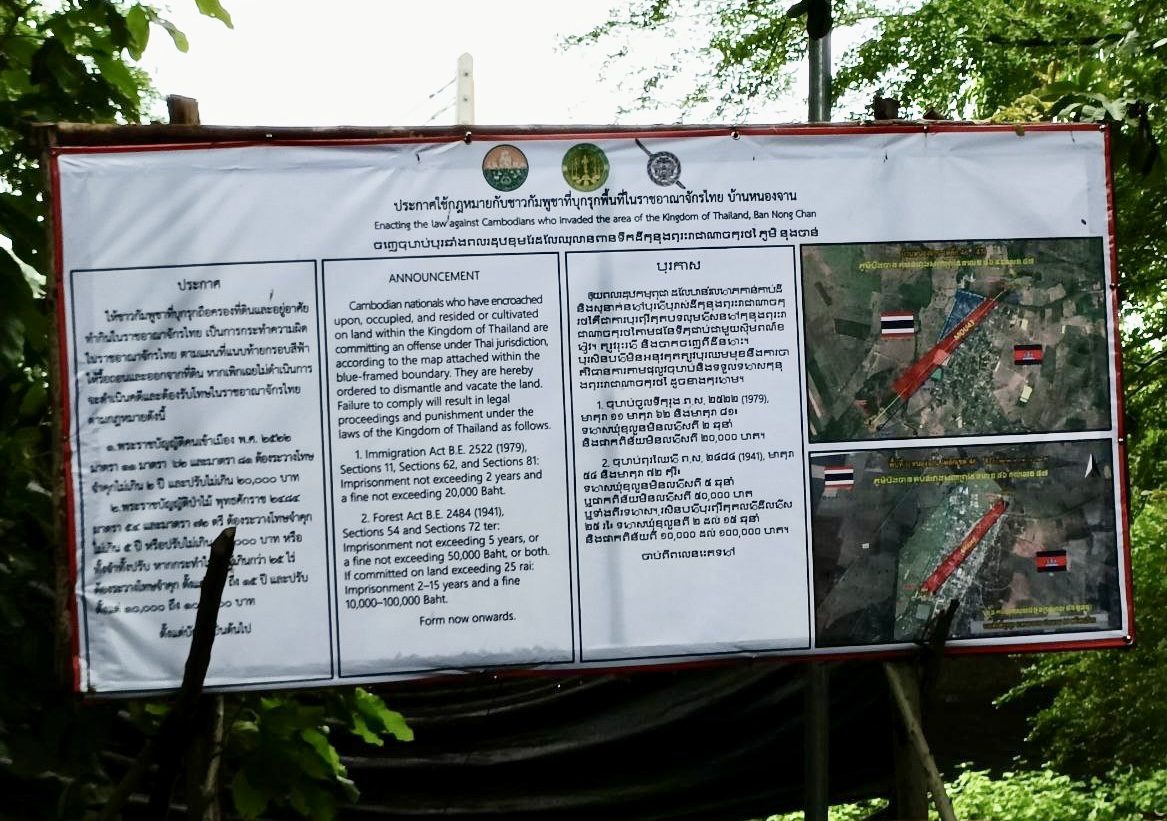
Authorities in Cambodia’s Banteay Meanchey province protested after officials in Thailand’s Sa Kaeo province put up banners ordering Cambodian villagers in the disputed border villages of Chouk Chey and Prey Chan to leave or face repercussions under Thai law. Many of the villagers have lived there for years but have since been cut off from their homes and farms by Thai authorities.
Provincial governor Oum Reatret has called on the Thai authority to stop all activities that escalate the border dispute and increase tension as it also violates the ceasefire agreement signed on July 28.
“The repeated action of setting up the banner and declaring [implementation of Thai law] are a serious threat to the rights of Cambodian citizens who have been living in the two villages for a long time,” Reatrey said in a statement.
He mentioned that Cambodian people have been living in the villages before the Memorandum of Understanding (MoU 2000) on the Measurement and Demarcation of the Cambodian-Thailand Land Border came into force.
He added that Sa Kaeo provincial administration does not have the authority to demarcate the border and enforce Thai laws on the Cambodians who were living and benefiting from the areas where the border demarcation has not been completed.
A Thai media outlet reported on Saturday that the authorities installed six notices in three languages to order Cambodian villagers to “leave the disputed forest areas” along the border within 15 days.
The deadline for eviction was set for October 3 for Prey Chan village (or Ban Nong Chan in Thai) and October 10 for Chouk Chey village (Ban Nong Ya Kaew). Thai authorities said anyone who stayed beyond that date will face arrest and prosecution.
Banteay Meanchey deputy governor Ly Vannarith told CamboJA News that Thai authorities installed the signs near the barbed wire and tire fencing to block a road where Thai soldiers evicted six families in O’Bei Choan commune in August.
“Where can we go? Our homes are here. The villagers’ homes are here. Yes, it [the instruction] is based on their unilateral map,” he said, adding that Thai authorities had initially planned evictions on September 26 and October 10.
He noted that the situation remains calm for now, with villagers continuing to guard their respective homes.

Kim Chanpanha, spokesperson for Preah Vihear province, said that the situation remained the same on Monday, following the attack by Thai soldiers which fired mortar and small arms on Cambodia army positions in the An Ses area last Saturday.
Sok Sam Oeun, chief attorney at AMRIN Law firm, told CamboJA News that Thailand’s planned enforcement of its own laws on Cambodian citizens in Prey Chan and Chouk Chey villages is a “threat”, as the land issue remains a border dispute. If such threats are made, the Cambodian government must be prepared to safeguard its citizens from attempts by Thailand to enforce its laws, he said.
“It is disputed land, so Thai law cannot be applied. This is a tactic by Thailand to intimidate us,” he said, noting that until the border commission reaches a decision, the Cambodian government must continue to reject Thailand’s claim that the area belongs to them.
At the 80th Session of the United Nations General Assembly on September 27, Cambodian Foreign and International Cooperation Minister Prak Sokhonn raised concerns over the forced evictions of Cambodian citizens, threats of martial law by the Thai government, and the expulsion of families from villages they had lived in for decades.
“These acts violate Cambodia’s sovereignty and territorial integrity, as well as the rights and dignity of its people,” he said, urging dialogue and a peaceful resolution in line with the ceasefire agreement.
He also called for continued support from the ASEAN Chair, member states, the UN, and the international community to ease tensions and prevent further tragedies.
Cambodia has continued to call on Thailand to release 18 soldiers who have been held in Thai military custody for the past two months.
Note: This article’s lead was updated at 10:00 a.m. on Wednesday to include reference to the undemarcated border areas and Thai authorities’ demands for Cambodian villagers.