Listen to the audio version of this article (generated by AI).
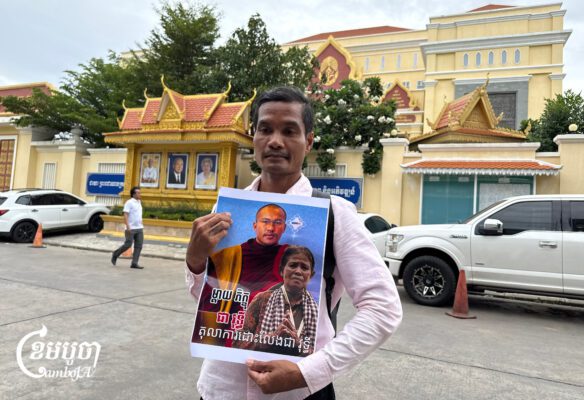
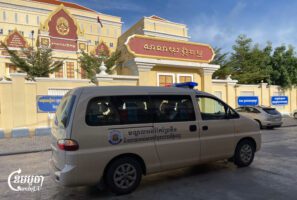
Rong Chhun, a top adviser to the opposition Nation Power Party, on Tuesday asked the Supreme Court for permission to travel to his hometown in Kandal province for Pchum Ben, despite restrictions imposed after his incitement conviction was upheld earlier this year.
About 20 Nation Power Party members accompanied Chhun to the court to submit the request. Pchum Ben, one of Cambodia’s most celebrated holidays, is a 15-day festival during which most citizens travel to their home provinces to honor their ancestors.
Chhun said he hoped the court would respond positively. He described the requirement to seek permission each time he wants to travel as “repeated harassment and restrictions on his freedom.”
“We have to be patient and continue to struggle to find ways to improve Cambodia’s image,” he told supporters outside the court. “We also do not want to see such circumstances imposed on me or on the people as a whole.”
The Supreme Court in June upheld Chhun’s 2025 conviction for incitement to disturb social order over public comments about online scam operations in Cambodia and the country’s border with Vietnam. It set aside his four-year prison sentence, reduced a lifetime political rights ban to five years and placed him under three years of judicial supervision, which bars him from leaving Phnom Penh or attending public gatherings.
Opposition figures and rights groups have denounced the case as politically motivated. Human Rights Watch has said Cambodia’s government has a long record of misusing incitement charges to suppress critics.
Ouk Kimsith, a Supreme Court spokesperson, said he had not yet received information about the request and could not speak to how the court would consider it.
Chhun was previously sentenced in 2021 to two years in prison on separate incitement charges, after accusing the government of ceding land to Vietnam near the border. He served roughly 15 months in custody before an appeals court released him, suspending the remainder of his sentence.
Chhun said he had committed no wrongdoing and that the charges against him were unclear. He added that the Supreme Court’s decision was inconsistent with Articles 34 and 35 of the Constitution, which he said guaranteed the rights to vote, freedom of movement, freedom of expression and the right to stand for election.
Other opposition figures called for his request to be granted.
“I also hope that the decision-makers and the highest institution of Cambodia’s Supreme Court will grant the request […] in accordance with Article 35 of the Cambodian Constitution, which states that citizens’ requests must be considered, given attention and addressed by state institutions,” said Thel Thielen, a member of the Nation Power Party’s executive committee.
Another supporter, Heng Chan Sothy, said he would be disappointed if the court did not restore Chhun’s freedoms, including his ability to engage in political activities and travel both inside and outside the country.
“Every citizen has the right to join any political party of their choice, the right to vote and the right to stand for election, in accordance with the principles of liberal multiparty democracy,” he said.
The show of opposition support for Chhun comes as arrests of opposition figures and activists have spiked this year, according to the rights group Licadho.
Other opposition figures have received partial reductions to their sentences this year, such as Kem Sokha, former leader of the now-dissolved Cambodia National Rescue Party, who received a partial pardon in May that ended his 27-year house arrest sentence on a treason conviction but left intact his lifetime ban from politics and a five-year ban on foreign travel.