Listen to the audio version of this article (generated by AI).
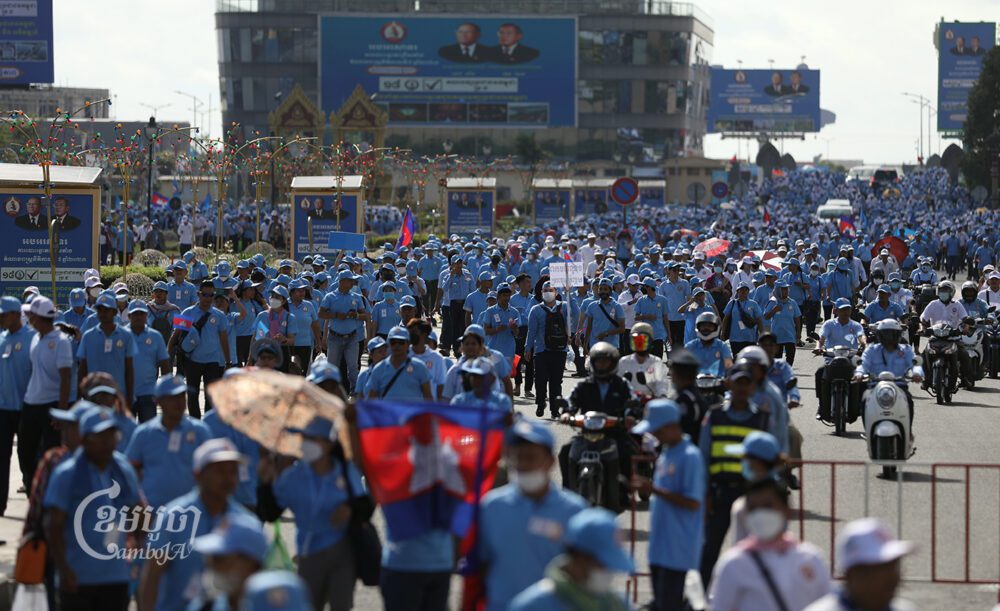
The ruling Cambodian People’s Party (CPP) plans to use the “peaceful resolution policy in the border dispute” as a campaign tool ahead of the 2027 commune election and 2028 national election, which an opposition party and election observer viewed as “unfair” competition to seek political gains.
Acting Head of State and Senate President Hun Sen, who holds the CPP president post, said on Wednesday that his party would use the Cambodia-Thailand border dispute as part of its election campaign for the upcoming elections.
“I pointed out that the peaceful resolution [of the border issue] is the policy of the Cambodian People’s Party for campaign in the 2027 and 2028 elections,” he said in a meeting with about 1,600 councilors in Siem Reap province.
Hun Sen has been on the road meeting with provincial, district and commune councilors across 13 provinces since April 25.
The commune council elections are scheduled for June 6, 2027. There are 1,652 communes nationwide.
In previous commune elections, the CPP claimed more than 74% of the popular vote with leading opposition Candlelight Party gaining 22.3%.
Kong Monika, secretary-general of the Khmer Will Party, said it is normal for CPP to use public forums to promote its achievements, but there should not be a monopoly on issues.
“I want to say that we should have only one standard, not two or more standards, so that other political parties are also allowed to raise issues, such as border issues and social injustice, when meeting voters,” he said.
“Please allow other political parties to [also] fully exercise their freedom of expression. Do not [only] allow one party to enjoy all the rights while other parties don’t have sufficient space to express their opinion. That is unfair competition,” Monika added.
He said that his party continues to face challenges in carrying out political activities at the grassroots level, including restrictions on installing party logos and alleged acts of intimidation.

Political analyst Meas Nee echoed Monika’s view that the ruling party always took the opportunity to promote its political message.
“A peaceful solution to the border issue is the only option Cambodia can pursue because it cannot use armed force to resist [Thailand],” he said. “The ruling CPP is aware of the political pressure surrounding concerns over territorial losses along the border. If the ruling party fails to resolve the issue, it could affect its reputation ahead of elections.”
Korng Savang, policy and advocacy coordinator for Committee for Free and Fair Elections in Cambodia (COMFREL), said that most political parties are currently conducting outreach activities to meet with their members and grassroots activists.
“The question is when a person is meeting councilors, what role are they playing while campaigning? If they use their role in the state to campaign for a political party, it is a political advantage over others,” he said.
National Election Committee (NEC) spokesperson Hang Puthea said Hun Sen has been talking about the commune council election, following a schedule to remind citizens of their obligation to participate in the election.
“The announcement, as a reminder to citizens, doesn’t break the law because it is not an election campaign forum. It is a reminder to citizens to prepare to participate in the coming election,” he said.
“It is good that he uses that forum to remind citizens of constructive developments at commune levels,” Puthea said.