Listen to the audio version of this article (generated by AI).
Interior Minister Sar Sokha issued a directive to sub-national authorities to establish a “secret” monitoring system on drug-related criminals and to crack down on the activities using the same approach used to monitor activists.
At the opening of the conference to review the achievements of the Fifth-Mandate Commune and Sangkat Councils on Monday, Sokha said that drug-related problems are prevalent in sangkats (communes) despite the seizure of tons of drugs in each case.
Over 400 communes surveyed showed that drug-related problems, gang violence, livestock theft, and gambling occur at high rates at the local level.
“The drug problem is not only existent in Cambodia, but also the region. We have to look at it as a whole. As I have mentioned before, when Phnom Penh and provincial police commissariats monitor activists […] they even know when that person goes to the bathroom. So why don’t we use the same intelligence system and surveillance methods on drug-related cases,” he said.
According to Sokha, results of Safe Village-Commune Policy implementation competition from 2022 to 2025 showed that 1,243 communes were ranked first, 364 ranked second, and 41 ranked third. He advised commune administrations which ranked third to do more to implement the Safe Village-Commune Policy so they can achieve better results in the future.
Last month, a second deputy sangkat chief from the Candlelight Party quota in Oddar Meanchey province was arrested by authorities and charged with “incitement to discrimination” and to “insult” in connection with a telephone conversation.
Nam Sot, Rong Roeung Commune Chief in Stoung district, Kampong Thom province, said that authorities in his commune previously arrested many people involved in drug use, but they continued using drugs even after receiving education and guidance.
He also expressed concern about the increasing number of teenagers under the age of 15 in his commune who gather to smoke cigarettes around schools.
“As preventive measures, the commune council and police hold meetings and conduct awareness campaigns at primary and secondary schools, as well as in villages. We also conduct direct outreach with parents through schools and students,” he added.
Meanwhile, Cheang Seavy, Kampong Popil Commune Chief of Peam Ro district, Prey Veng province, said that authorities would hold a meeting to introduce measures to monitor drug-related offenses following the guidance from the ministry.
“They already use preventive and monitoring measures. We regularly cooperate with the police. The measures include holding meetings with the commune council and law enforcement officials to develop further plans.”
Adhoc president Ny Sokha called on the government to target major drug kingpins and those who protect them, saying that this is necessary to eliminate the drug problem. As for the arrest of young people in villages and communes who use drugs, he said they are simply victims of drug abuse.
“What needs greater attention is the root cause. If we only crackdown on people who use drugs at the local level, I think the problem will not disappear unless we address the root cause involving major corrupt figures and drug-trafficking networks. That needs to be cracked down,” he said.
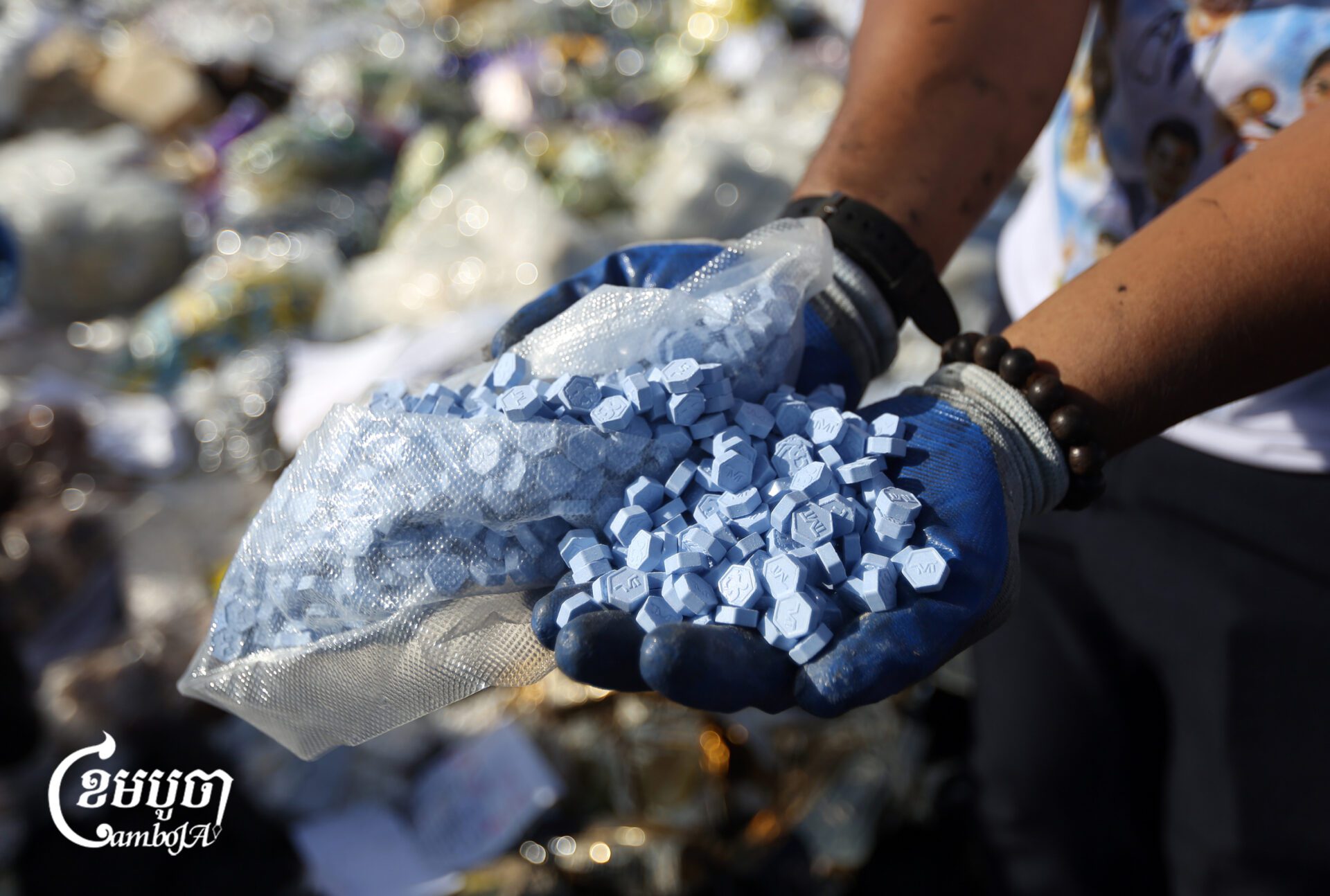
On July 21, 2026, authorities destroyed more than five tons of drugs seized from various operations during “International Day Against Drug Abuse and Illicit Trafficking” in Ponhea Lueu district, Kandal province.
A month later, on August 25, authorities destroyed over four tons of drugs in Koh Kong province.
In 2025, Cambodian authorities cracked down on a total of 10,743 drug-related cases and arrested nearly 28,000 suspects linked to drug offenses. Authorities also seized approximately 48,000 kilograms of drugs and drug substances and shut down 12 business premises.