Koh Kong, Cambodia — Illegal trawlers have long threatened Cambodia’s coastal marine ecosystems and the livelihoods of small-scale fishers. But in a quiet corner of the Koh Sdach Archipelago, a community-led conservation effort is rising from the seabed.
Taking a boat ride across the turquoise waters off the coast of Cambodia’s southern Koh Kong province, deputy commune chief Sorn Srenh directed the vessel toward the 14 concrete anti-trawling blocks his team deployed back in 2023.
He tracked coordinates within the Community Fishery in the Koh Sdach Archipelago with a GPS device, helping to locate the underwater blocks, but also marine species such as a rare population of sponges documented nearby.
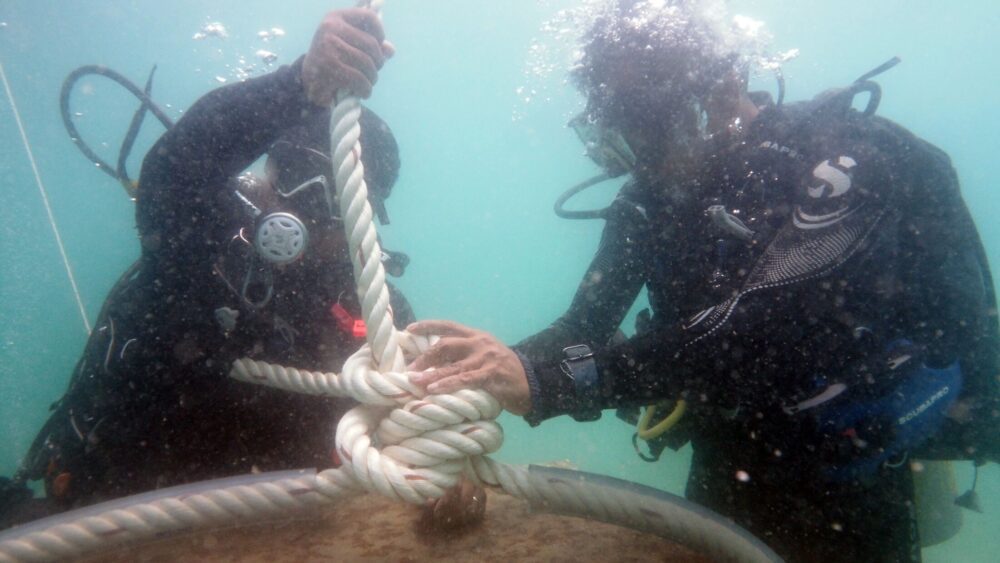
Supported by an international conservation NGO, Fauna & Flora, and the Cambodian Fisheries Administration, these blocks were arranged in rows along common routes of trawlers. By dragging fishing nets across seabeds, trawlers can damage habitats and indiscriminately scoop up large quantities of fish and other species.
The structures, measuring 1.5 meters long and weighing up to 1.2 tons each, serve a dual function: physically obstructing illegal trawling boats from entering community waters while also potentially creating artificial habitats for fish and coral.
“Fishermen told us that some trawler boats got stuck where we deployed the blocks,” Srenh said during the boat ride, adding that he has also observed a growth in marine species near the blocks and more reliable catches for local communities.
Born on the island, Sorn—nicknamed ‘Sea’—grew up to become a local leader in the Koh Sdach Archipelago, a cluster of 12 islands that serves as a vital habitat for diverse marine species and coral reefs.
He has joined forces with government officials and nonprofit partners to expand the concrete block initiative in recent years.


The Koh Sdach anti-trawling blocks are not the only example of collaborative efforts to deploy artificial reefs in Cambodia.
It was inspired in part by the ongoing movement of the local NGO Marine Conservation Cambodia (MCC), which had previously built underwater concrete reef structures in Kep Province in 2018, sparking a trend of artificial reef building in Cambodia.
Srenh said that the block project is an efficient way to manage illegal fishing activities in Koh Sdech, serving as a passive physical barrier and reducing the work of community members volunteering their time to patrol the waters.
“The blocks are one of the mechanisms that help [protect] our Community Fishery boundary from illegal trawling boats, especially because we don’t have enough capacity and human resources to do patrolling all the time.”
Built on evidence
Citing the decline in Cambodia’s marine fisheries due to overfishing, climate change and a lack of effective regulations, in 2022 the Asian Development Bank (ADB) approved financing for a project to restore 40% of the nearshore fisheries in the coastal provinces of Koh Kong, Preah Sihanouk, Kampot, and Kep.
Cambodia’s Ministry of Agriculture, Forestry, and Fisheries is in charge of executing the US$104 million project.
One component of the project involves the Fisheries Administration working alongside MCC to develop and deploy 5,000 fishery productivity structures along Cambodia’s entire 440-kilometer coastline — built on the evidence-based success of the past project.
Before the ADB funding, MCC had installed over 300 structures in the Kep Marine Fisheries Management Area and around 80 more in community-managed fisheries in Kep and Kampot, with the help of local fishers, volunteers, and residents.
These low-cost cement blocks function as artificial reefs, providing safe habitats for marine species—including fish, coral, and seagrass—while deterring destructive trawling practices.
Data collected by MCC in the Kep Archipelago suggests that trawlers began to avoid areas where the concrete structures were deployed beginning in 2018, according to a 2023 internal report.
The group has also documented regrowth of pioneer seagrass species in the areas protected by the structures where seagrass meadows were previously destroyed.
In a statement, MCC said these structures are “a key initiative to restore depleted marine ecosystems and thus facilitate local fisheries sustainable management,” adding that reports from local fishers on the concentration of commercial species in the vicinity of the structures show their potential to improve livelihoods.

The success of the anti-trawling initiative in Kep province was part of the inspiration for Fauna & Flora’s project in the Koh Sdach Archipelago.
“[MCC’s] work has been very successful in that province. We saw it as an opportunity to build on the momentum that they have done elsewhere, and adapt it to the needs of the [Koh Sdach] Archipelago,” said Kieran Murray, project manager for marine species and ecosystems at Fauna & Flora.
A new set of 12 anti-trawl blocks are currently being constructed by a local contractor, with plans to deploy them during the dry season between October and December this year. Srenh confirmed that discussions are underway to finalize the new locations for the blocks, with input from local fishers on where the structures are most needed.
Cementing a future in tourism
By reviving marine ecosystems and fish stocks, the concrete block projects may also serve to boost tourism across Cambodia’s coast.
Koh Sdach Archipelago is known for its vibrant coral reefs, rich marine life, and palm-fringed white beaches that draw both tourists and investors.
Its biodiversity supports popular activities like fishing and snorkeling, providing sustainable income for local communities through boat services, guided tours, and the sale of local products.
Choeurn Hong, 46, a resident of Koh Sdach village, fished for a living between 2015 and 2021 but stopped about four years ago as fish numbers declined due to increased competition, advanced fishing fleets, and illegal trawlers operating in community waters.
Now working as a tourist boat operator for primarily Cambodian customers, Hong welcomes conservation efforts such as the deployment of cement blocks, which he says have helped reduce illegal fishing and protect marine life.
“The cement blocks help to preserve fish populations and also attract tourists who enjoy fishing for fun. However, they do not completely prevent illegal fishing. We need more support and assistance—specifically, more concrete blocks—to make a greater impact.”

Hong credited the blocks and marine conservation initiatives for the significant rise in tourism that he has observed, noting growing interest in local species like coral reefs, seahorses, and sponges. His boat can carry around 25 passengers, offering fishing trips, snorkeling, and island sightseeing.
He earns around $100 a day during the dry season, but operations are limited during the rainy season when waves become unsafe.
“When tourists request tours in the rainy season, I always check the weather forecast to make sure it’s safe,” he added.
“We’ve seen a big improvement in tourism. First, we have fresh seafood, and second, the coral reefs are spectacular. The islands are close together, which makes them even more appealing. If we can preserve the reefs, tourism will keep growing.”
Under-resourced patrolling
While the deployment of concrete blocks has played a role in reducing illegal trawling, local leaders say strict law enforcement in protected areas and community involvement are equally important in protecting marine resources.
Establishing Marine Protected Areas (MPAs) and Marine Fisheries Management Areas (MFMAs) are key strategies in restoring Cambodia’s coastal fisheries.
Globally recognized for combating declining fish stocks and degraded ecosystems, MPAs in Cambodia aim to balance conservation with sustainable use.
The government declared the country’s first 405-square-kilometer MFMA in the Koh Rong Archipelago in 2016, followed by one in the Kep Archipelago and another in Prek Kampong Smach. Three additional MFMAs are currently under development, including one in the Koh Sdach Archipelago.
Fauna & Flora said in a statement that it supported the Fisheries Administration’s efforts to bring Koh Sdach under further management, and the NGO hopes there will be an update on the status later this year.
Neither Agriculture Minister Dith Tina nor Khim Finan, undersecretary of state and spokesperson for the ministry, responded to multiple requests for comment.
Khvay Atitya, spokesperson for the Ministry of Environment, did not respond to multiple requests for comment on the process of establishing new MPAs.


Oeurn Sina, 53, the village chief of Koh Sdach, said the number of illegal trawlers entering local fishing grounds has noticeably declined since the cement blocks were installed.
“But these are insufficient to prevent illegal activities,” she said.
Sina is part of a women’s patrol team working under the Community Fishery (CFi), a collaborative group of residents and authorities aiming to ensure sustainable fishing and safeguard conservation areas.
Patrolling three to four times a month, Sina and her team track trawlers involved in illegal, unreported, and unregulated (IUU) fishing—activities that have severely depleted Cambodia’s marine stocks and threatened local livelihoods.
The group has organized boat patrolling, which remains a crucial but under-resourced aspect of fisheries management.
“Our patrol boat can barely carry five officers, making it difficult to respond effectively to large, illegal fishing fleets,” Sina explained. “Most illegal activities happen at night, which is dangerous for us, especially with such small boats.”
Sina said the CFi team is not authorized to arrest offenders or confiscate illegal catches. Instead, they report incidents to the Fisheries Administration and the Ministry of Environment, which jointly manage the area.
“I worry our efforts are limited. When trawlers enter to scoop up big fish, they also destroy coral reefs and other marine life. Without stronger enforcement and better equipment, it’s hard to keep up,” she said.
(Additional reporting by Leila Goldstein)
Note: Reporting for this story was supported by Internews’Earth Journalism Network.