Listen to the audio version of this article (generated by AI).
A new report by a prominent U.S. crime expert argues that despite a Cambodian government crackdown that emptied out most industrial fraud compounds in the country, authorities have not addressed the underlying corruption and elite protection that allowed the scam industry to flourish.
The more than 120-page report was written by Jacob Sims, a visiting fellow at Harvard University’s Asia Center, and published by the National Democratic Institute and data analytics firm Inca Digital. It is the second report on Cambodia’s scam industry from the transnational crime researcher, who was previously barred by his former employer from returning to Cambodia over unspecified threats.
The report draws on “an array of published and novel evidence” to advance what Sims calls Cambodia’s “scam state architecture,” a system, he writes, in which networks of political and business elites shield the industry from accountability while allowing it to keep adapting at scale.
“No politically exposed domestic elites have faced credible prosecution,” the report said. “No structural reform to the protection frameworks that continue to enable the scam economy. The ruling coalition’s institutional grip remains unbroken.”
The report identifies four types of what Sims calls “elite mediators,” political and law enforcement figures he says connect criminal money and territory to political protection.
One example he cites is Hun To, a cousin of Prime Minister Hun Manet who acknowledged owning a 30% stake in Huione Pay, a now-collapsed payment platform the U.S. Treasury said was involved in laundering billions from scam operations that targeted Americans. Citing new blockchain analysis conducted with Inca Digital, the report also says more than $170 million tied to Huione Pay wallets flowed into cryptocurrency wallets the U.S. Treasury sanctioned in April 2026 over their ties to Iran’s central bank, which is itself under sanction for funding Iran’s Islamic Revolutionary Guard Corps.
Sims also points to senior anti-trafficking and police officials he accused of controlling how far investigations into scam compounds are allowed to go, as well as a network of Western lobbyists, consultants and lawyers he says help Cambodian officials and scam-linked businessmen manage their international reputations and legal exposure.
He argues it can only be dismantled by reversing those same functions, including sanctioning the mediators themselves and protecting the local journalists and civil society groups who exposed the system in the first place.
Cambodian elites and officials have long been connected to the scam industry by journalists and the U.S. Treasury Department, leading to a wave of sanctions against them beginning in 2024 and an international pressure campaign on Cambodia and other countries in the region to dismantle an illicit industry believed to generate tens of billions of dollars annually.
Sims argues the crackdown came amid mounting pressure from the U.S., Britain and China, as well as Thailand’s targeting of suspected scam sites along the border during a recent border conflict.
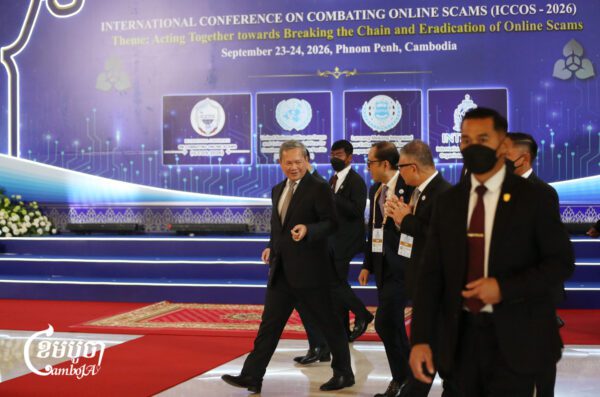
Cambodian authorities said they have cleared more than 600 locations linked to online scams since 2025 and detained nearly 30,000 suspects from 39 nationalities. Among those arrested were 15 high-ranking officials and law enforcement officers, according to the Anti-Corruption Unit. The government has touted the crackdown for closing all known industrial-scale scam compounds in the country but has acknowledged that fraud networks have adapted, shifting to smaller, decentralized operations
The government has also faced criticism from human rights groups over limited protections for foreign nationals trafficked into the industry, a population the United Nations estimated at up to 100,000 people in 2023.
Two U.S. congressional committee chairs Wednesday also urged the State and Treasury Departments to consider sanctioning more Cambodia officials, including Interior Minister Sar Sokha, Deputy Prime Minister Neth Savoeun, and Hun To. Sims also recommended sanctions against them in a report published last year. Hun To and Sar Sokha have denied criminal allegations.
Ministry of Interior spokesperson Touch Sokhak said the officials were also named in Sims’ earlier report, and that “the matter later went quiet after Cambodia provided explanations.” He said Sar Sokha “is not involved in this offense” and pointed to a July visit by FBI Director Kash Patel, claiming Sokha had even “received praise” from Patel for his work leading law enforcement operations, and that he has faced “life-threatening risks and threats to his family from anonymous criminals.”
“I believe the U.S. government does not act lightly, as it is a global power,” Sokhak said. “It cannot simply act upon requests from any individuals [lawmakers]. While it is the right of lawmakers within a democratic system, it does not mean that the U.S. government will act on everything raised; they rely on facts, legal principles, and concrete evidence.”
Other authorities did not immediately respond to requests for comment on the report or the sanctions push from U.S. lawmakers, or referred reporters to prior statements. Senate spokesperson Chea Thyrith referred questions to government spokesperson Pen Bona, who pointed to Prime Minister Hun Manet’s prior statements about dismantling the scam industry and targeting officials who benefit from it.