Listen to the audio version of this article (generated by AI).
The Anti-Corruption Unit (ACU) recently unveiled four separate cases of high ranking Foreign Affairs Ministry officials involved in corruption, including an alleged $3 million scheme to illegally sell visa stickers for foreign scam operators.
However, an analyst has called for an investigation to not only examine individual wrongdoings but also weaknesses in oversight, immigration control and official accountability.
Details of the ACU’s investigation revealed incidents of corruption carried out by Tho Samnang, the former director-general of the ministry’s General Directorate of Legal, Consular and Border Affairs, who stepped down in April to become an advisor. Similar offenses were committed by his subordinates Nop Ratha, former deputy chief of the Cambodian Citizen Protection Office, and Yos Rane, a contract officer who provided illegal visas, violating ministry’s policies.
Samnang and his two associates allegedly issued and sold around 12,000 C and Cex visa stickers to foreigners, including alleged online scammers. The visas were allegedly sold for personal gains of up to $3 million, while Samnang admitted to receiving about $450,000.
The investigation began after a 2025 year-end audit found missing visa stickers. Authorities, who later seized $980,000 from Samnang and $250,000 from Ratha, are seeking to freeze and confiscate the money.
The three were charged last week for internal destruction and embezzlement, abuse of power, and money laundering, according to court spokesperson deputy prosecutor Chhay Hong.
Hong said Samnang owned 375 bank accounts in seven different banks, while Ratha had five bank accounts, and Rane, 11 bank accounts.
Samnang admitted that he had only 50 visa stickers left out of 6,000 he initially possessed, and had destroyed them all. He also admitted he sold C/Cex visas to foreign online scammers for $6,000 per visa.
Earlier, ACU investigated three other cases, which led to the arrests of Sor Samnang, ex-deputy director-general of Immigration Uk Heisela and Phnom Penh deputy police commissioner, and retired US military Brigadier-General Meas Marin, as well as two associates accused of accepting bribes from a man named Tony, head of Morgan Names, an online gambling company, in Koh Pich. They allegedly received monthly payments of up to $10,000 to escape police inspections.
The court charged six people with bribery and money laundering after discovering $100,000 linked to the proceeds, according to the ACU.
Another case involved a Thai online scam boss who was accused of paying $774,000 in bribes to secure the release of 43 Thai scam workers from a compound in Banteay Meanchey’s Poipet city. The ACU recovered $370,000 of alleged bribe money and sent five military and police officers to court. Two Thai suspects are still at large.
Recently, the ACU investigated Pursat provincial deputy prosecutor Kry Seiha for allegedly accepting bribes to release five suspected online scammers, related Chinese and Vietnamese nationals.
Seng Vanly, an independent political analyst, said that given the scale of the alleged scheme, investigations should extend beyond the three accused officials as it is related to the alleged misuse of thousands of visas. It has broader implications for state credibility and immigration control, he added.
“In my view, the deeper roots of corruption here are likely to involve weak internal controls [as] too much discretionary power concentrated in a few hands,” he said.
He cited poor financial and asset monitoring, a patronage network in which the problem is not only about those who took money, but also the system which made it possible.
“The key issue is why the problem was not stopped at the earliest warning sign. That raises serious questions about internal auditing, reporting chains and accountability,” Vanly said.
The reported scale makes it very difficult to treat this as a “small isolated case”, particularly thousands of visa stickers could allegedly be diverted over an extended period, pass through immigration controls, internal supervision and be linked to online scam networks, he said.
“That is why the investigation should go beyond the three accused officials. [It] should examine the entire chain of authorization, supervision, financial transactions and beneficiaries,” Vanly said.
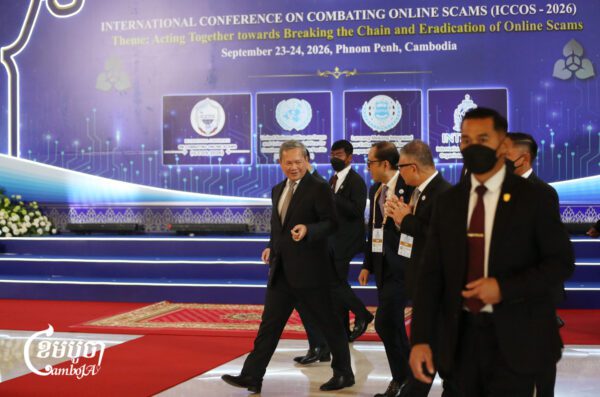
The case comes as Cambodia continues to crackdown on the online scam industry, which made the country a hub for transnational crime syndicates. Authorities and researchers have stated that the activity bilked tens of billions of dollars a year from victims worldwide. The United Nations estimated in 2023 that more than 100,000 people from dozens of countries have been subjected to forced or coerced labor in scam operations in Cambodia alone.
The government says it has shut down hundreds of scam compounds and deported tens of thousands of scam workers, but it continues to face criticism for failing to protect trafficking victims and for not acting against senior officials sanctioned by the United States over alleged links to the industry.
General Department of Immigration spokesperson Sok Somnea declined to comment but briefly said the immigration department has already cooperated with relevant institutions by referring to ACU, while its spokesperson Soy Chanvichet, could not be reached for comment.
Foreign Affairs Ministry spokesperson Chan Rottana could not be reached for comment.