Listen to the audio version of this article (generated by AI).
The return of hundreds of thousands of migrant workers from Thailand could lift Cambodia’s overall economic output but leave households poorer, a research institute chaired by the central bank governor said in a recent report.
The Cambodia Development Resource Institute’s (CDRI) report, published Sept. 7, came about two weeks before the Asian Development Bank cut its 2026 growth forecast for Cambodia to 3.9% from 4.1%, citing weaker tourism, tensions along the Thai border and concerns over the country’s scam industry. Days later, the International Monetary Fund said growth would slow to 3% this year. The government forecasts 4.2% growth.
The institute, founded in 1990, was endorsed by Cambodia’s Council of Ministers in 1991 and became a private nonprofit in 2000. Chea Serey, governor of the National Bank of Cambodia, has chaired its board since 2024. Three of the report’s four authors are economists at Australia’s Victoria University and the ADB, which also funded the study.
Under its moderate scenario, the report projects Cambodia’s economy would be 1.5% larger by 2030 than if the border had stayed open. But output per person would be about 1% lower and consumer spending per person about 5.4% lower, largely because of lost remittances and a slump in tourism.
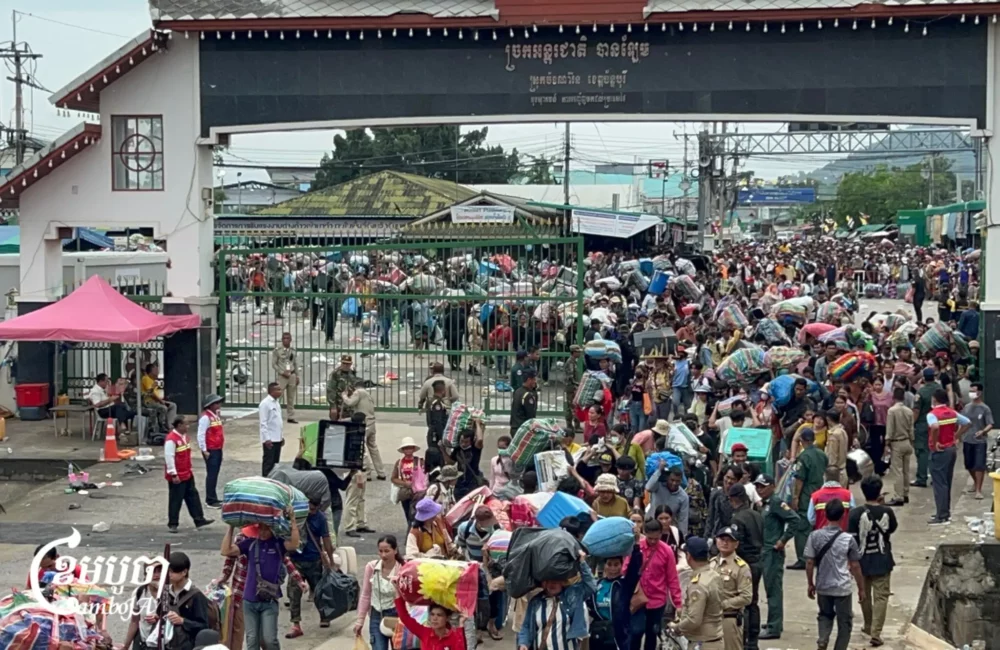
About 900,000 Cambodian migrant workers returned from Thailand after border tensions escalated into deadly clashes last year. The Labor Ministry said in December that nearly half a million had since found jobs. Many returnees face heavy debts, irregular work and lower pay.
Meas Soksensan, a spokesperson for the Ministry of Economy and Finance, and Sun Mesa, a spokesperson for the Labor Ministry, did not respond to requests for comment on the report or on returnees’ conditions.
The report cites earlier institute research estimating that returnees’ incomes fell by about 37% after they came home.
Sin Chantrea is among those earning less. She sold seafood in Thailand before returning to Banteay Meanchey province after the border conflict and now works at a garment factory in Phnom Penh, earning about $290 a month. In Thailand, she often brought in more than $300 a month, she said.
“It affected how much I could help my family,” said Chantrea. “In Thailand I could earn more. Some months I could send money home, and some months I couldn’t.”
The loss of money sent home by migrant workers is expected to be one of the biggest pressures on households, according to CDRI. Its moderate scenario assumes remittances from Thailand fall by 60%, cutting Cambodia’s total remittance inflows by nearly half.
The same scenario assumes trade between Cambodia and Thailand falls by 30% and international tourist arrivals drop by 20%, including a nearly 88% decline in Thai visitors, with the declines phased in over 2025 and 2026. Weaker tourism would hit hotels, restaurants, transportation and other services, while reduced Thai demand would hurt Cambodian exporters, the report said.
For returnees, rising prices and debt have deepened the squeeze. Chantrea said she tried to sell her family’s rice farm to repay a bank loan and a private loan, but the offers were too low. Meanwhile, the IMF projects inflation of 5.6% this year.
“I don’t think prices will go down. They will only get higher and higher,” she said. “That’s why I have to think before I spend money.”
Chan Sophal, director of the Center for Policy Studies, echoed CDRI’s findings, saying a bigger economy does not necessarily mean higher incomes.
“GDP is the total income generated within the country, including income earned by large companies, the wealthy and the poor,” he said. “When GDP increases, it does not necessarily mean everyone’s income increases.”
Wages earned in Thailand do not count toward Cambodia’s GDP, so returning workers add to domestic output once they find jobs at home, even if they earn less, Sophal said. He compared it to Cambodia’s population suddenly growing to 20 million: “GDP would increase, but household income would not necessarily increase. It could even decline.”
To create jobs for returnees, he said, the government should offer stronger incentives for investors, particularly by easing electricity costs, such as letting factories use their own solar power during the day without extra charges.
Khun Tharo, program manager at the labor rights group Central, said the border crisis had exposed Cambodia’s “deep structural dependence” on migrant labor and remittances, and that debt was the “single biggest vulnerability” for returnees and their families.
Many returnees had worked in Thai agriculture, construction and fisheries, Tharo said, skills that don’t match the factory jobs available at home. Some are trying to return to Thailand through unofficial routes, risking arrest and exploitation, because Thailand has not offered a way for workers with expired permits to regain legal status, he said.
Government training and job-placement programs help but are not enough without debt relief, stronger social protection and investment in decent jobs, he said.