Listen to the audio version of this article (generated by AI).
CIVICUS, a global alliance of civil society organizations and activists, urged the 63rd Session of the UN Human Rights Council, member states and the UN Special Rapporteur to push the Cambodian government to drop all charges against activists and political opponents. It also called for the repeal of restrictive laws, and raised concerns of alleged repression escalating ahead of the local council elections in 2027.
According to its website, CIVICUS is working to strengthen citizen action and civil society throughout the world.
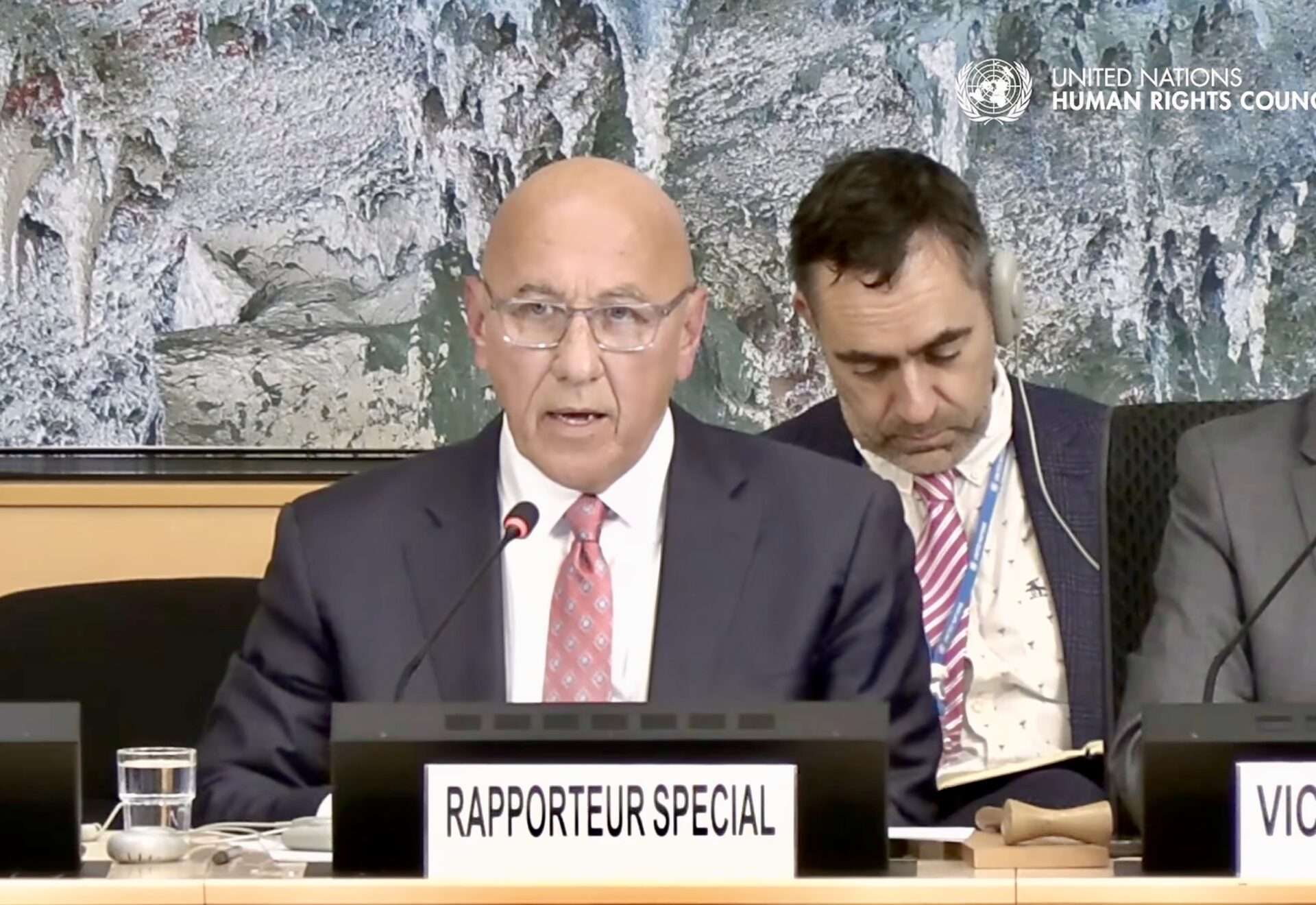
Olimjon Bakhtalive, who spoke on behalf of CIVICUS at the UN council, welcomed the concerns raised by UN Special Rapporteur on Cambodia Thomas Andrews on the human rights situation and freedom of speech in the country.
“We remain concerned that repressive laws are routinely being missed by [Prime Minister] Hun Manet’s government to criminalize and jail human rights defense,” Bakhtalive said in a statement, citing the imprisonment of five Mother Nature Cambodia activists and people who opposed the Cambodia-Laos-Vietnam Development Triangle Area (CLV-DTA) agreement.
“We call on this Council, all member states and the UN Special Rapporteur to continue to engage with activists and civil society, push the government to drop all charges against activists and to release them immediately,” he said.
The UK echoed the Special Rapporteur’s report relating to the shrinking civic and political space, while welcoming his continued engagement with Cambodia.
“We encourage the Cambodian government to engage constructively with the Special Rapporteur’s recommendations and to promote an open and inclusive environment in which all voices can participate freely,” read the statement.
Cambodian Human Rights Committee spokesperson Pa Bunnara dismissed CIVICUS’s statement, stating that freedom of expression was guaranteed in the Cambodian constitution.
“Every expression must not infringe upon the rights, freedoms, dignity, national security, public order and traditional customs of the nation. All of these serve as boundaries,” he said.
“When we cross the boundary of our freedom and infringe upon the rights and freedom of others, the legal elements are met to lead up to an offense,” Bunnara said.
In his speech at the UN council, UN special rapporteur Andrews mentioned that Cambodia was allegedly restricting freedom of expression and civic space, arbitrarily applying repressive laws to crush political opponents and detaining scores of human rights defenders, including journalists as well as stripping the political rights of others.
“Free, fair and credible elections will be impossible if political leaders remain behind bars or are sidelined by restrictions on their political right or when electoral laws and administrative procedure disqualify viable candidates and bar popular opposition parties competing,” Andrews said.
He also highlighted the border crisis in Cambodia, which he observed during his 12-day mission in July, affecting some 20,000 Cambodians who remain displaced despite the end of the conflict with Thailand.
Ly Sothearayuth, who is with Alliance Toward the Future, a coalition of four opposition parties, supported the issues raised by the UN Special Rapporteur, particularly the shrinking civic and political spaces, and called for good practices and an open political environment approaching the 2027 commune elections.
“If these concerns are not addressed, public confidence in elections may weaken, Cambodia’s international reputation may suffer, and opportunities for constructive political dialogue could be reduced,” said Sothearayuth, secretary-general of Candlelight Party.
Government spokesperson Pen Bona referred questions to the Cambodian Human Committee.