Listen to the audio version of this article (generated by AI).
The United Nations’ human rights investigator for Cambodia wrapped up a 12-day mission to the country last week, meeting with communities displaced by the border conflict with Thailand, officials, jailed activists and journalists.
Special Rapporteur Tom Andrews, a former U.S. congressman who took up the Cambodia mandate in March 2026 after six years in the equivalent role for Myanmar, will present his full findings to the U.N. Human Rights Council in October.
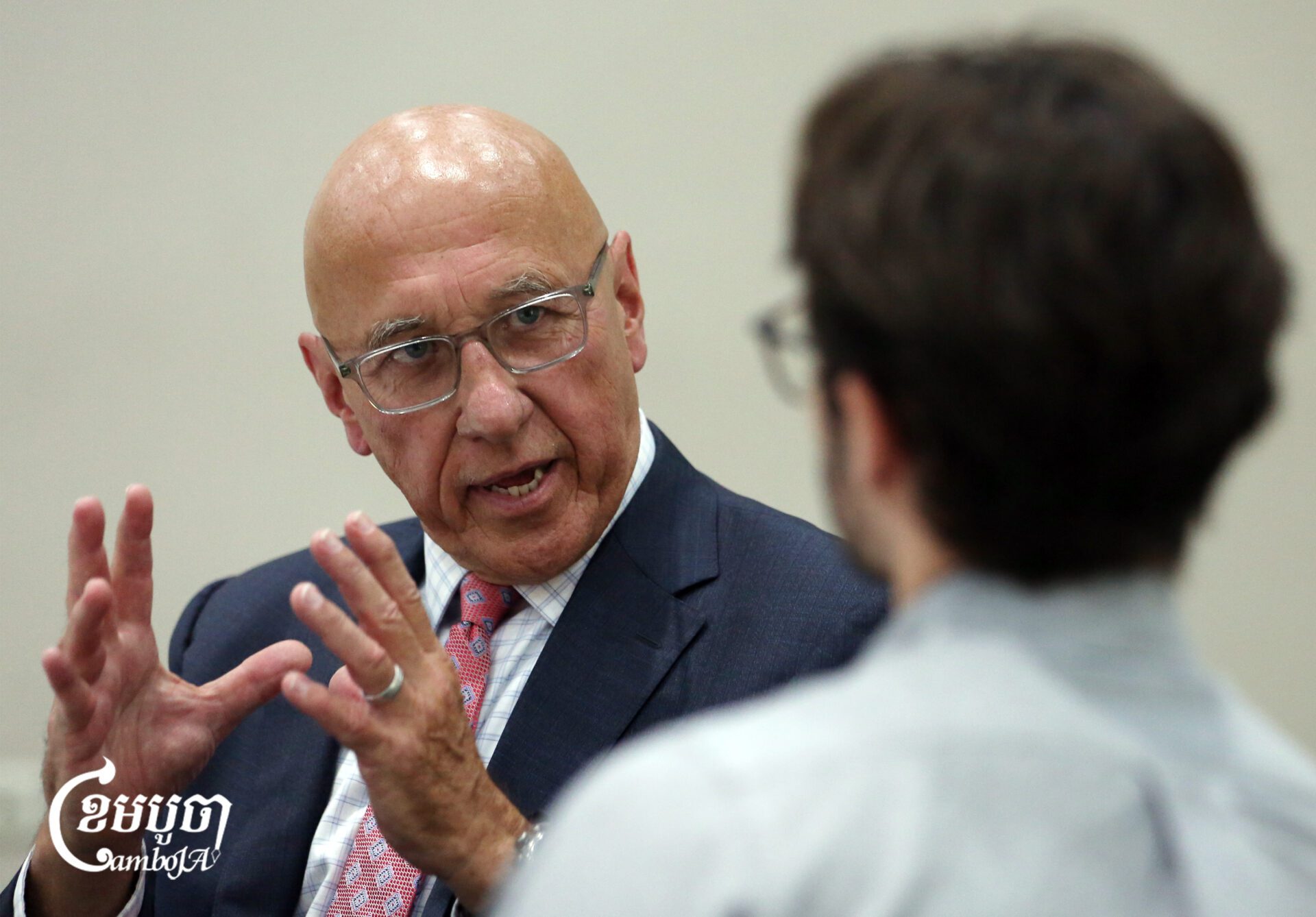
He sat down with CamboJA News’ Coby Hobbs at the end of his mission on Friday to discuss protections for the displaced, imprisoned activists, the scam crackdown, a new amendment allowing Cambodians to be stripped of their citizenship, and next year’s commune election.
More than 20,000 Cambodians remain displaced half a year after the ceasefire, most still in temporary shelter, with Cambodia blaming continued Thai military presence on formerly undisrupted land. What specific protections or assistance are still missing for these families – and what leverage does your office actually have to press Thailand to withdraw and allow people home?
The prism that I’m looking at this conflict and that I bring to this discussion is human rights, and also a foundation on international law as a foundation for addressing this particular crisis and the human rights of those who are suffering. There is a legal obligation, both in terms of international law and in terms of the agreement that was signed on the 27th of December last year – for people to have the right to return, to go home.
I was able to see extraordinary housing that had been constructed in a very short period of time for those who had been displaced from the conflict. And watching these kids, lining up for their breakfast and then meeting with the people who had been displaced was very powerful. It was a very powerful moment for me. Often we talk about these issues in Geneva or New York, in analytical terms and we lose sight of the human dimensions of these issues.
So that’s what was most valuable for me to be there. I think that the fundamentals are clear in this in terms of the human rights of the people here. They have the right to return to their homes and their villages.They have the right to livelihood. They have the right to educate their children. They have the right to health care. And as a practical matter, not only is that a matter of right, but it’s also in the interest of everyone. That border area, and as I learned there, so much of the economy is based upon trade. And so if you take away that, then you disrupt the economy for both sides of the border. So it seems to me that if there is a commitment to international law, and if there is a commitment to pursuing the mutual interests of those who live in that area, then there is going to be a path forward to address the crisis.
Now, I don’t know what that’s going to take. I’m not going to comment on the geopolitical dimensions of the conflict. But I certainly am available to both sides to discuss the human rights prism in which I’m looking at this and to do whatever I can to help perhaps facilitate moving forward.
Have you raised that directly with Thai counterparts or through the U.N. system?
No, I have not discussed this with them at this time.
Thailand said Saturday that a portion of the displacement figures cited by Andrews in his end-of-mission statement do not qualify as internally displaced persons, arguing that those individuals settled in areas Thailand opened for humanitarian shelter in the 1970s and never returned to Cambodia. Cambodia disputes this, saying the villages in question are its territory.
Dozens of people, including activists, journalists, opposition figures, ordinary citizens – have been arrested or charged over commentary on the conflict, often under incitement or national security provisions, and rights groups Licadho now tracks around 120 “prisoners of interest” jailed on what it calls unfounded charges criminalizing speech. What do these cases tell you about the state of freedom of expression in Cambodia right now, and did you raise specific cases directly with officials during this visit?
Well I think there’s important work to be done. The answer is yes I did. I think that there’s a need both for an examination of the relationship between Cambodian law and judicial processes and international standards. There is some foundation on which those discussions can be pursued. The government of Cambodia has accepted or ratified eight of the nine U.N. human rights related treaties. It’s accepted 84% of the UPR (Universal Periodic Review) recommendations. Those instruments give us a foundation on which we can engage.
I intend to address and engage with the government of Cambodia: the relationship between international standards, and the law here in Cambodia with respect to human rights and the application of that law. We had disagreements about the cases that we discussed. I won’t talk about the details of those discussions. But the government officials with whom I spoke, committed to engaging on these questions. I think that’s important. I was very clear in saying that nobody should be behind bars because they’re exercising their fundamental human rights, expression, association, and assembly. I’m very eager to pursue with the government discussions to address those who are behind bars, who have been exercising those fundamental rights.
Cambodia’s scam-compound crackdown is its most significant to date, yet rights groups like Amnesty International say freed and escaped workers aren’t being properly screened for trafficking – often treated as visa violators and held in overcrowded detention. Did the government give you a straight answer on why victim identification isn’t happening at scale, and does the campaign’s trajectory so far meet Cambodia’s obligations under the Palermo Protocol?
The answer was it was a capacity issue. But to be honest with you, there’s a real cloud around this for me because I heard very contrasting perspectives on what’s going on.
Some officials said, ‘We have a process in place. We’re screening. We’re caring for those who are victims of human trafficking. We ‘re providing support for them in various facilities.’ And then others say, ‘No, we’re not. We never have the capacity to do that.’
Then the numbers are all over the place in terms of what I’m being told. So this is an area of inquiry for me. I’m going to try to drill down to get as much information as I can. Then based upon that, engage in discussions about how this applies to human rights law and what measures can be taken to move this forward. But it’s clearly an issue. The government was saying to me, ‘we know that these operations continue.’ They’re changing in form. If you’ve got billions of dollars – you’re going to find a way. I was told some of these operations are going out into rural areas. There are scamming operations in condominiums. Some are being operated out of automobiles. There’s just a range of things that people are using to try to continue the scamming operation. It’s not going to be easy, and the government has been aggressive. They’ve shut down these facilities. I made the point that I think the enforcement has to be on all levels – that no one should escape accountability for this. And the prime minister noted that there’s due process, there’s innocence until proven guilty. But, we’ll be following this closely.
Cambodia’s commune elections are set for next year. Given the shrinking political space rights groups have documented, what would you consider the minimum conditions for those elections to be credible?
I think that people have the fundamental right to make a choice when they go to those polls. They have the right to have access to information on which to base those decisions. The fundamentals are that they deserve respect and protection for freedom of expression and assembly and association. The various forms of intimidation that I’ve been hearing about, subtle and not so subtle, to put pressure on politicians, political parties and opposition groups, all need to be addressed.
I think that what is important for me is to get to the facts as much as I possibly can, to be interviewing and engaging with people who are being blocked from a fair opportunity to make their case and to get their case to people.
There are a range of ways in which intimidation is going on. I was talking to a group that said they wanted to put a second level on their political party headquarters and they weren’t allowed. Others who found that they couldn’t find a headquarters, even though they had the money to rent because the landlord was afraid of the implications and the outcome of what would happen if they actually rented to them. This is where the rubber meets the road when it comes to these fundamental human rights. I’m a veteran of election campaigns. I insist when I’m running in fairness and I’m going to be observing. This is the beginning of my mandate and I’m going to be the Special Rapporteur throughout both election cycles and I am going to be paying close attention.
Cambodia made amendments to its Law on Nationality last year that gives the government the power to revoke citizenship from individuals that have committed acts deemed as treason. Given the state of Cambodia’s political environment, how concerned are you about this law and did you raise it with officials?
I’m concerned about a range of laws, including the citizenship law (or Law on Nationality). The government has agreed to work with me to systematically look at various bodies of law within Cambodia with respect to international law and their commitments to the UPR process. This is something that we’ll be delving into and will be engaging with the government.