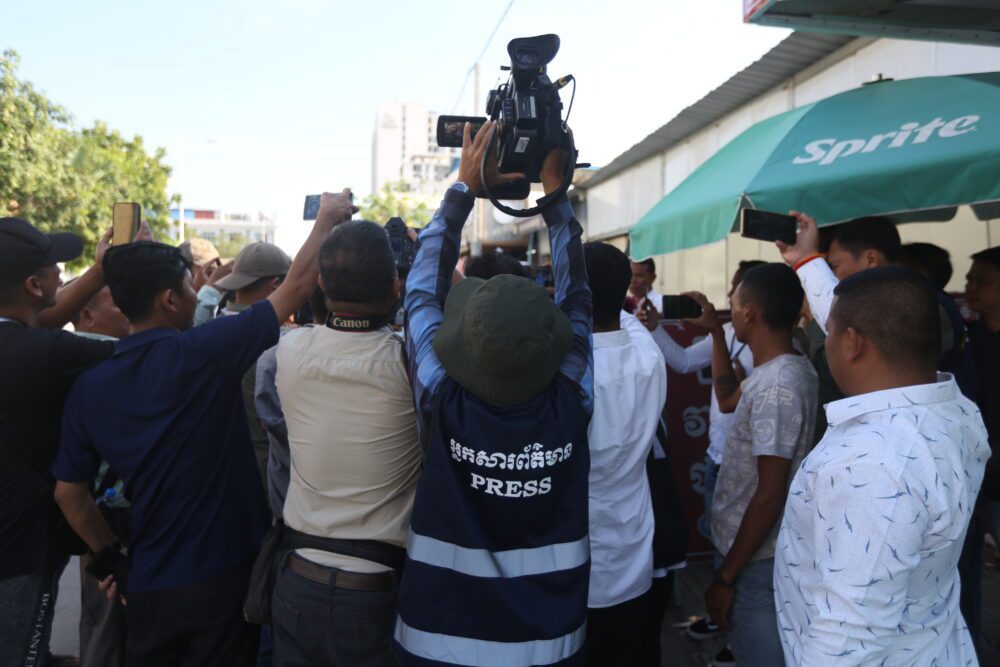
A coalition of 13 civil society, media and labor organizations has called on the government to ensure independent and transparent investigations into crimes and rights violations against journalists, warning that impunity continues to threaten press freedom.
From January and September 2026, Cambodian Journalists Alliance Association (CamboJA) documented 29 cases of human rights violations targeting journalists and media organizations. Of these, 19 involved violations of legal safety, including summonses, detentions, pre-trial detention, and imprisonment, according to the groups’ joint statement marking International Day to End Impunity for Crimes against Journalists.
The statement said human rights violations and crimes against journalists remain a serious concern, with authorities allegedly the primary perpetrators of violations against journalists. However, accountability for these violations remains largely absent, allowing those responsible to continue acting with impunity.
“This pattern raises serious concerns about the abuse of power and lack of accountability for violations committed against journalists, further undermining public trust in the justice system,” the coalition said on Thursday.
Four journalists are still in prison for incitement, demoralizing the armed forces, and illegally encroaching on and clearing forest land. Two journalists — Phorn Sopheap and Pheap Pheara — were each sentenced to 14 years in prison for allegedly supplying a foreign state with information prejudicial to national defense.
Chhan Sokunthea, executive director of the Cambodian Center for Independent Media (CCIM), told CamboJA News that from January to October, nearly 40 cases affecting journalists and citizen journalists were recorded. Among them, 13 cases involved significant challenges, and one individual remains imprisoned.
She added that journalists reporting on serious issues felt fearful, and hesitate to cover topics deemed sensitive, citing the incident of two journalists who are facing charges that carry sentences up to 14 years. In addition, close to 40 journalists and citizen journalists face arrest or harassment, contradicting reports by the Ministry of Information.
“Journalists still do not have full freedom to report due to numerous barriers, including those in announcements issued by the ministry and various forms of harassment on them,” Sokunthea said.
She added that although Cambodia is a democracy and guarantees freedom under Article 41 of its Constitution, and has ratified the International Covenant on Civil and Political Rights, journalists lack total freedom to report, particularly on online scams, corruption, and other sensitive issues. “They continue to be targeted.”
Chhen Leakena, a citizen journalist based in Steung Treng province, told CamboJA News that she is afraid of exercising her right to report about issues in her community even though citizen journalism was recognized by the law.
She said that she feels that she is being monitored when she interviews sources while reporting on local community issues. There are also attempts to persuade her family to make her stop working as a journalist. Thinking about these threats has affected her mental health.
“I hope the government will recognize and appreciate the work of activists and journalists who dare to speak the truth, and release those in prison, including environmental activists. Authorities should not view us as enemies; we should be encouraged,” she said.
The groups said that targeting journalists, particularly those reporting on human rights, corruption, environmental issues and other matters of public interest, undermines press freedom and freedom of expression,and restricts people’s right to information. Such an environment makes it difficult for journalists to hold those in power accountable for their actions.
“When authorities fail to investigate crimes against journalists and bring perpetrators to justice, they perpetuate a culture of impunity and send a dangerous message that such violations can be committed without consequences,” read the statement.
A record compiled by the Cambodian Center for Human Rights (CCHR) showed that at least 15 journalists have been killed in Cambodia since 1994. Twelve of them were reporting on sensitive issues, including environmental and political matters that exposed the actions of powerful individuals, government officials and state institutions.
Cambodia ranked 151 out of 180 countries in the Reporters Without Borders’ (RSF) 2026 World Press Freedom Index, placing it among countries where press freedoms are in a “very serious” situation.
Ministry spokesperson Tep Asnarith said he cannot comment because he has not read the statement.
The organizations urged the government to end judicial harassment and the arbitrary detention of journalists, create a safe environment for reporting, promptly and impartially investigate attacks and threats, and introduce safeguards against abusive lawsuits, including strategic lawsuits against public participation (SLAPP).
They also called for accessible protection mechanisms for journalists and human rights defenders, including risk assessments, emergency protection and follow-up on reported threats.