Listen to the audio version of this article (generated by AI).
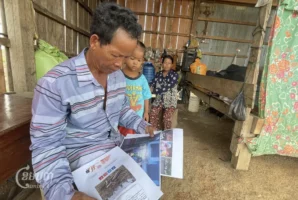
Kampong Speu – Hok Poeun remembers the chemical smell of smoke that drifted through her village in July, when a battery storage facility caught fire. The haze lingered for days over Toul Sambor village in Kampong Speu province. Her grandsons fell ill with respiratory infections and were hospitalized for a week, she said.
The Ministry of Environment determined that improper storage of lithium batteries caused the fire, which injured a few workers, and found high levels of air pollutants. The ministry fined the company that owns the facility, Xinshengsheng Metal Materials Industrial Park, and will require it to relocate the facility.
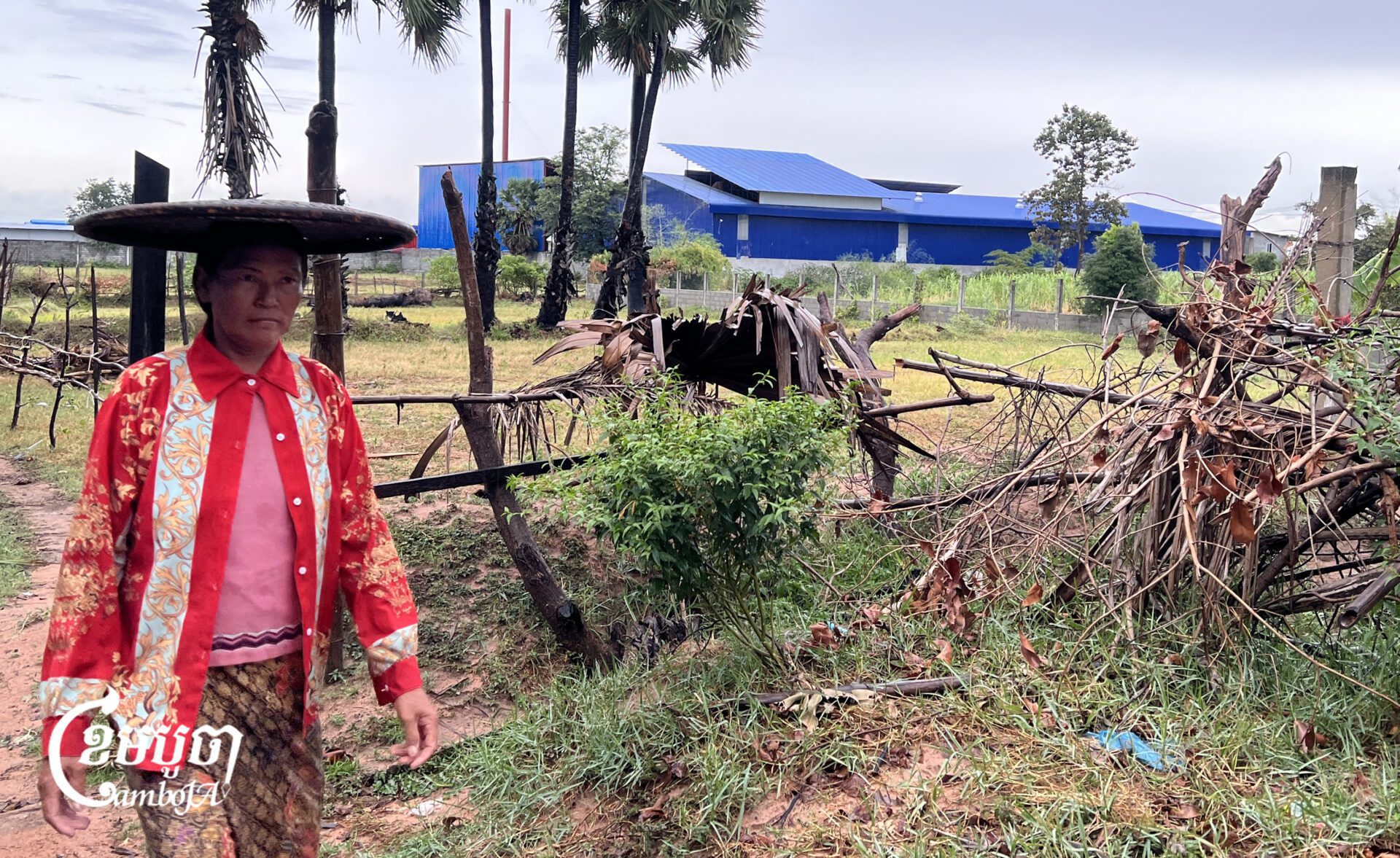
But Poeun is still worried. Next to the ruins of the storage facility, a factory that residents say smelts used batteries is still operating.
“If they continue running the smelting factory nonstop like this, how are we supposed to live here?” the 53-year-old grandmother said.
Residents of Toul Sambor village in Damnak Raing commune have lived in fear of the factory, just 60 meters (about 200 feet) from their homes, since it began operating early this year. They say it smelts used lead-acid batteries, which the government classifies as hazardous waste and bans from import, in a process that can release lead, a toxic metal with no known safe level of exposure. Residents say no one consulted them before the factory opened, and they are asking why it was allowed in a residential area — and why it keeps running despite the fire and the high pollution levels the ministry documented.
Fearing long-term harm to their health, environment and livelihoods, they are demanding the facilities be permanently removed.

‘We Know We’ve Been Exposed’
In October 2025, the Council for the Development of Cambodia approved a $6.3 million investment by Xinshengsheng Metal Materials Industrial Park to build a metallurgical and processing factory in Toul Sambor. The council said the factory would create 455 jobs but did not specify what metals it would process.
Residents told CamboJA News in September that there was no public consultation before the industrial park was built. CamboJA News was unable to verify whether an environmental impact assessment, which Cambodian law requires for smelting operations, was conducted for the factory and industrial park.
The battery factory began operating early this year, according to Toul Sambor village chief Khut Phoeun. He said he learned the factory would process battery materials only after supplies had been delivered to the building.
Phoeun and several other residents said the factory smelts used lead-acid batteries mostly from motorbikes and cars for recycling. The factory shares an entrance with the burned facility under a Xinshengsheng sign, CamboJA News observed, and a photo of it accompanied the council’s approval of the company’s project. About 20 Cambodian and foreign workers are employed at the factory, Phoeun said.
The Ministry of Environment did not confirm whether Xinshengsheng owns the smelting site, whether it has been inspected since the fire or what regulations it must follow. CamboJA News could not independently confirm what the factory processes, where it gets its batteries, or why lithium batteries were being stored at the site that burned.
“I may be uneducated, but I still question why they were allowed to set up right here among us,” Poeun said. “Of course, people want factories so they can make a living, but if it comes at the cost of harming the community, who could possibly be happy?”

If the factory is smelting lead-acid batteries, as residents say, the risks are well documented. Without proper controls, the process releases lead fumes and dust that settle on soil and surfaces, where people can inhale or swallow them, according to a 2017 World Health Organization report.
Lead can damage the brain, kidneys and cardiovascular system, the report says. Young children absorb about half the lead they swallow, compared with about 10% for adults, and exposure during pregnancy may be linked to reduced fetal growth, preterm birth and miscarriage.
Phorng, 51, whose chicken farm shares a boundary wall with the factory, said the plant lacked overhead exhaust stacks, so fumes leaked through its walls and corrugated iron roof into his farm during smelting. During the fire, he lost thousands of chickens and a motorbike, for which he later received compensation from Xinshengsheng’s chairman Zhang Jingchuan, he said.
When the factory began operating and producing a foul odor, villagers demanded that the village and commune chiefs inspect the site, several of them told CamboJA News. Phoeun said he contacted the company over the smell about a month before the fire. An environment official also came to seek a resolution, and the factory owner promised to modify its operations and do more testing if the odor persisted, the village chief said. That month, ventilation pipes were installed, which he said improved the smell and reduced complaints.
“Toxic substances in the body don’t cause immediate death like a chicken dying suddenly,” said Phoeun. “We know we’ve been exposed, but we haven’t filed any lawsuits.”
Xinshengsheng did not respond to a request for comment. A man who answered the number listed in corporate records for chairman Jingchuan, told a reporter to send questions over Telegram. The man, who did not give his name, viewed the messages but did not reply or answer subsequent calls.
Ministry of Environment spokesperson Khvay Atitya said the storage facility that burned down has yet to be granted permission to rebuild at the park, and that the ministry is looking for a new site farther from residential areas. Atitya and Chanthet Thanoreak, director of the Kampong Speu Provincial Department of Environment, did not respond to questions about the smelting factory’s current operations.
In August, Environment Minister Eang Sophalleth urged provincial governors to strictly enforce Cambodia’s ban on importing battery and electronic waste, warning that some proposed battery-recycling projects had sought permission to import hazardous waste as raw material.
Or Chanmoly, director of the Research and Innovation Center at the Institute of Technology of Cambodia, said battery factories need specific safety measures because fires there can cause serious environmental harm.
“If the pollution-control system is not properly managed, the emissions may contain toxic substances. These can affect the respiratory system,” he said.
Other countries require battery factories to have fire-protection and alarm systems and to hold regular evacuation drills, he said, but these measures are not always followed in Cambodia. Chanmoly said the health and environmental damage from battery-factory fires can be hard to recover from, and urged the Ministry of Environment to address it.
Lo Oun, 60, said she suffers from frequent sore throats and coughing and sometimes struggles to breathe, problems she never had before the factories began operating.
“I’m afraid of dying and leaving [my family] behind when toxic smoke fills the air like this,” she said. “We’re afraid of inhaling it into our lungs, and if we get sick, we don’t have the money for treatment.”
She wants the factory shut down, fearing for her family, particularly her pregnant daughter, and for her cattle. Six or seven of her neighbors’ cattle that had shown no signs of illness have died this year, she said.
“Even when we run inside the house and close everything to hide, the smoke gets into our noses and mouths,” she said.

A Warning From the Next Village
Toul Sambor residents need only look to nearby Peang Lvea village, on the other side of Peang Lvea Mountain, to see what they fear. A battery-smelting factory has operated there for about five years, villagers said. It also caught fire two years ago and was relocated farther away after residents protested.
One villager’s rice field can no longer be farmed because of chemical runoff from the burned site, residents said. Others said factory fumes killed their cattle, and their income from cutting bamboo plummeted when the plants died from chemical exposure.
Cheng Sok, 52, who worked at the factory in 2023, said she became seriously ill and needed six months of treatment. She said doctors told her she had a lung disease that had eaten away almost half of her lung.
“It hurt so much that I even prayed to die quickly,” she said. “People said it was because I worked with batteries, and that the toxins got into my lungs like that.”
Back in Toul Sambor, Phorng said he wants the factory gone.
“It would be ideal if the factory weren’t here at all. Then people could live in peace,” he said. “But if things stay the way they are, everyone’s health will continue to suffer.”
In September, Phorng filed a complaint with provincial officials asking that the owner modify the factory again, but he has little hope.
“No matter what modifications are made, the odor remains and the impact persists,” he said. “Even if there is no visible smoke, the smell is still incredibly strong.”
Poeun, too, fears for her family’s future as long as the factory stands.
“We want nothing more than for this to be resolved,” she said. “As long as the battery-smelting operation continues, everyone lives in fear.”