Listen to the audio version of this article (generated by AI).
Cambodia recorded 839 forest fire incidents in a single week, prompting the Environment Ministry to order all 25 provinces to conduct awareness campaigns and prohibit the burning of trash, rice straw, and forest, while a researcher expressed concern of a gap in the call for measures by the government.
Fires were recorded nationwide between January 12 and 18—Preah Vihear province reporting the highest number of cases at 192, followed by Oddar Meanchey and Kratie (111 cases), and Mondulkiri (107 cases), according to a statement by the ministry.
Environment Minister Eang Sophalleth on Monday instructed all 25 provincial and capital environmental departments to conduct outreach campaigns, and strictly ban the burning of trash, rice straw and forests, and conducting open fires to prevent dust pollution from affecting public health.
“The air quality must be protected at all costs for the well-being of Cambodian people and the environment,” read the statement.
The air quality index (AQI) in Phnom Penh and other provinces was “good” late Sunday to early Monday, with an average concentration of particle density equal to 35.03 µg/m3 compared to the standard of 50 ug/m3. The API in the capital is around 11.82 µg/m³, which is considered good.
Based on the data, blue zones—sites where the air quality is “very good”—consisted of Kampong Chhnang, Kampot, Kampong Thom, Prey Veng, Kampong Speu, Kratie, Preah Sihanouk, Mondulkiri, Svay Rieng and Tbong Khmum provinces. Green zones or “good” air quality sites included Battambang, Kampong Cham, Koh Kong, Phnom Penh, Preah Vihear, Pursat, Ratanakiri, Stung Treng, Kep, Pailin and Oddar Meanchey provinces.
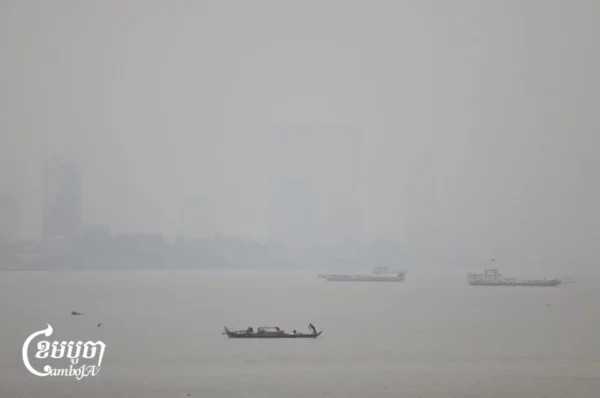
Last year, Phnom Penh was said to be the world’s “second most polluted city”, according to Swiss quality firm IQAir, with AQI of 191 and particle concentrations at 125 micrograms per cubic meter, both classified as “unhealthy”.
Institute of Technology of Cambodia associate professor at the research and innovation center Or Chanmoly said ministerial responsibilities are limited, as forest fires that affect air quality are addressed by the Environment Ministry, although the issue extends to the Agriculture Ministry which has led to “ineffective measures”.
“As we have seen, the [government’s] instructions have not been effective in reaching farmers at the grassroots level [as the] responsibilities of each ministry appear to be limited,” he said.
“The Ministry of Environment is responsible for air quality, while the Ministry of Agriculture is in charge of forestry and rice production. However, the burning of rice straw—linked to agricultural practices—directly affects air quality,” he added. “There is a gap between the Environment Ministry and Agriculture Ministry leading to ineffective measures.”
The air quality has been deteriorating from year to year due to the burning of trash and forest fires, and emissions from the industrial sector.
Mondulkiri provincial environment deputy director Din Bounthoeun said forest fires occur every dry season, particularly along roadsides, and are mostly caused by human activities such as cigarette butts carelessly discarded and open burning, including in protected areas.
“We have yet to assess the damage because the fires occurred in isolated locations,” he said. “The fires have damaged young trees and wildlife, affected the greenhouse system, and worsened air pollution caused by the burning of forests and trash,” Bunthoeun said.
His department is working closely with relevant authorities, especially the provincial police, to prepare fire trucks and respond quickly to forest fires, he added. Authorities have also strictly instructed the public and private enterprises to stop open burning of trash.
Environment Ministry spokesperson Kvay Athiya could not be reached for comment.