Listen to the audio version of this article (generated by AI).
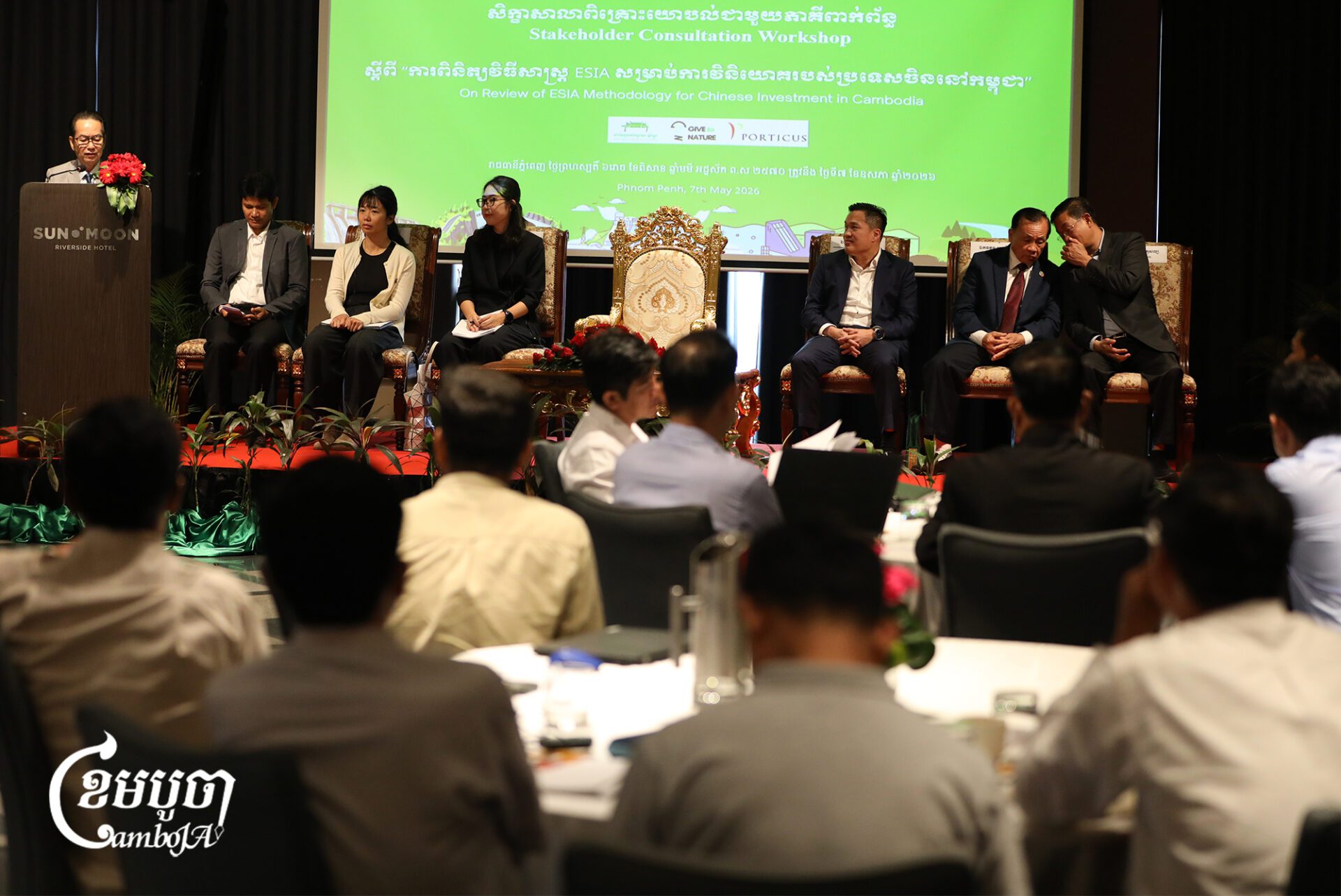
Cambodian civil society groups on Thursday called for stronger environmental and social impact assessments for major Chinese-backed projects during a workshop that brought together government officials, Chinese Embassy representatives and affected communities.
The workshop in Phnom Penh, organized by policy and advocacy group NGO Forum, reviewed studies tied to projects including the Dara Sakor Special Economic Zone, Funan Techo Canal and Lower Sesan 2 hydropower dam, which have faced concerns over their environmental and social impacts.
The discussions were part of a sustainable development initiative aimed at amplifying community concerns and pushing for stronger regulatory safeguards around Chinese investment projects.
Chinese investors, many of them state-owned enterprises, account for the bulk of foreign investment in Cambodia. Chinese-backed ventures made up more than half of 630 investment projects approved in 2025, worth about $10 billion, according to the Council for the Development of Cambodia.
Major infrastructure projects from Chinese firms, such as the Lower Sesan 2 hydropower dam and another slated hydropower project, have sparked concerns over environmental impacts and displacement of communities.
Soeung Saroeun, executive director of NGO Forum, said the discussion was important as Cambodia continued to benefit from foreign direct investment, more than 70% of which comes from China. He cited a 2024 report commissioned by the group that found nearly 80% of Cambodians surveyed were concerned about whether Chinese companies complied with local regulations.
“This reveals the truth that we need to be responsible for project investment,” he said.
He added that the consultation, which included research conducted by the group since April, served as a platform for stakeholders, including the private sector and the Chinese Embassy, to exchange recommendations on improving project implementation and strengthening compliance with regulations.
Saroeun said NGO Forum planned to conduct further impact assessments in the coming months on projects including the $1.2 billion Chinese-backed Funan Techo Canal, whose development has slowed since groundbreaking began in 2024.
The 180 km (112 miles) canal, which would link the Mekong River to the Gulf of Thailand and reduce Cambodia’s shipping reliance on Vietnam, has continued to raise concerns among communities along its route, many of whom say they have limited access to information about the project, its effects and compensation plans.
The Ministry of Environment emphasized that environmental and social impact assessments, or ESIAs, are a priority.
“In the context of rapid development, all development projects must undergo strict ESIA evaluations,” said Tea Choup, secretary of state at the Ministry of Environment, at the event.
He said the ministry encouraged strict implementation of ESIA procedures to identify both positive and negative impacts.
“If the negative impacts outweigh the positive, the project must not be approved,” he said. “But if the positive impacts are greater, the project may proceed while measures are taken to address the negative impacts.”
He added that public participation in the process was important.
Rights and environmental groups have previously criticized the lack of ESIAs for various projects, as well as limited public disclosure and consultation with affected communities.
A representative from the Chinese Embassy said Beijing encouraged Chinese investment projects in Cambodia to comply with local environmental and social impact assessment laws and regulations.
Chen Qiqi, a secretary at the Chinese Embassy, said Chinese projects also contributed to local livelihoods through job creation and community support, adding that the embassy would continue engaging with NGOs, civil society groups and Cambodian authorities on sustainable development issues.
Chinese-backed dam and infrastructure projects elsewhere in Southeast Asia, particularly in the Mekong region, have also faced criticism over environmental damage, displacement and limited public consultation.