Listen to the audio version of this article (generated by AI).
Construction of the nearly $1.2 billion Funan Techo Canal, expected to ramp up by late 2025, remains stalled more than a month into the new year, CamboJA News observed Monday.
The government says the delay comes as the construction firms, a Cambodia–China partnered venture with local companies holding a 51% stake, move to settle compensation with residents along the canal route, arguing that unresolved land disputes could disrupt work once building begins.
The stated reason for the holdup runs counter to long-standing patterns of land grabs in Cambodia, where rural communities often say they are undercompensated for development and commercial projects.
The proposed 180 km canal (about 112 miles) would link the Mekong River to the Gulf of Thailand and reduce Cambodia’s shipping reliance on Vietnam. The project officially broke ground in August 2024 and has drawn scrutiny over potential environmental impacts and limited information on compensation for displaced residents.
Concerns persist, according to several affected residents who spoke with CamboJA News reporters, who also observed little to no construction activity at the broken-ground site between May 2025 and early February. Political analysts say unresolved border tensions with Thailand and financial constraints may also be contributing to the delay. The government maintains construction will begin only after a large number of compensation issues are resolved.
“I think they will dig, but I don’t know when – maybe after the war [border tensions] end,” said Dim Mech, a Kandal province resident who has lived along the proposed canal route for more than two decades. “At first it was hard, not knowing where we would go or whether we’d have money to buy land, but now we don’t even think about it. This is how they make us feel.”
Mech said that in November, local authorities asked villagers to collect their land titles from Ministry of Land Management surveyors but gave no explanation or indication that it was linked to the canal project. He added that officials and workers have regularly dug test holes near his home to examine the soil.

After more than a year of waiting for construction and compensation, Mech said his family now hopes the project will not move forward. “It’s been too long. If it isn’t constructed, we are happy,” he said, adding that residents want proper compensation if the project proceeds. “If they pay less, there will be no results, only crying.”
Phan Rim, spokesperson for the Ministry of Public Works and Transport, said excavation will begin once the Ministry of Economy settles compensation issues, adding that the ministry is “handling impacts on affected people.” He did not comment on whether border tensions may be contributing to the delay.
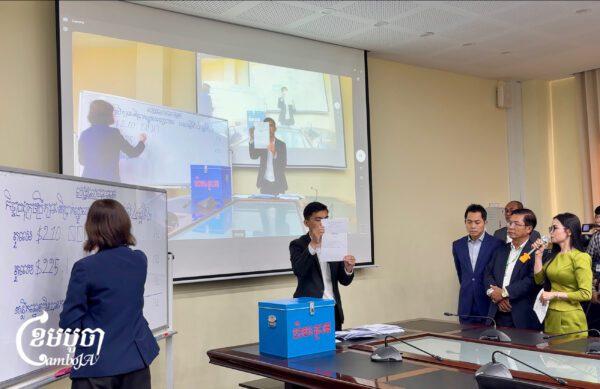
Meas Soksensan, spokesperson for the Ministry of Economy, did not respond to requests for comment. At a public forum on macroeconomic management and the 2026 National Budget Law on Monday, he said efforts to address the canal’s impacts are ongoing and the project remains on track for completion by 2028.
He told the forum that some preliminary digging could start in certain areas, but the construction company wants compensation issues with residents resolved first to avoid pauses once work begins, without specifying which company. “So we need to resolve it a little longer to make it run smoothly,” Meas said.
For Phnom Penh-based independent political analyst Ly Sreysrors, border tensions remain a factor in the delay.
“When there is fighting along the Cambodian-Thai border, it can affect government planning, since authorities focus on the conflict rather than digging the canal,” she said, referring to recent hostilities with Thailand before a ceasefire was reached in December. She added that financial challenges may also be slowing progress.
Few details on the project’s financing have been released. Only a $26.8 million loan from the Cambodian government is committed in this year’s national budget.

While Chinese investors hold a 49% share, Cambodian investors Phnom Penh Autonomous Port (PPAP) and Sihanoukville Autonomous Port (PAS), both publicly listed, have reportedly provided little information to shareholders about their involvement, prompting some investors to question the canal’s return potential under a build-operate-transfer model.
Civil society groups said the lack of financial transparency and slow progress is leaving residents uncertain and vulnerable.
Oum Somaly, program manager at Solidarity Actions for Community Harmonization and Sustainability at the NGO Forum, said the government should provide transparent and timely communication with affected communities.
“The government should share compensation information or hold public discussions on a clear assessment of the affected land, assets and livelihoods,” she said
She warned that prolonged delays could disrupt livelihoods, reduce income sources, heighten tensions and erode community trust in authorities.