Listen to the audio version of this article (generated by AI).
For Ouen Sreyvin, the Mekong River that flowed past her childhood home now brings more fear than comfort, she said.
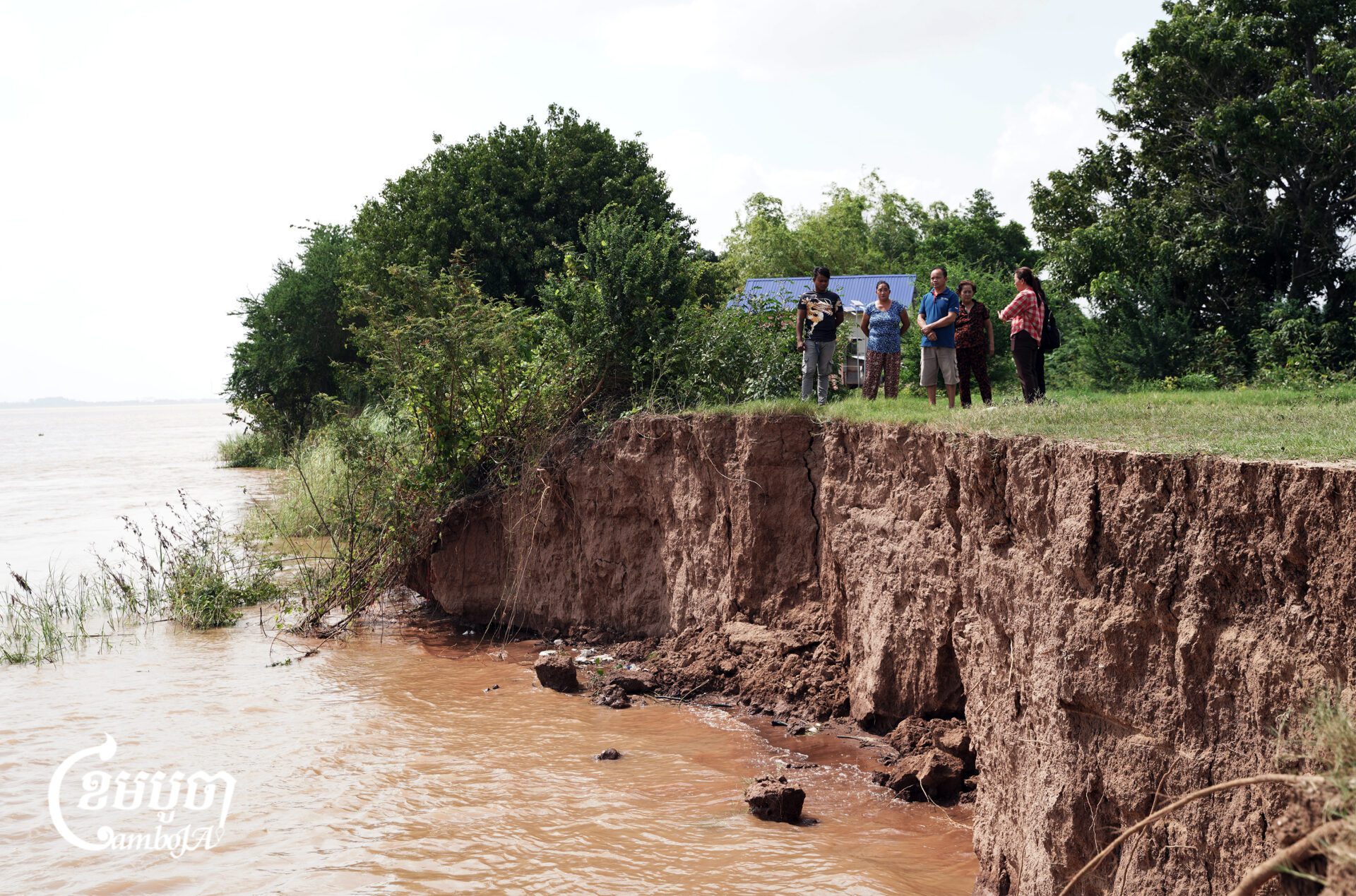
Rampant sand dredging over the past few years has eaten into the riverbank near Thmey village, a small island community in the Mekong in Cambodia’s Prey Veng province, Sreyvin and other residents told CamboJA News during a visit in July. They said they have filed repeated complaints with local authorities.
“But no authority ever paid attention,” said Sreyvin, 29. “That is why the residents decided to protest by themselves.”
In July, the frustration spilled into a viral video. Several Thmey villagers were filmed boarding boats they said were illegally dredging sand nearby, confronting the crews and hurling rocks.
But even after the incident led to the creation of a local committee to monitor sand mining in the area, villagers said years of unfulfilled promises from officials leave them doubtful that intervention will help.

Years of Unkept Promises
Sreyvin said the riverbanks near Thmey village began collapsing dramatically in 2020, after more dredging barges began arriving. The river that used to flow 30 meters behind her house is now just 10 meters away, she said.
The government has previously said dredging in the area is fully licensed and operations have stayed within project zones.
Thmey village deputy chief Chea Heang said the community has appealed to the government multiple times over the last two decades, including petitioning members of parliament. But local authorities have repeatedly broken those promises, Heang said, failing to stop companies from dredging outside designated zones or to install the boundary buoys meant to mark the limits of licensed operations for villagers and dredging crews alike.
After several hundred members from the community staged a protest in 2024, the government established the Sand Resource Management Committee, a national regulatory body to monitor the operations of the sand mining industry and take legal action against illegal dredging.
But Thmey Village Chief Rin Sreymach said oversight lapses remain. She claimed that Global Green Energy Development Co. Ltd., a firm linked to the U.S.-sanctioned tycoon Try Pheap that has previously faced scrutiny for sand mining operations attributed to sandbank collapse and the destruction of homes, was spotted dredging beyond its permitted area between 2023 and 2024.
The company did not immediately respond to a request for comment.

Concerns over sand dredging elsewhere also resurfaced this month after authorities in Koh Kong province said they had approved a sand mining operation exporting to Singapore, despite a national export ban imposed in 2017 after large-scale dredging was found to be damaging riverine and coastal ecosystems.
The recent confrontation between dredgers and residents was triggered after repeated boundary violations by Chaktomuk Resources Supply Import Export Co Ltd., Sreymach said.
The company, along with Global Green Energy Development and Sokha Cambodia Co. Ltd., reportedly received a license in 2024 from the Ministry of Mines and Energy to extract 1.39 billion tons of sand from the Mekong and Bassac Rivers, most of which is intended for sale to Vietnam for highway projects.
A Chaktomuk Resources staff member hung up on a reporter seeking comment on the allegations.
Ung Dipola, a spokesperson for the Ministry of Mines and Energy, did not immediately respond to a request for comment or to a request to be put in contact with a representative of the inter-ministerial Sand Resource Management Committee.
Dipola had earlier defended Chaktomuk Resources at a July press conference, saying that it holds a valid license and was operating within designated boundaries.
He went on to say that riverbank collapses can be due to a “variety of natural and man-made factors.”
Yet researchers who study river erosion point to sand extraction as the core reason.

Why the Banks Are Collapsing
Continuous sand extraction can trigger bank collapse by eroding the foundation of a riverbank known as the toe, said Christopher Hackney, senior lecturer in physical geography at Newcastle University.
“Regardless of whether material is being extracted close to the toe of the river bank, or a bit further away, when sand is removed from river beds, the levels of those river banks deepens [sic],” he explained. “Once river banks over steepen they become unstable and can fail.”
Hackney also noted that sediment plumes from dredgers can affect plants and fish in the Mekong and its tributaries by hindering light penetration and reducing oxygen levels.
A 2020 study by Hackney and other researchers found that sand mining operations in the lower Mekong can destabilize river banks by dredging just two meters into the river bed. They documented dredging pits up to eight meters deep.
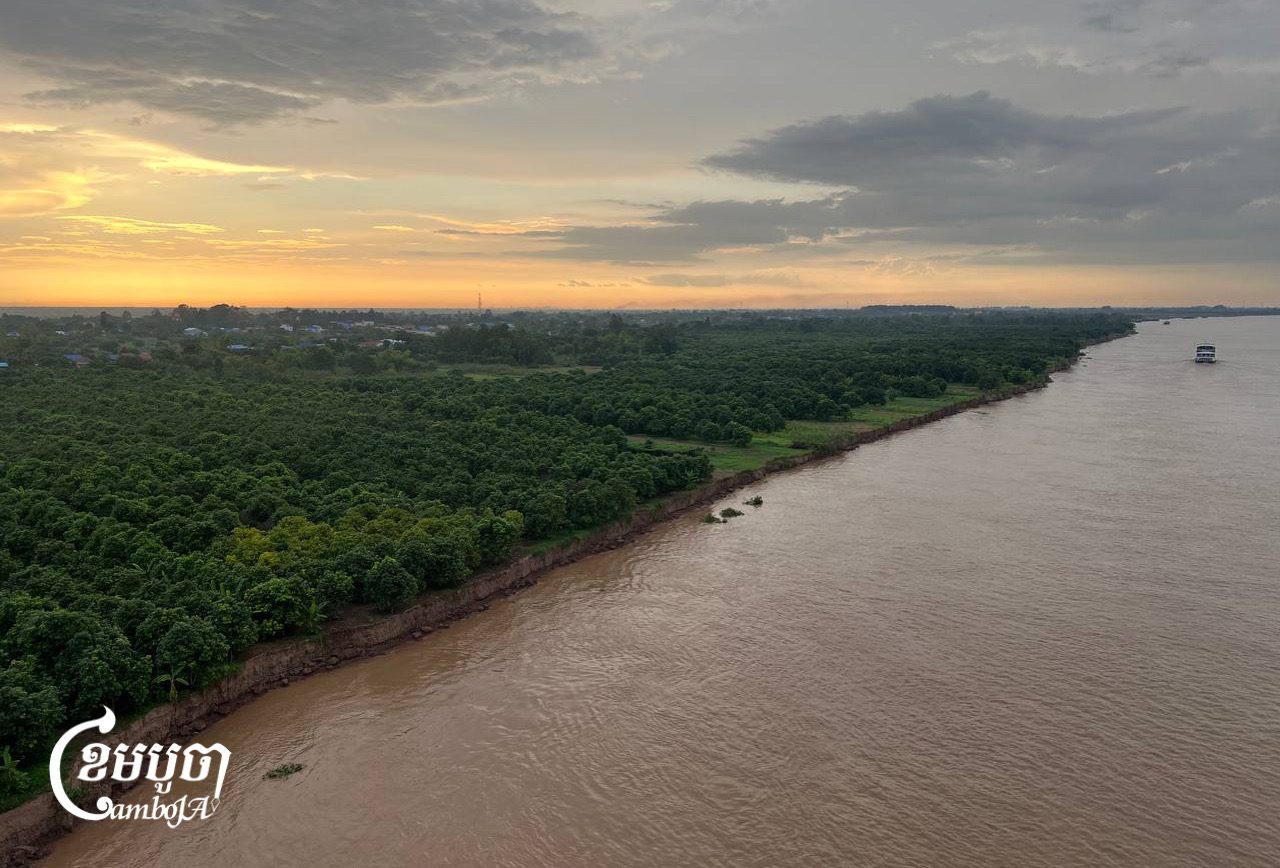
Yet these impacts are not confined to the island of Thmey village. Several residents just eight kilometers away in Preak Ksay Kha commune showed CamboJA News six homes that have developed deep, structural cracks along their walls and foundations. They attributed the destruction to mining operations and said they have received no government support. A few families said they are spending thousands of dollars on truckloads of rocks to shore up the eroding banks.
In Ampil Tuek village, also along the Mekong in Kandal province, one resident, who spoke on condition of anonymity, described how his relative’s mango farm, their primary source of income, is being eaten away at a rate of one or two trees a day. CamboJA News observed mango trees and soil at the plantation slipping directly into the river.
A Cautious Response
The collapsing banks and homes, and the outcry from riverside communities on the lower Mekong, have prompted some response from authorities.
Following the clash with the Chaktomuk barge staff, Prey Veng Governor Soun Somalin invited Thmey villagers in July to meet at the district hall. But villagers refused to attend and demanded that officials visit the island to inspect the destruction themselves.
“The reason we wanted him to come in person was that a ministry official claimed there was no erosion here at all,” said resident Chhun Thoeun. “That is why we insisted that officials come down to see the real situation on the ground.”
Thoeun said Somalin later visited the island on July 8 with a group of technical experts and local authorities to inspect the shoreline and held an open meeting with residents.
“[The experts] claimed the erosion was 50% due to natural factors and 50% due to sand mining,” deputy village chief Heang said. “But as someone born here, I know nature is not 50% of the cause.”
After the meeting, local authorities established a joint monitoring committee to observe and report dredging activity that encroaches too close to shore. The committee is made up of village representatives, local officials, police, and sand mining company representatives.
A spokesperson for Somalin, On Pheareak, did not immediately respond to a request for comment.
Other villagers expressed skepticism that the new monitoring committee will lead to improvements.

Sam Samet, 65, has lived in Thmey village all her life. She wants sand dredging banned entirely in the area and said she doubted companies would stay within the boundary going forward.
“When they dredge, the sand barges just keep creeping closer and closer [to the shore]. And when night falls, they will come right up near the farmland behind our house again,” she said.
Dredgers are only permitted to operate between 6 a.m. and 6 p.m., according to a Ministry of Mines and Energy regulation.
Looking back on the clash that drew national attention, many villagers remain convinced that taking matters into their own hands was their only option.
“If every household hadn’t stood firm together, we wouldn’t have reached this point,” Thoeun said. “If we didn’t push back and demand a solution, we would have faced total land loss with nowhere left to live.”