Listen to the audio version of this article (generated by AI).
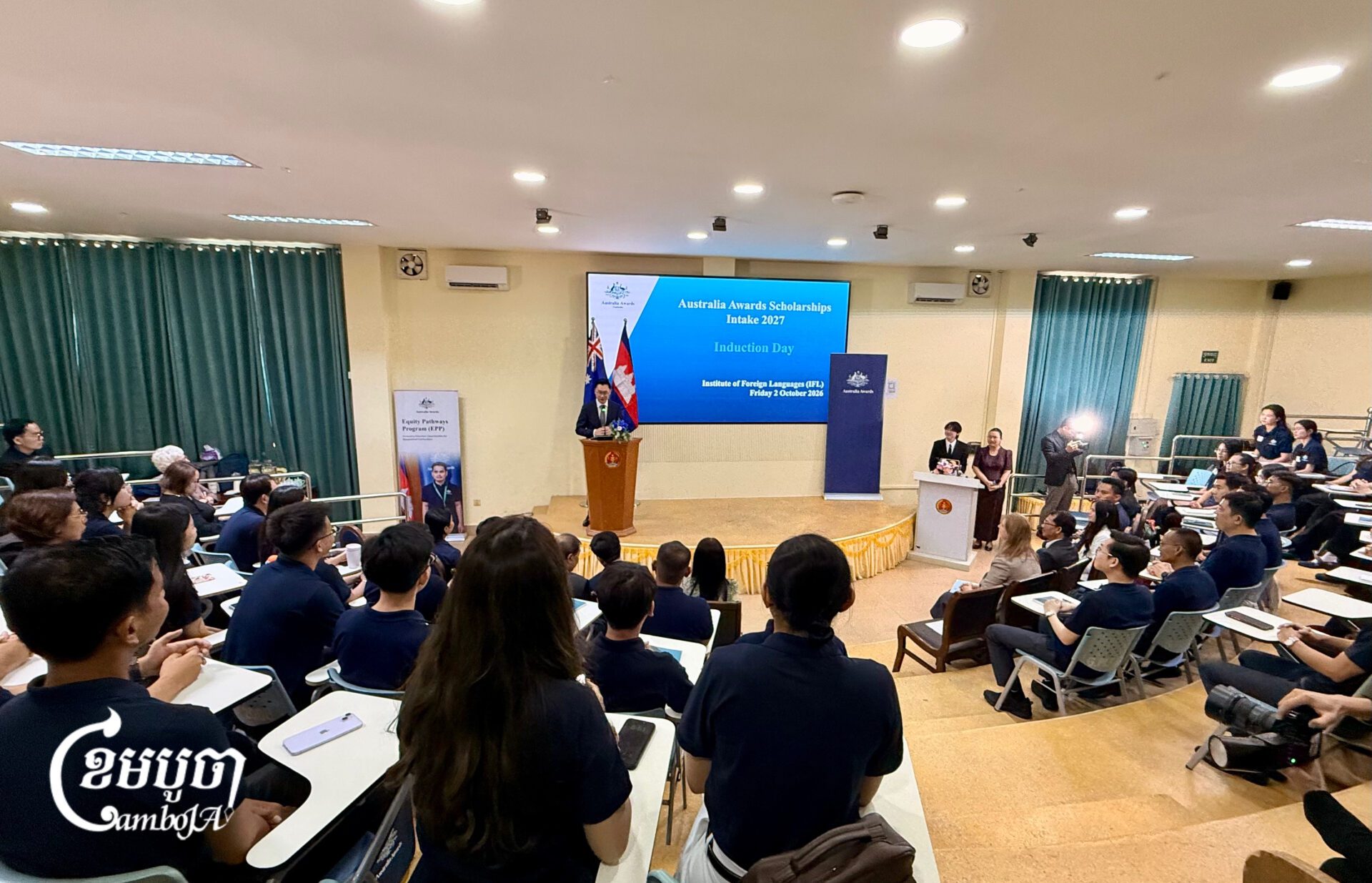
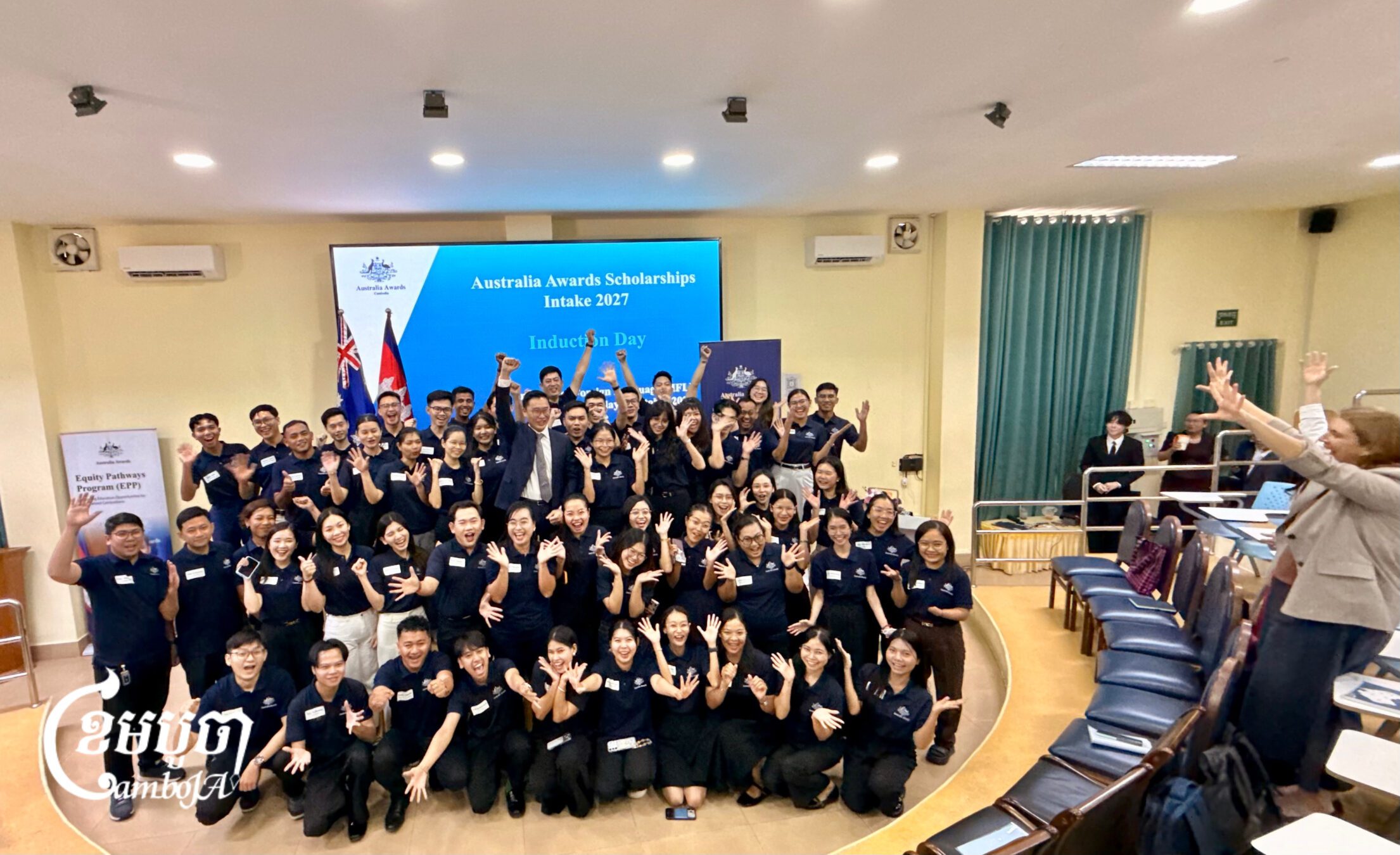
Fifty-five Cambodians received provisional Australia Awards Scholarships for Intake 2027 at the Royal University of Phnom Penh (RUPP) this week, kicking off with an Induction Day, with civil society advocating similar opportunities to reach disadvantaged young people.
According to the Australian embassy in Cambodia, the induction at RUPP would prepare them to undertake their studies in Australia. Five awardees received scholarships through the Mekong Australia Partnership program.
The scholars would join over “1,100 brilliant Cambodian students who have been awarded scholarships to study in Australia under the Australia Awards and its predecessor programs”, the embassy said.
Derek Yip, Australian Ambassador to Cambodia, said that the Australia Awards Scholarships are open to applicants from all sectors in Cambodia, including public sector agencies, academia and think tanks, civil society organisations, media and private sector.
He said that the Equity Pathways Program (EPP) is a support scheme designed to promote equal participation and improve social inclusion in scholarship by assisting groups in Cambodian society that have faced social, educational and structural barriers limiting their access to opportunities, including scholarships.
EPP participants receive English language training, interview preparation, professional development and mentoring to compete for an Australia Awards Scholarship, which many go on to receive. Scholarship recipients can study any field except general business management courses.
“We regularly conduct outreach initiatives targeting women, people with disabilities and rural populations. This includes our ‘Dare to Dream’ provincial roadshow, which has visited most provinces in Cambodia,” he said.
Monitoring Evaluation and Learning (MEL) is an essential part of the Australia Awards Scholarships program which provides data on progress towards outcomes – including inclusion.
“The Equity Pathways Program has helped talented Cambodians from disadvantaged or diverse backgrounds prepare for and meet the eligibility requirements for an Australia Awards Scholarship,” Yip said.
One of the recipients, Um Keorithear, who will pursue a Master’s degree in Disability Practice and Leadership at the University of South Australia, works for the Ministry of Social Affairs, Veterans and Youth Rehabilitation.
“When I was first shortlisted for the interview, it felt like a dream,” she said. “I thought the scholarship was extremely competitive. Then I kept passing each stage, from the application and interview to the final stage. I never imagined that I would make it this far.”
Keorithear said one of her initial challenges was a lack of confidence, as some of her friends viewed the scholarship as “too difficult to obtain”.
“They said scholarship is really challenging and I won’t be able to do it. When they said that, I also didn’t have enough confidence in myself to believe that I could do it,” she told CamboJA News.
She said an English-language program offered through the scholarship helped to improve her English and confidence to compete with other applicants.
She chose to study disability practice and leadership because disability remains a major issue in Cambodia and is part of the government’s national development strategy.
“I believe that when I return, I will be able to contribute to the development of the disability sector, particularly via the Ministry of Social Affairs,” Keorithear said.
English proficiency was one of the biggest challenges, she recalled and encouraged prospective candidates to practice consistently. She also urged them to understand their own goals before applying.
Another recipient, Than Yuthyea, said the program has helped to develop Cambodia’s human resources since its establishment in 1994. Many Australia Awards alumni now hold leadership positions in both government and private institutions, and continue to share their experience and knowledge gained in Australia.
“Looking at the alumni who graduated from Australia, we see that many of them have gone on to lead or work in government and private institutions,” he said. “My goal is also to do what they did to contribute and help our country move forward and develop faster,” he said.
Yuthyea applied to do a Masters in Data Science, which also involves aspects of artificial intelligence. He chose this field because his current work involves monitoring and evaluating the implementation of development strategies.
“We have a lot of data, including administrative and survey data collected by the National Institute of Statistics. However, one limitation or gap I observed is that the use of this data to produce evidence or inputs for decision-makers remains limited,” he said.
Monitoring implementation is important, he said, because it needs to be tracked to know how it is being implemented. Without that, it is difficult to know how effective the policy is.
“So, I want to find a way to consolidate different types of data, including textual data, such as reports and survey data, and turn them into evidence that can help leaders decide what should be done next, where we should focus our efforts or allocate additional resources to make policies more effective,” he said.
Nop Vy, executive director of the Cambodian Journalists Alliance Association (CamboJA), said there are still significant gaps in access to educational opportunities, particularly for young people from remote rural areas and low-income families.
“There are also young people from poor families or families facing significant burdens, including the children of human rights activists, Indigenous families in remote areas, farmers, workers and environmental activists. They often have limited access to education and opportunities to participate in social work.”
He said many of these families have a long history of contributing to their communities, but their children often remain excluded from opportunities such as overseas scholarships.
“Opportunities to study on scholarships in Australia and other countries, are still very far [for some groups],” Vy said. “Scholarship programs, particularly those offered by governments of democratic countries, should pay special attention to young people from families of human rights defenders, journalists and forest or environmental activists.”
He called for more attention to young people from families with a history of community service, including those involved in environmental protection, human rights, freedom, democracy and independent journalism.
“We should pay special attention to young people, particularly those from families who have a strong commitment to their country, protecting the environment and promoting human rights, freedom, democracy and independent journalism,” Nop said. “We should encourage them so they can become the next generation to carry on the work of their parents and relatives.”
Eng Chandy, president of Gender and Development for Cambodia (GADC), told CamboJA News that she has not received information about Australia Awards having specific quotas for people with disabilities, Indigenous people or women.
“From what I’ve observed, Australia Awards recipients at Master’s and PhD levels have become more diverse. The number of women has increased, and people with disabilities also appear to have more opportunities than before,” she said.
But, she opined, Australia Awards could look at whether young activists, or children of activists, have access to information about the scholarship and opportunities to apply.
While scholarships have various requirements, she thinks providing support from the beginning including English-language training, preparation and information would be good to encourage activists, such as environmental or human rights activists, to apply for scholarships.
“I think the main challenge for the groups we are talking about is a lack of comprehensive information about scholarships and the opportunities to apply,” Chandy said, adding that equality should not be measured only by whether everyone has the same opportunity to apply.
“When we talk about equality, we should not look only at equal opportunity, meaning, everyone has the same right. We also need to look at equal access to opportunities and the final outcomes of those opportunities, including scholarships,” she said.
“It helps to determine whether gender equality is truly being achieved in the selection process and outcomes of the Australia Awards.”