Banteay Meanchey provincial administration on August 25 has objected to the Sa Kaeo provincial governor’s promise to give land titles to Thai citizens in Nong Chan village, Khok Sung district, Sa Kaeo province in Thailand, as it violated the Cambodia-Thailand memorandum of understanding in 2000, especially the demarcation by the Joint Border Committee (JBC).
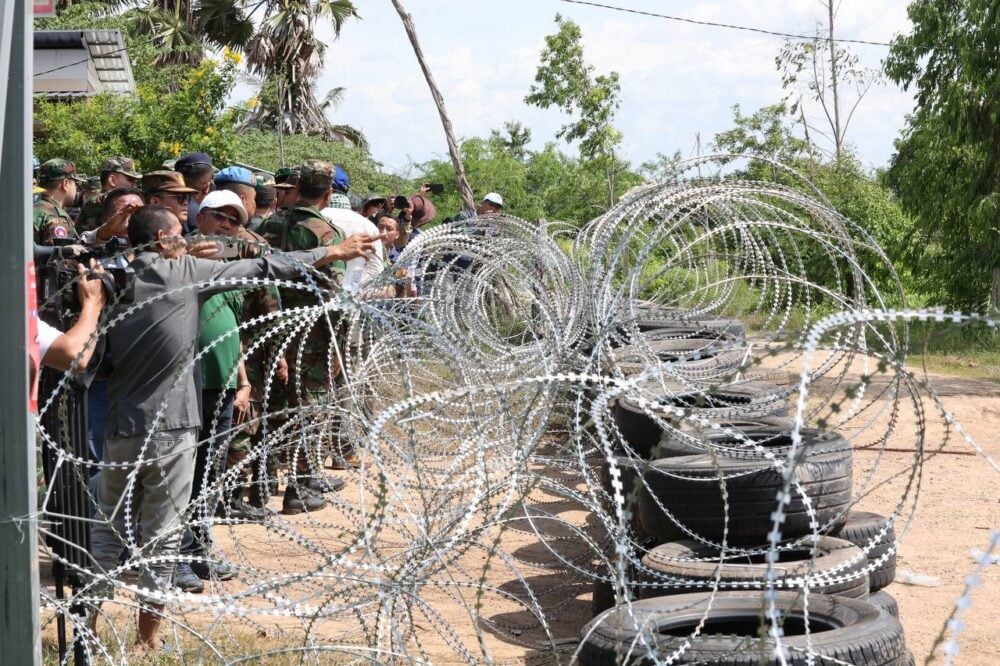
On the same day, a social media user went live on Facebook to show viewers that Thai soldiers were laying barbed wire near people’s farmlands in Banteay Meanchey. In the video, a Thai soldier is seen holding a gun while villagers plead with the Thai military to stop, saying that their farmlands are within Cambodian territory while reminding them to respect the ceasefire.
According to the National Defense Ministry, Thai military forces tried to build a barbed wire fence at 2.20 p.m in Chouk Chey village, O’Beichoan commune in the province, which is opposite Nong Chan village in Khok Sung district of Sa Kaeo province in Thailand. However, the people and authorities strongly opposed the action, causing the Thai forces to take out the barbed wire.
In recent weeks, Thai soldiers have fenced off homes in Banteay Meanchey, displacing 12 Cambodian families who now live in temporary camps, which follows the displacement of tens of thousands of people during the five-day border clash, which started on July 24.
One of the residents whose house was fenced off by Thai troops is Hul Malis, 52. She told CamboJA News that Thai soldiers pulled her away while they built the fence with barbed wire and tires around her house—located about 500 meters from the Thai border in Prey Chan village, O’Beichoan commune, on August 13.
Having lived in her hometown for 30 years with more than 200 other families, she was sad that she and her four children were forced to leave and live in a camp not far from the house.
However, Malis does not dare to return home because the Thai army installed security cameras, and she is also afraid that the Thais might have planted mines. She hopes that the government will speed up the resolution, as she ”only wants her land and house back”, as living in the camp is very difficult.
“I don’t dare to go home. When the resolution is done, I will ask the authorities to check the area around my house and also for mines because we do not trust them [Thai authorities]. We fear that the Thai soldiers would have planted mines,” said Malis.
In the event of a lengthy settlement process, she expects the authorities to provide land and houses to displaced people near their original locations. “I requested the authorities for land nearby if possible, and they told me to be patient,” Malis said.
Ly Sovannrith, deputy governor and spokesperson of Banteay Meanchey province, reiterated that 12 Cambodian families’ homes were surrounded by barbed wire and taken by the Thai army in two villages. They consist of four houses in Prey Chan village and four houses in Chouk Chey village. So far, 12 families are staying in camps, while others have returned home.
On August 14, ASEAN defense attachés visited the Cambodia–Thailand border in Banteay Meanchey, where Thai armed forces illegally erected a fence using barbed wire and tires to block a road and encircle people’s houses in Prey Chan village.
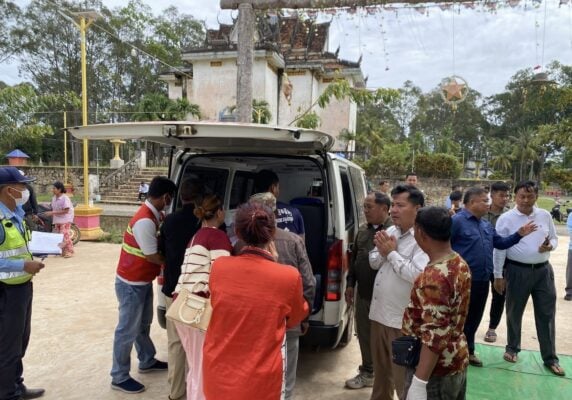
Another resident in Preah Vihear province, Mao Him, said he has been living in a refugee camp in Kulen district for a month now after leaving his home in Choam Ksan district. He and his family have been displaced since the Thai military attacks began on July 24, 2024. They face difficulties living in the camp and being far from their home and farm.
Him, 70, has not returned to his home because he does not trust Thailand, even though the two countries have agreed to a ceasefire. He is afraid that the Thai army will attack Cambodia again because they have launched drones. He received news from villagers near the border that “smoke” had been released by Thailand.
Having suffered injuries during the Thai invasion, he said he would “never forget the brutal acts of Thailand against Cambodia.”
“I don’t dare to go back. Drones are launched two to three times every night. We fear being exposed to poison [chemical gas]. Some people went back home, but some went back to the camps because they were afraid of the poison, so they went to the rice fields for two to three days, and then came back.” Him said he felt sad that Thailand had invaded Cambodian territory. They [Thai soldiers] broke down our houses [and fled] our villages.”
Meanwhile, the extraordinary meeting of the Cambodian-Thailand Military Region Border Committee (RBC) between the 5th Military Region of Cambodia and Border Protection Commands of Chanthaburi and Trat provinces of Thailand saw both sides vowing to strengthen communication, prevent clashes, and rebuild trust as thousands of displaced Cambodians remain in camps.
According to the National Defense Ministry, on August 25, the Cambodian and Thai sides agreed to maintain regular communication between military regions and areas as well as units along the Cambodian-Thai border and strive to resolve all issues peacefully and avoid clashes.
The parties also stressed the importance of further strengthening relations at all levels to build trust and promote good neighborliness. Through this communication, they emphasized the positive developments and progress achieved so far, aiming to promote cooperation in all fields and return to normality.
Preah Vihear provincial deputy governor, Kim Chanpanha, told CamboJA News that as of now, 40 percent of the displaced people have gone home, leaving another 5,000 families who remain in the camps in the province.
He said many of those who have not returned are because their homes are along the border, which is on the frontline, and are worried about being attacked by the Thai army again.
“Overall, the situation is calm, but people are still worried, and they think that waiting for the situation to calm down will help. They do not want to go back yet,” said Chanpanha.
Cambodia’s Ministry of Foreign Affairs and International Cooperation (MFAIC) reported that Deputy Prime Minister and Foreign Minister Prak Sokhonn led a diplomatic mission to Banteay Meanchey and Oddar Meanchey provinces on 22–23 August, joined by more than 60 diplomats, UN agencies, and NGOs. The delegation inspected areas affected by Thai military barriers and bomb explosions and expressed support for displaced Cambodians’ safe return.
Diplomatic representatives from Japan, the U.S., and the EU voiced support for maintaining the ceasefire and called for peaceful dialogue. U.S. President Donald Trump and Secretary of State Marco Rubio also urged both governments to uphold their commitments.
Separately, Cambodia hosted the Secretariat Meeting of the Cambodia–Thailand Regional Border Committee in Pailin on 24 August, preparing for an extraordinary meeting on August 25. Cambodia raised concern over 18 Cambodian soldiers still detained by Thailand since July 29, shortly after the ceasefire began. It has been 27 days since Thai soldiers captured Cambodian military personnel.