The number of Cambodian migrant workers in South Korea rises every year, Prime Minister Hun Manet said, which is due to the good diplomatic relations between the countries. However, workers argued that the increase is a result of low income and scarce jobs in Cambodia.
Last week, Hun Manet made an official visit to South Korea from May 15 to 18 where he met with President Yoon Suk Yeol and Prime Minister Han Duck-soo, and private companies to discuss cooperation, trade and investment. Twelve agreements were signed during the trip.
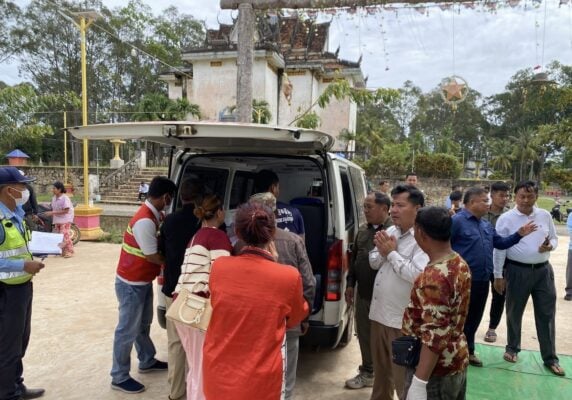
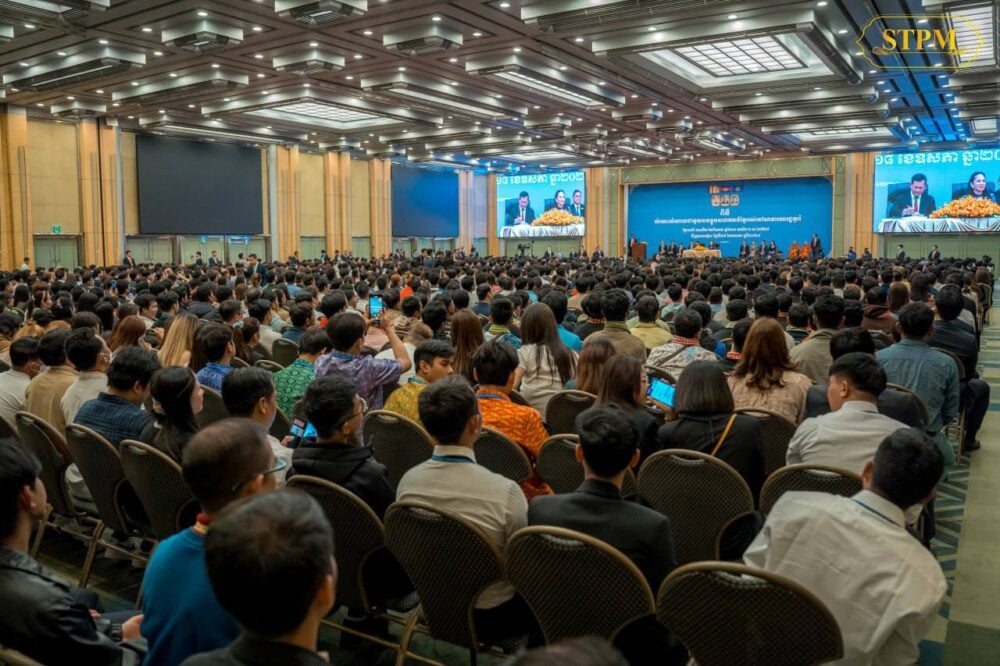
On the last day, he touched base with more than 2,000 Cambodian students and workers in the republic. In his speech, he mentioned that there are more than 45,000 Cambodian workers in Korea at present, which was an increase of 12 percent from 2023, or 92 percent in comparison to 2014.
The increase was an indication that there are more opportunities for Cambodians, he said, while pointing out three reasons supporting that growth.
“The first is because of the re-establishment of diplomatic relations between Korea and Cambodia in 1997. If Cambodia didn’t have a good diplomatic relationship, people would face issues working there.” “ The second is the effort of institutions, such as the vocational institution and Cambodian embassy, which have strengthened relationships. Thirdly, the most important aspect of the increase is the people themselves who want to work in Korea.”
Khlok Leap, spokesperson for the National Unity Democracy Movement in Korea and a migrant worker for almost eight years, told CamboJA News that if migrants can find a job with a good salary in Cambodia, they would not move to another country.
“My family is poor, so I decided to come to Korea,” he said. “What makes us want to work here is the salary, because it is different from Khmer. If garment workers in Cambodia can get $300 a month, I will also work there.”
But, even though Cambodian workers in Korea earn a high income, they also face challenges in terms of working conditions with their employers.
Leap said he had changed jobs four times. In his first job, he worked in a factory which required heavy labor and its location was in the cold zone, so he stopped and moved to another job. He continued to change jobs after that because it was hard to find factories as they did not have adequate hours for him.
During the transition, most workers have to look for jobs themselves by sending a letter to the Korean Labor Ministry and they only have three months to find a job. If they cannot find one, they will become illegal workers.
‘It’s not like we want to migrate’
Leap acknowledged that Cambodian workers in Korea contributed to the foreign country’s economy, but it was only because they were unable to find work with decent wages in Cambodia, forcing them to migrate to Korea.
“Even if Cambodians hadn’t come to Korea, they would flee to Thailand as their salaries [in Cambodia] were not adequate,” he said. “We came to Korea because of the good salary. We don’t [actually] want to come. Some workers are dying. Some died of heart attacks [due to the cold weather].
Vibol, 38, who works as a construction worker in Korea, said the biggest challenge is having to work with a bad employer, which results in workers wanting to change their employment. But it is not easy because they need the employer to sign off their resignation.
“If we work with a difficult boss, we have to change jobs. If we do not know Korean, we need to ask someone who can speak Korean well to help ask the boss to resign,” he said.
Despite the difficulties, many do not want to return to Cambodia because they have to earn an income. “The reason they continued to work here is because they do not have work [in Cambodia]. If the salary [in Cambodia] is high, they won’t come to Korea as migrant workers,” Vibol said.
He hoped that Hun Manet’s trip to Korea would attract more investors to Cambodia and help many people get jobs.
Vibol believed the visit would benefit the development of the nation after both government heads met along with the investors, however, he wanted to wait and see if Korean investment increased in Cambodia.
“When the PM visited Japan, he said there would be many companies investing in Cambodia, and the Cambodian economy would grow and people would have jobs. He then visited Korea and said the Koreans are interested in investing in Cambodia. We’re happy that many companies want to go to Cambodia, then people wouldn’t have to migrate anymore,” he said.
Many migrant workers in debt
Labor and Vocational Training Ministry spokesperson Kata Orn told CamboJA that good diplomatic relations between Korea and Cambodia and that Cambodians “rarely have any problems” working for Korean employers are some of the factors driving the increase in Cambodian migrant workers in Korea.
“Korea is Cambodia’s job market for high-salary, good working conditions and has a proper labor protection mechanism,” he said. “Workers rarely have problems because the two governments have good working mechanisms and responsibilities,” Orn said. He added that in case they face issues, the Cambodian embassy and the labor attorney will immediately intervene.
That said, migrant workers Vibol and Leap commented that the Cambodian embassy was “very slow” to help workers when they are in trouble, except when the problem becomes viral on social media.
Moeun Tola, executive director of Center for Alliance of Labor and Human Rights (CENTRAL), told CamboJA that migrants have jobs and better living standards is a “one-sided reflection”.
There are two factors that motivate people to migrate. The first being poverty, which refers to unemployment, and wages which are not comparable to market prices. The second factor is the attractiveness of salaries abroad, he said.
“If we think deeply, it is not ideal for a country to have a large population of migrants as it might indicate a lack of jobs for local people. A majority of migrant workers are in debt,” he shared.
Tola said when migrant workers work overseas, it does not help the Cambodian economy but the host country’s economy. Indeed, workers can remit their salaries as they have an income and can repay some debt. “But, those who benefit are countries with many migrant workers. If the government and parties concerned do not resolve it, it may affect the workers.”
‘Freedom of expression is normal’
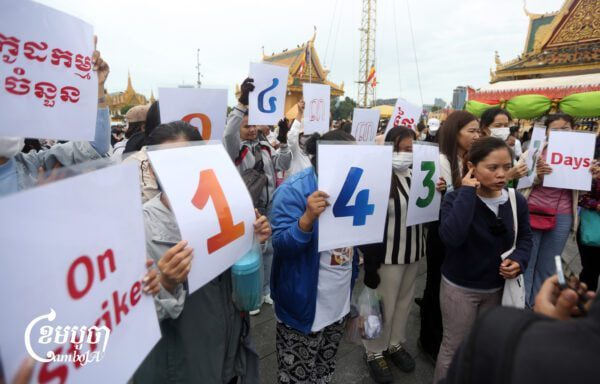
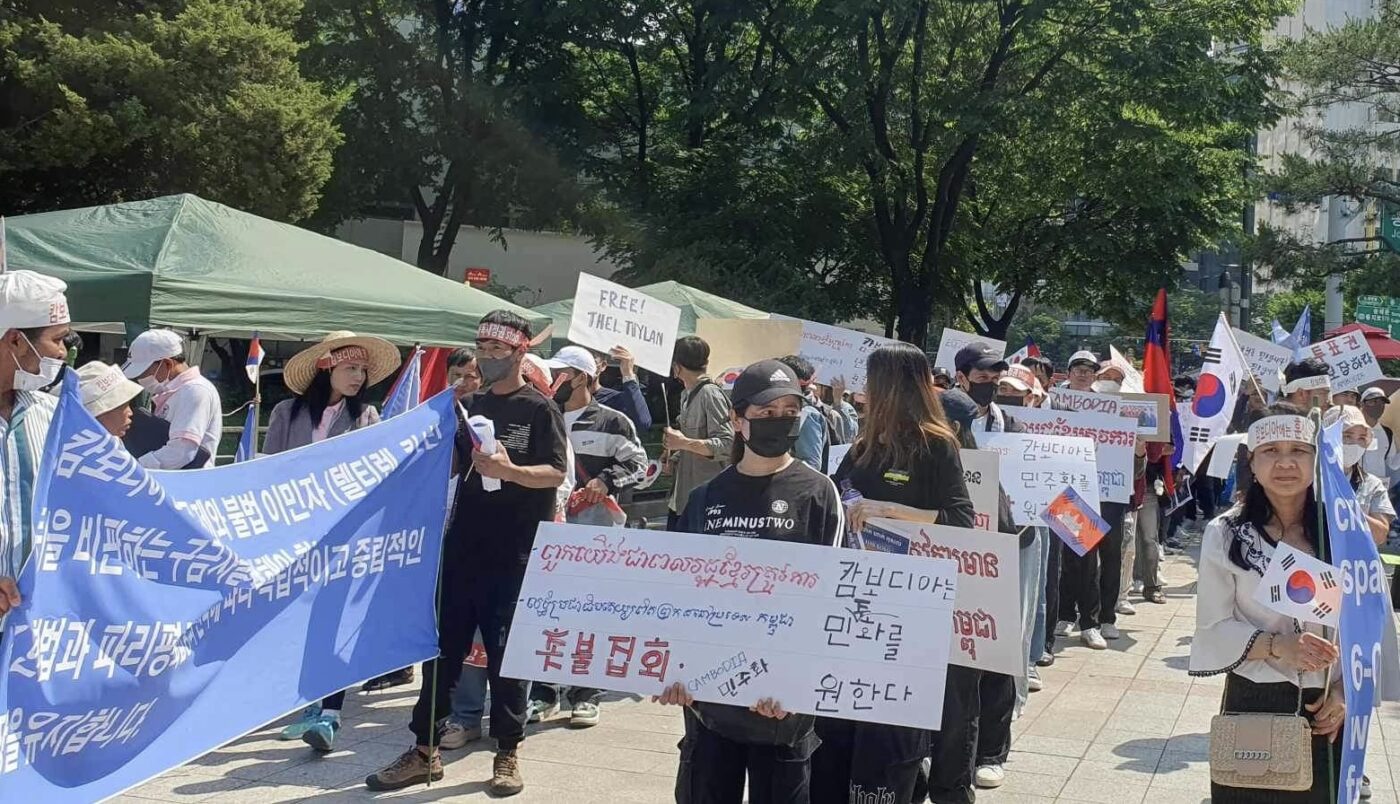
A day after Hun Manet returned from Korea, some 500 Cambodian workers gathered in Seoul to call on the Cambodian government to respect human rights, freedom of expression, press freedom and to release imprisoned politicians.
National Unity Democracy Movement spokesperson Leap, who also joined the protest, said the PM’s discussions with Korean officials and private companies are just a form of diplomacy between the countries. He said there might be something else, such as borrowing money from the Korean government.
Cambodian workers in Korea urged the Cambodian government to follow the path of democracy and allow people to exercise their rights.
However, he added, the protesters did not oppose Hun Manet’s visit to Korea, rather they wanted the government to respect human rights and solve social issues.
“We hope the Prime Minister knows this. We demand for press freedom and freedom for politicians, opposition parties and activists [to exercise their rights].”
He added that some of the workers were threatened by government officials and leaders of the teams who brought them to Korea because those who are there do not have a permanent visa. So, if they participate in the protest they could face legal action when they are back in Cambodia.
The protest ended smoothly, Leap said, adding that the Korean authorities assisted by arranging for police security and allowing the workers to exercise their right to protest.
Meanwhile, government spokesperson Pen Bona said it is the right of the workers to protest but their action did not have an impact on the Cambodian government.
“It’s a democratic society, freedom of expression is normal,” he told CamboJA News. “The migrant workers’ protest in Korea doesn’t affect the government, instead it reflected democracy in Cambodia,” he said, noting that over 2,000 migrant workers welcomed the prime minister, but “only a few joined the protest”.
“Their excuse was that they were blocked, but in fact they couldn’t find people to join the protest,” Bona mentioned.
Asked to comment on the protest, Tola of CENTRAL said the government should address the issues raised by the protesters and listen to them rather than oppress them. “We need to see that it [the issues] must be addressed to what extent.”