
Cambodia organized its first two-day Senate-National Assembly congress to review the social protection system, informal economy, and agriculture sector.
The congress, conducted upon the request of Prime Minister Hun Manet, was attended by 182 Senate and National Assembly members, including 27 political party delegates, and Supreme Consultative Council members.
About 69 members raised issues and made suggestions, as well as praised the government’s performance and policies. The congress also approved the draft on the decisions on the social protection system and informal economy, and the agriculture sector.
The first day’s session started at 8 a.m, ending only at midnight, while the session on the second day finished at 7 p.m.
Speaking at the opening on Monday morning, Hun Manet talked about the government’s six priority policies, three of which are related to the social protection system.
He said the programs include providing universal health coverage, vocational and technical training for youth from poor or at-risk families, and institutionalizing national social assistance programs for poor families and vulnerable groups.
Social health coverage has reached 7.9 million people, while free and subsidized training programs have enrolled more than 110,000 youths, including 40,000 from poor households.
Opposition senator Kong Monika of Khmer Will Party said the policies can only be implemented effectively if citizens are fully aware of the benefits they receive, and local authorities, who work closely with them, are aware of it.
He urged expanding social services to informal workers and increasing subsidies for the elderly, which are now insufficient to cover medical expenses. People have told him that those who are genuinely poor did not receive the equity cards, but many others who were not poor did instead.
“I hope the government accepts this [occurrence] and addresses the problem,” he said.
Senate President Hun Sen acknowledged that irregular practices in terms of equity card provision have happened in some places, agreeing with Monika.
With regards to the informal economy, Member of Parliament Rofy Othsman said the Khmer Muslim community has not received any information about registration or the importance of registering as an informal worker.
He urged the government to intensify outreach, especially the Muslim community, through the head of mosques so that they can continue spreading the word.
“We ask for publicity, especially in the Islamic community, through the ‘Hakim’, known as the head of the mosque, so that he can share this information in 627 mosques and 841 sarai throughout Cambodia, where more than 470,000 out of 800,000 Muslims, worship,” Rofy said.
On another matter, Kampot province Member of Parliament Pen Simon said local markets have been turned into a place for the sale of goods of neighboring countries due to weak education of vendors and lack of consumer protection systems. “Buy Kampot durian or buy durian in Kampot,” he said, drawing an analogy of the situation in the marketplace.
Cambodia needs to strengthen the sale of existing products, Simon said, claiming that some countries buy goods from Cambodia and export them. “They seem to know how to market and can earn many times more than Cambodians,” he added.
Parliamentary member for Kampong Thom province, Yos Thanavy, urged the government to provide training in business planning, business management, and technology to women in the informal economy. She suggested building street stalls for food and other items, and ensure that they are well-maintained to attract domestic and international visitors.
On the agriculture sector, senator Sok Hach from Khmer Will Party, raised the issue of low irrigation during the dry season and the need to lower electricity costs. “We have many canals, but there is not much water during the dry season. The congress should ensure the availability of water during this season.”
He also said agricultural products in Cambodia are of good quality but fall short of processing, which Hun Sen agreed, noting that factors, like the lack of warehousing and harvest collection resulted in export failures. “We must work hard to resolve the problem of processing products for exports in order to add value and increase jobs,” Hun Sen remarked.
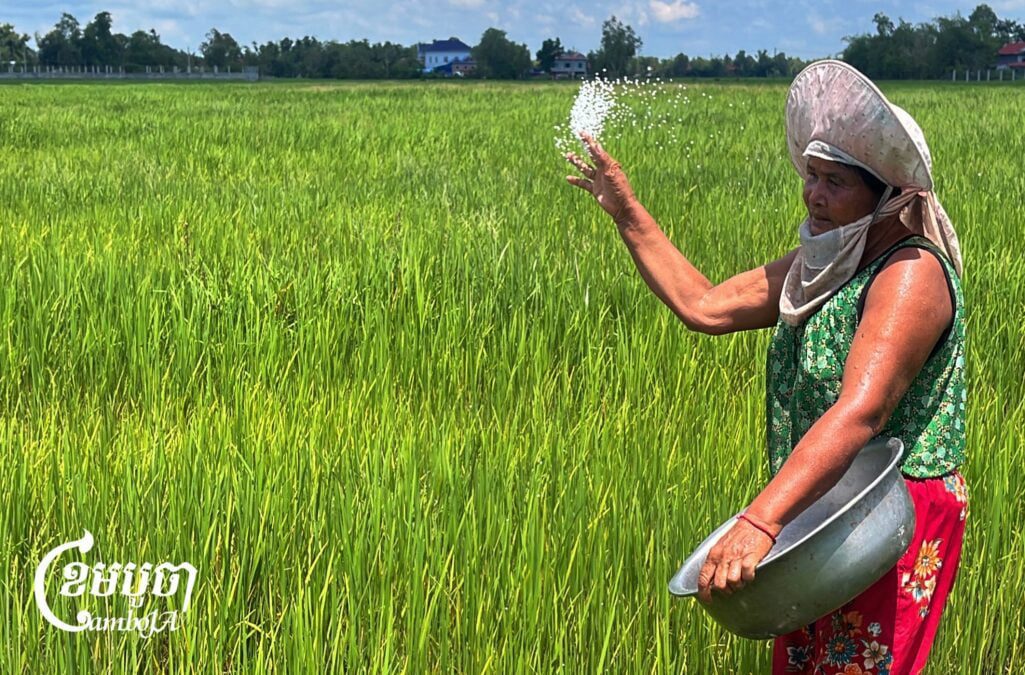
Kong Bundol, a National Assembly member from FUNCINPEC party, called on the government to lower the price of fertilizer, pesticides, and fuel, and provide insurance for small and medium agricultural enterprises.
He also asked the government to explain why marine fisheries are less productive than freshwater fisheries, and what are the state’s plans to develop this sector to increase growth.
Senator and agriculture tycoon Mong Reththy asked the government to prevent the import of poor quality fertilizer, which causes farmers to produce low yields at high costs.
“The government needs to check fertilizer imports, especially its quality, so that low quality fertilizers are not sold to our farmers who use them on crops, but experience low yields and high production costs,” he said, adding that a similar situation exists with the import of breeding animals.
Reththy also proposed that the government focus on producing fruit tree varieties that are sold by neighboring countries to Cambodia.
He said Cambodia is currently buying fruit tree saplings which are not wanted by neighboring countries.
“They don’t want us to produce a lot of fruits so that we will [continue] buying vegetables and fruits from them. Sometimes [we consume fruits with] chemicals and we end up going to their hospitals to seek treatment,” he alleged.