Displaced people, whose loan or interest repayments were suspended due to their financial condition, might have to resume payments as the forbearance period, which started on July 30, ends on October 31, causing distress among many who have not returned home or found jobs.
Voeun Sinoun, 43, from Preah Vihear to Siem Reap is anxious that the date to start paying her loan is fast approaching as she has no money. Her family owes nine million riel (approximately $2,200) to KB Prasac (formerly Prasac MFI) and six million riel to LOLC Cambodia microfinance institution, with a total monthly payment of about $200.
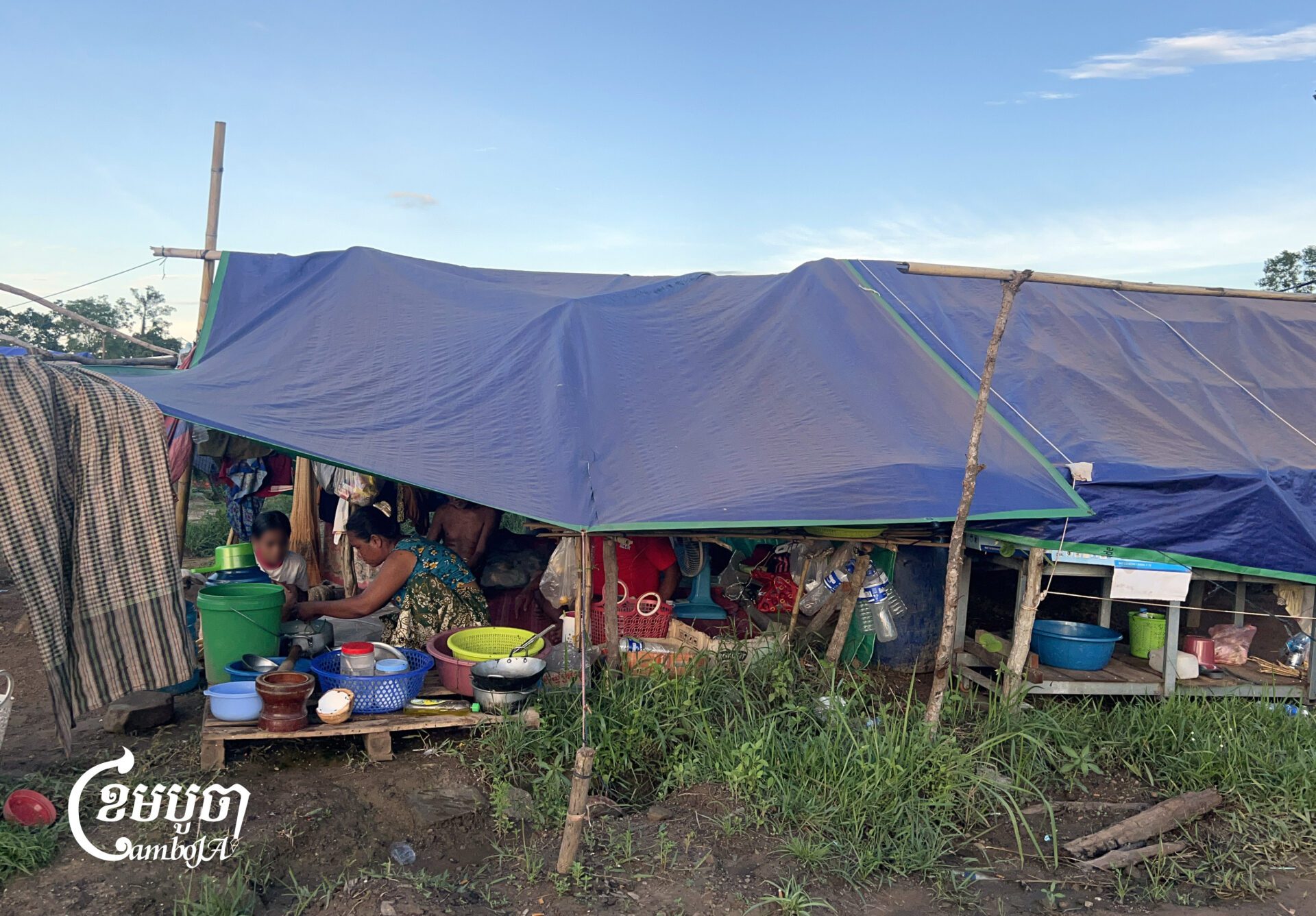
Since July 24, she and her husband and their three children have been staying in the displacement camp as their home is in the risk zone. This has resulted in Sinoun and her husband being unable to earn any income for nearly three months, though their children have continued their studies.
“I can’t afford to pay the bank loan. I don’t know what I am going to do because it’s almost time. I’m so sad that I can’t earn money. I’m so sad I can’t even sleep,”she said.
Not only has she had no income for months, a five-hectare rice farm she rented has been destroyed by insects. She said she might lose it, as she spent at least 3.5 million riel (approximately $900) on rent and to plow it.
“I might lose it this year. There are a lot of weeds and insects [in the rice field]. I’m so sad. If the rice [field] is good, I won’t be so worried,” she added.
Han Chantha, 33, a former migrant worker in Thailand, said that her family owes LOLC about $4,000. Before the border conflict, she used to send home at least $60 a month from Thailand to pay the loan. Beginning November, she said she will not be able to pay, as she has no income after returning from Thailand at the end of July.
Two days after coming from Thailand, Chantha had to flee her home in Samrong district, Oddar Meanchey province, to a safe camp in Srey Snam district, Siem Reap province. They just returned home early October.
She and her husband found work in a Chinese construction site but the employer refused to pay them, fearing that there would be another armed conflict. She and her husband decided to quit their jobs without pay, and have yet to find another job.
“Since the conflict, it has been very difficult to find a job or earn money as there are no trustworthy employers,” she said, adding that she has spent a lot on food and milk for her children, aged two and five. Because they have no income, their daily food is prahok (fermented fish). At times, her husband would catch fish but due to the low water level, there is no catch now.
“Since returning from the displacement camp, I haven’t been able to earn anything. I’m getting sick and thin as I struggle to look for work,” Chantha said.
When they worked in Thailand, the couple earned 3,000 baht each every two weeks, which is slightly more than $90. But now she occasionally earns about 150 baht (18,000 riel) as a dishwasher, about $4.50 a day.
She urged the government and relevant parties to extend the forbearance period for those affected by the border conflict until it is completely resolved. “Let’s wait for our country to be peaceful and stable again, and for displaced people to find work or have an income.”

Recall that Prime Minister Hun Manet and the National Bank of Cambodia (NBC) told financial institutions to suspend loan principal or interest payments for displaced people to ease their financial burden after losing their livelihood when they fled their homes for safety in displacement camps. NBC also urged the institutions to consider debt cancellation of up to 80 million riel (about $20,000) for families of fallen soldiers.
On July 30, the Association of Banks in Cambodia (ABC) and Cambodia Microfinance Association (CMA) heeded the call and declared a three-month suspension of interest and principal payments for affected people till October 31, 2025, and a six-month suspension for active duty military personnel directly engaged in combat till January 31, 2026.
Chea Sothy, 55, a displaced woman and wife of a soldier, said although her family was granted a six months grace period, she said staying in the camp cost a lot of money as she and her eight-year-old daughter fell sick often.
“Even though I don’t pay the bank, coming to this camp is a waste of money. My daughter and I always get sick, and I can’t walk now,” she said.
According to Sothy, many displaced people in Svay Leu district, Siem Reap province, complained about not having money to pay the bank loan.
Both ABC and CMA spokespersons Sok Chan and Kaing Tongngy, respectively, said there is no announcement on a policy for customers yet. However, they said, the existing mechanism for affected borrowers is credit restructuring, which refers to revising the original loan contract to provide relief to customers experiencing economic hardship.
Tongngy said they are assessing the impact of the displaced people to see if further relief is needed. “We’ll discuss further with the NBC and study the possibility [to provide relief] and what we should do next.”
ABC’s Chan said the association is discussing internally about customer protection, with a meeting planned for late October.
“So, the agenda for customer protection and a new regulatory framework and guidelines from regulators will be discussed at the meeting,” he added.
ACELEDA bank Plc and LOLC bank could not be reached for comments via email.
Government spokesperson Pen Bona referred questions to the Ministry of Economy and Finance and NBC. Kimti Kormoly, chief operating officer of NBC, could not be reached for comment.
Oddar Meanchey provincial deputy governor Met Measpheakdey said as of October 20, more than 300 families remain in the camp, which is equivalent to over 500 people.
Preah Vihear deputy governor Kim Chanpanha confirmed that some 1,800 families or about 6,000 people were still at the displacement camps in the province. Of that, over 1,600 families sought refuge at the 5,000 Bodhi Tree Pagoda, which is the largest displacement camp in the country.
He added that those who returned home will receive food supplies such as rice, noodles, fish and spices from the authorities. If they need more, they can request help from the local authorities.
Regarding those affected by the Cambodian-Thai border conflict, Chanpanha said first and second class IDPoor cardholders will get living allowance, but he could not state the amount as the government will announce soon. “Soon, we will provide funds for each family that was affected by the war.”
Yang Kim Eng, executive director of People’s Center for Peace and Development, said the government should instruct all lending institutions to continue to help displaced people because they are currently dependent on the government and charity. He urged relevant parties to intervene if displaced people were forced to pay for the load.
“Without any relief and still at displacement camps, how can people be expected to service bank or microfinance loans,” he said. “There is no income to rely on. So if they [bank or microfinance] ask for repayment, where will displaced people get the money from?”
According to a report by the National Defense Ministry, nearly 170,000 displaced people fled to safety camps in five provinces near the Thai border during the deadly conflict from July 24 to 28. After Cambodia and Thailand agreed to a ceasefire agreement in Malaysia on July 28 and August 7, 2025, authorities allowed the people to return home gradually.
However, the Thai military launched an attack on Cambodian army positions in the An Ses area in Preah Vihear on September 27, forcing some to run back to the camps.