While older villagers living along the border of Cambodia and Thailand can unmistakably identify the loud popping sounds of gunshots, having experienced life under Khmer Rouge, the same sounds caused fear and anxiety for thousands following the recent Cambodia-Thailand conflict.
However, support and care have been provided by many to the affected communities, including the donation of essential items.
Mental health institutions in the country are supporting people through their hardship via charity campaigns, live talks, and setting up banners with emergency contact numbers at the conflict zones.
One of them, SSEAYP International Cambodia (SIC), ran a Mental Health Support Campaign for Displaced Persons campaign to promote mental health welfare for displaced people. They acknowledged the need for continuous support even after the end of donations, including those from Samdech Techo Voluntary Youth Doctor Association (TYDA).
“We see that mental health support is not only fundamental for displaced people, but for all 17 million Cambodians, including those living abroad. The frontline soldiers worry about their family members, and vice versa,” said SSEAYP International Cambodia president Im Rachana, who led the campaign, last week.
Since the deadly clash on May 28 and the flare-up on July 24, which saw artillery attacks and air strikes in the five days of fighting, 120,000 civilians were displaced in five provinces, including over 150,000 students not being able to attend classes.
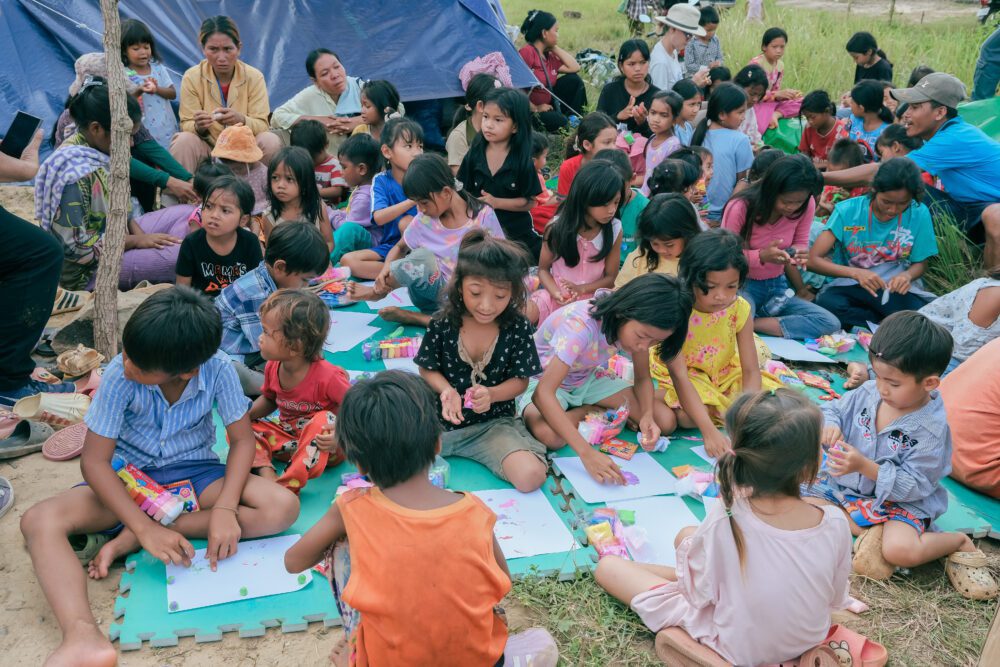
The campaign provided daily supplies for families and children. Mental health professionals and children’s education specialists offered consultations and emotional support to parents, while engaging young children in creative activities and games to relieve their fear of war and challenges due to the sudden relocation.

Yim Sotheary, a psychotherapist and founder of Sneha Center, said that psychological support is a form of humanitarian aid to prevent severe trauma, adding that Cambodians are “more or less affected by the conflict”.
“From my research and observation, I found that most displaced people experienced depression, anxiety, and stress. Even these symptoms are a response to this hardship. Such symptoms also intensify the existing psychological trauma without proper treatment in the early stage,” said Sotheary.
“Basic needs like food and essential supplies are vital, but mental health support must not be overlooked,” said Sotheary, urging the government and related institutions to increase support for citizens’ mental health wellbeing in the present situation.
Transcultural Psychosocial Organization (TPO) deputy director Taing Sopheap, said it is crucial to support displaced people’s mental health, as the living conditions in shelters are not pleasant. In addition, women and children feel tension and unsafe due to the absence of daily roles.
“For parents, we taught them how to identify the symptoms and signs, and how they can practice self-support as a way of prevention before the symptoms develop into a mental crisis,” said Sopheap.
A 66-year-old-man from Preah Vihear, who only identified himself as Eam, said he was happy to receive donations, including clean water and hygiene supplies, which lessened his burden in the shelter, but was upset that he lost his crop harvest back home.
“I am still praying for our frontline soldiers,” Eam said. “This armed clash reminds me of the pain I went through during the Khmer Rouge regime when I didn’t get to eat sometimes.”
Older citizens with memories of the Khmer Rouge period were worried that the border conflict could escalate further, Sotheary of Sneha Center said.
“Recently, some older citizens felt physically unwell but after a doctor’s check showed no physical issues, it became clear that the symptoms were psychological. Yet somehow, they are mentally stronger compared to young children because they had experienced armed clashes in the past,” Sotheary said.

The Sneha Center team organized games for children, provided psycho education, and encouraged the young ones to open up about their hopes and fears during the recreational activities. Doing so helped the children relieve their anxiety, and rebuild a sense of security.
Korng Yout, 66, who had been at the shelter for nearly twenty days already when CamboJA News interviewed her, said the armed clashes did not frighten her, as she had endured “far worse” during Khmer Rouge.
“This time I get to live with my children and grandchildren. My son-in-law is a soldier at the frontline, so I am worried about him as he called me several times to say he wasn’t feeling well,” Yout said.
Although the conditions in the shelter were hot and uncomfortable compared to being at home, she was pleased to receive emotional support from an NGO, which eased her worries a lot.
“I have never had anyone to consult with about my mental health or well-being, and I still feel a bit scared. It hasn’t fully gone,” she added.
According to DC-Cam’s research, 87% of Khmer Rouge survivors still experience disturbing memories from the regime, post-traumatic stress disorder (PTSD), depression, and trauma-related disorders.
As of the second week of August, NGOs had not stopped providing support to affected people in the provinces. They suggested that other institutions stepped in to support the mental health of displaced people.
A total of 124,940 civilians were displaced across five provinces in Cambodia on August 4. The highest number of displaced persons is reported in Preah Vihear (42,016), followed by Siem Reap (39,486) and Oddar Meanchey (34,027), according to the Ministry of National Defense.
Thousands of displaced families have returned home after Cambodia and Thailand agreed to an enhanced ceasefire deal on August 7, 2025 at the General Border Committee (GBC) meeting in Malaysia.