Preah Vihear Province: Thousands of displaced people in shelters in Preah Vihear province have started returning home, finally able to check on their livestock and farms which were abandoned abruptly at the height of the conflict.
Their decision to pack up and leave for home follows Cambodia and Thailand’s agreement to a 13-point enhanced ceasefire agreement on Thursday.
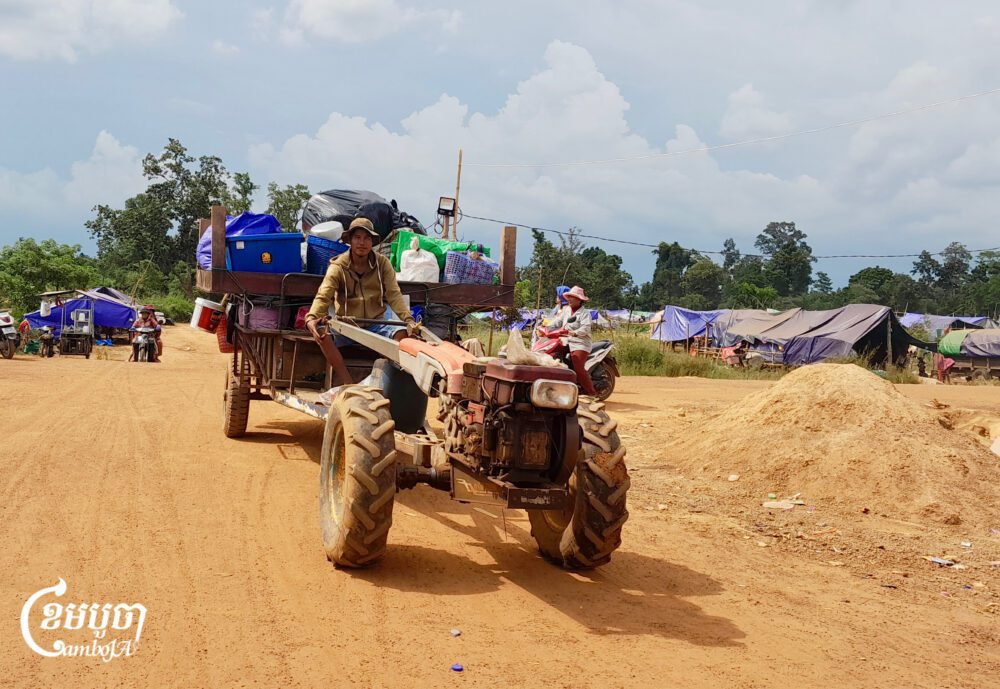
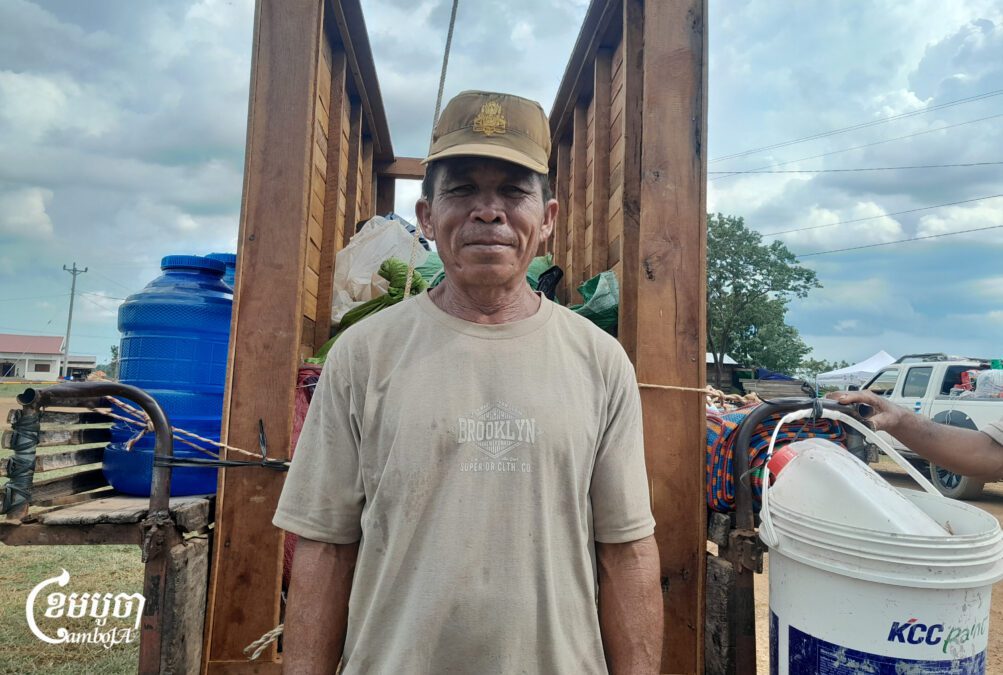
Loading his things on a walking tractor at Wat Por 5000 in Kulen district, Preah Vihear, farmer Son Chit said he and his family of five decided to go home after the situation calmed down. They are eager to see the condition of their house and farm that were left unattended for many days during the conflict.
“It has been quiet and [I want] to see my fields, farm, house and my village. I miss them,” he added. “I can’t predict. If it [conflict] happens, I don’t know what to do […] maybe, I will come [to the camp] again”.
Despite knowing that there might be unexploded bombs as well as remnants of toxic chemical in the air sprayed by Thai fighter jets during the conflict, Chit was determined to return to his house in Chheu Teal Kong Village, Choam Ksant commune in Choam Ksant district, about four kilometers from the Thai border.
The authorities advised him that if he comes across any unexploded bomb in his fields, he must immediately report it to the local authorities, he said, adding that he was told to purify drinking water in “antique” water jugs and use “garlic” to “rub on his nose” to protect himself from the toxic air.
Pen Sreylak, a street vendor, said authorities barred her from returning because they were worried that the toxic air will affect her health, but she has insisted on going back.
She said staying on in the camp is not going to help her earn an income, and she noticed that people started returning home on August 8 because they were worried about their homes, farms, and livestock.
“It’s not easy to live here [camp] compared to home. I want them [Cambodia and Thailand] to remain peaceful, and I’ll be happy.”
Due to her insistence, the authorities relented but gave her a mask to protect herself from the toxic air. Her village was not heavily bombed by Thai forces as she lives in Tham Cheat village, Sra Em commune in Choam Ksant district, Preah Vihear.
On August 4, the total number of displaced people from five provinces was 124,940, according to the Ministry of National Defense. Of these, Preah Vihear recorded the highest number of evacuees at 42,016, followed by Siem Reap (39,486), Oddar Meanchey (34,027), Banteay Meanchey (8,505) and Pursat (906).
Phan Prem, 41, said he was not worried about the chemicals in the air or unexploded bombs as his home in Sok Sen Chey village within Kantuot commune in Choam Ksant district is far from the border.
“Seeing that our government has reconciled during the GBC [General Border Committee] meeting, there is peace and we can go home because we have been here [camp] for a long time. We are worried about our homes and our farms.”
Kulen district governor Pen Cheoung said approximately 30 percent of people who fled from their homes to Wat Por 5000 have returned home as of August 9, bringing the total number of families to 4,158 compared to 5,421 families on August 6. But he did not have the latest figure for August 10 as people have been leaving continuously.
Preah Vihear provincial deputy governor Kim Chanpanha said 1,569 families in 15 shelters in the province have gone home as of Saturday. The bad air quality in Choam Ksant district is no longer a problem as continuous rain helped to clean the air. As for unexploded bombs, he said, citizens have been advised to contact the local authorities if they see or suspect there might be one.
“If they see cluster bombs or unexploded ordnance, we told them to contact the CMAC [Cambodian Mine Action Centre],” Chanpanha added.
Yong Kim Eng, executive director of the People’s Center for Development and Peace, said authorities should ensure that people return to areas that are safe, adding that people should not be allowed to go home if their places are prone to conflict.
The government should also provide people with interest-free loans, help them to restart their lives and ease bank repayments after they fled their homes and lost their livelihood.
Earlier Sunday, the Military Attaché Corps of Phnom Penh visited Oddar Meanchey to assess the actual situation of the ceasefire and condition of displaced people.
The military attachés include representatives from Canada, Australia, France, United Kingdom, China, Japan, South Korea, Laos and Vietnam.