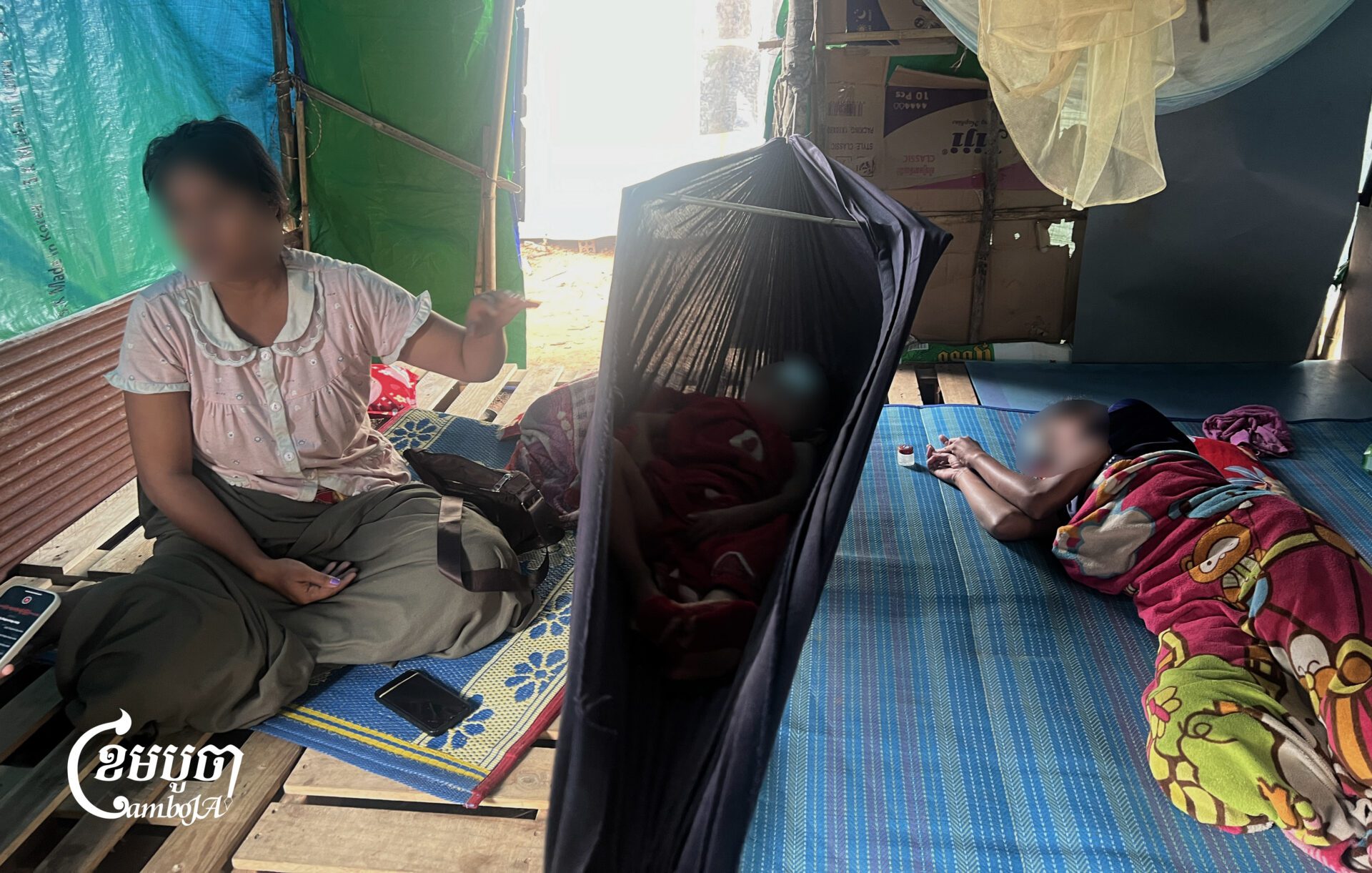
Preah Vihear Province: Many infants and children at displacement camps in Preah Vihear province have been subjected to unending fever, cough, vomiting, and diarrhea since they arrived there. Experts warn that the continuous cycle of illness may lead to chronic issues that could affect their development in life.
Sitting in her hammock in an open tent with her three-year-old son and one-year-old daughter, both with runny noses, Men Phally, said her children have been ill with fever, cough, runny nose, vomiting, and diarrhoea with slight bleeding after she moved to the shelter on July 24.
The 32-year-old mother described that on the first night, the family had to sleep without a tent and in damp conditions due to the rain, and this caused them to fall ill. Even with treatment, they have yet to improve.
“I feel sorry for my children. As soon as we got here, they fell sick.” She noticed that the change from very hot weather to rain severely affected the children who are already ill, causing their fever to rise.
“If we stay longer, I’m afraid it will get worse. We have been here for over a month, and there’s no improvement. I’m afraid it [could become] a chronic issue. I am also always worried because we didn’t have any money.”
With little money received from relatives, Phally had taken her daughter to a private clinic about three times, costing her around 50,000 riels ($12.50) each time.
The doctors at the camp and a private clinic told her that the high fever, non-stop flu, vomiting and diarrhea were caused by mucus build-up because children do not know how to spit it out. In addition, she said, people live close together in the camp, so when the wind blows, it makes everyone sick.

‘Want to cry seeing him like that’
This article is based on interviews with seven parents and children’s guardians in Wat Oddarkiri Tuol Andet and 5,000 Bodhi Trees Pagoda war displacement camps in Preah Vihear. Onsite interviews were done in mid-September with follow-up phone calls in early October which revealed that the children’s health showed no full improvement.
At the campsite, CamboJA News observed that young children roamed outside their tents and played in groups, including those with runny noses. Some younger children only wore t-shirts and nothing to cover their bottom as they played and sat on dirt. Those who were sick were seen sleeping in the tents with fever pads on their forehead.
Meng Chanthou, 23, who held her coughing toddler in her arms, said he has been sick since she moved to the camp, and that he was never like that when he was at home.
In the beginning, he had a fever for three days straight, and red, itchy rashes all over his body, which she thought was afflicted from children in nearby tents. She said his fever came back after dropping a few days, sometimes increasing to 38°C or 39°C. After taking some medicine, his fever reduced, but he is still coughing and sneezing.

It gets harder when they both fall ill. “I have to wipe his body, and mine. Whenever my son is sick, I just want to cry because he is feeling pain and has a hard time. Sometimes he moans in bed because his nose is blocked, and it’s hard to breathe.”
Worried all the time, she takes him to the doctor every day and is told to continue with the medicine, and that it will take awhile to heal.
Recently, Chanthou returned home to harvest rice and would return to the camp in two to three days but noted that although her toddler was sick with a cough and cold, he seemed a bit better than in the camp. She said if he could stay at home a little longer, he would soon recover.
No money for travel
Like Chanthou, Nai Socheat, 35, said that of her five children, her seven-month-old toddler often falls sick and has a fever every other day despite getting better.
She was worried that her child would be infected by dengue—caused by Aedes mosquito—even though she placed him inside a mosquito net at night.
“He doesn’t recover although he takes medicine. I’m afraid he has dengue fever because he has a fever month after month, and he’s still very young, only seven-months-old.” At the time, her son had a runny nose and was breathing fast.
During Phchum Ben festival, Socheat left the camp with her children for home. However, on September 27, their walking tractor met with an accident on their way back to the displaced camp, causing them to fall. She and her children were injured while her seven-month-old son’s condition worsened. She was advised by a doctor who was on duty at the camp to take him to Kantha Bopha Hospital.
“They advised me to go to Kantha Bopha Hospital in Siem Reap or Phnom Penh, but I don’t have money. If I had money [for travel], I would take him because he has been falling ill for a while now.”
Preah Vihear Deputy Governor Kim Chanpanha said provincial authorities regularly visited the camps to check if they are living in decent conditions and have proper shelter. The health of the people is a priority, he mentioned, adding that a team of doctors are on duty day and night.
The border conflict between Cambodia and Thailand which broke out on July 24, saw thousands of villagers from Oddar Meanchey and Preah Vihear provinces move temporarily to the shelters.
In Preah Vihear, 15 shelters, mostly Buddhist temples, accommodated at least 12,000 families or over 40,000 people.
The 5,000 Bodhi Trees Pagoda is the largest displacement camp in Preah Vihear, housing over 6,000 displaced families, equivalent to over 20,000 people. The camp was opened on June 8, 2025 after an initial confrontation in May left one Cambodian soldier dead, according to the provincial deputy governor.
With regard to the children’s serious health problems, Chanpanha said that might be due to them “playing in the rain and dirt“.
“We care very much about their health, especially children, and we also have a team of doctors on duty 24 hours a day. If the situation is not good, the ambulance is on duty to send them to the health center or provincial referral hospital,” he said.
As of October 2, nearly 3,000 families sought refuge in six camps, with over 1,100 of them being recent evacuees from the September 27 incident when the Thai military launched an attack on Cambodian army positions in the An Ses area in Preah Vihear, Chanpanha said.
Prone to chronic illness
Meanwhile, the medical teams at the 5,000 Bodhi Tree Pagoda and Oddarkiri Tuol Andet Pagoda displacement camps contend they are battling an influx of seasonal illnesses, primarily affecting children and the elderly.
According to Dr Nal Moni Udom of the TYDA team, the rainy season caused a continuous outbreak of dengue fever at the 5,000 Bodhi Tree camp. Children there are also suffering from seasonal ailments like respiratory syncytial virus (RSV) and skin rashes.
Moni Udom said they attend to over 100 patients daily, mostly adults aged 40 to 60 and children under five suffering from cold, diarrhea and gastroenteritis.
Another doctor, Chin Rachana, at the Oddarkiri Tuol Andet camp, confirmed that children under 15 frequently contracted flu, attributing it to the hot, closed environment of the tents. He added that his team treats more than 50 patients daily—half of them children.
“The biggest challenge is babies as they have a hard time. Due to their age, their health is still weak. They often have more problems than older children. Most of the issues we encounter are sore throats and colds.”
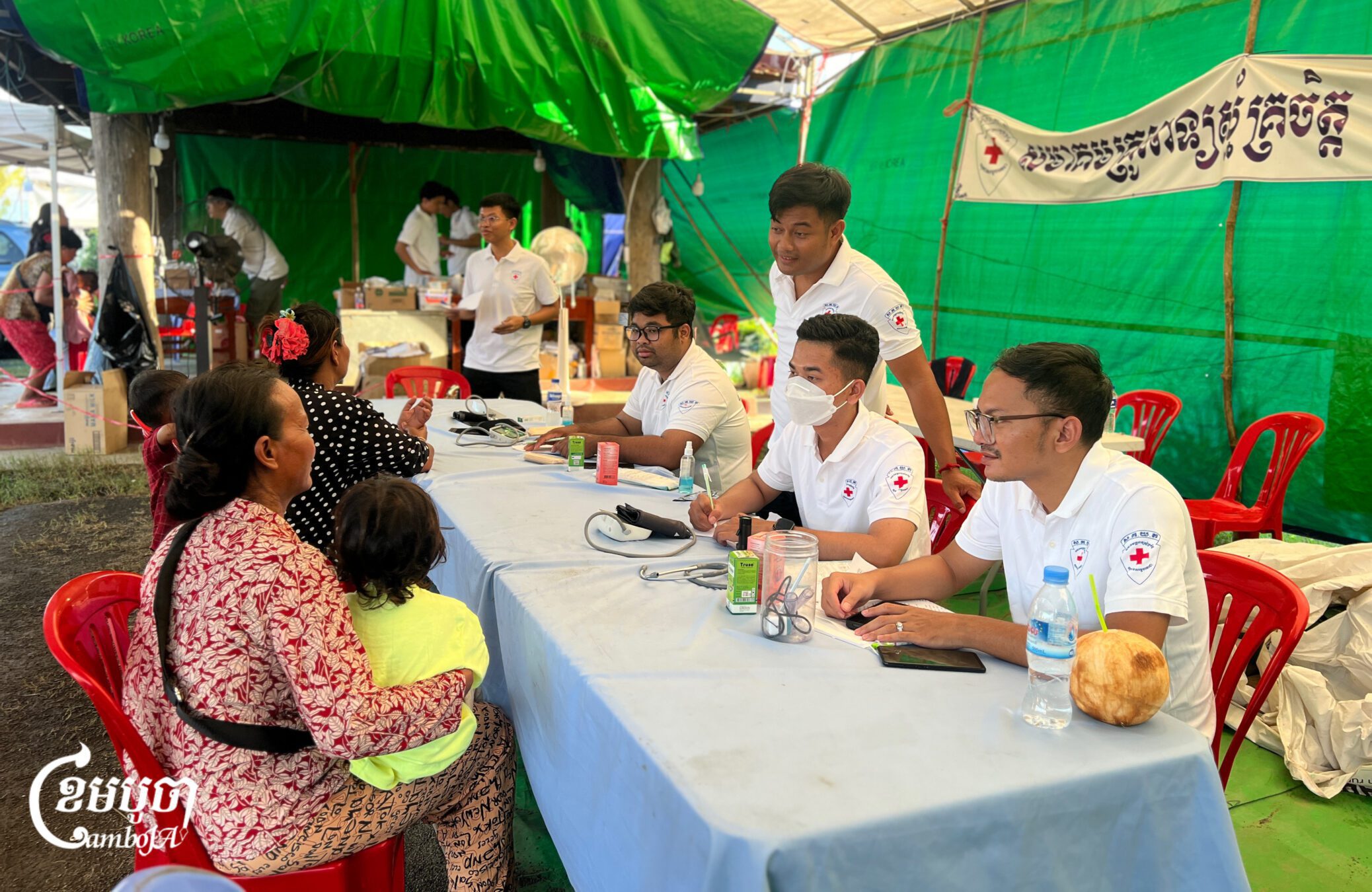
While the doctors provide medicine and advice on hygiene, Moni Udom and Rachana said many parents lack awareness of preventing diseases, including dengue fever.
World Vision International senior health and nutrition technician Lay Sambo remarked that displaced families lack critical primary and mental health care, posing severe long-term risks to children.
To mitigate this, she said World Vision provides nutritional support, has established safe play spaces, and constructed hygiene facilities (toilets) to prevent disease and support families in the difficult camp environment.
She felt that continuous illness in crowded camps, combined with poor access to services, would leave children vulnerable to chronic respiratory, waterborne diseases and severe malnutrition. These issues, including stunting and being underweight, can cause lifelong physical and mental developmental delays.
“The problems can have lifelong consequences if left untreated […] Long-term illnesses also affect growth, learning ability, and mental well-being,” she said.

Nut Sambath, president of the Institute of Medicine, Biology and Agriculture at the Royal Academy of Cambodia, said living in cramped quarters in hot and humid weather will make it easier for respiratory viruses to spread among malnourished children and infants. He said respiratory diseases are prone to recurring and could become serious.
“If not treated properly, it can lead to chronic lung disease,” he said, adding that the problem requires high-level treatment and adherence to the principles of eating clean, drinking clean, and living clean.