Thai armed forces have allegedly continued to encroach and unlawfully occupy Cambodia’s sovereign land along disputed border areas despite agreeing to a ceasefire last December, a move an analyst describes as “grave violation” of international law.
Following the end of weeks of deadly clashes along the 800km-long (500 miles) shared border last year which led to over 100 deaths and nearly a million displaced people on both sides, Thai forces have persisted to clear land, and construct roads and concrete structures on Cambodian soil.
Foreign Affairs Ministry lodged two formal protests within a week against the continued acts by the Thai military including the building of bunkers, Buddha statues and permanent structures in Preah Vihear, Odddar Meanchey and Banteay Meanchey provinces. In Banteay Meanchey, particularly Chouk Chey and Prey Chan villages, land plots have been allocated to Thai citizens, while residential homes in Boeung Trakoun, which were surrounded by barbed wires, were razed by the Thai military.
“Cambodia does not accept any boundary line or territorial claim unilaterally asserted by Thailand; the above activities shall not prejudice the legal rights and position of the Kingdom of Cambodia,” read the statement on March 20.
Cambodia called upon Thailand to immediately cease the activities conducted in Cambodia’s territory, and refrain from any further unilateral actions in those areas. It added Cambodia to reaffirm its consistent and unwavering commitment to seeking an amicable resolution to all boundary disputes with Thailand.

Displaced families move to temporary housing
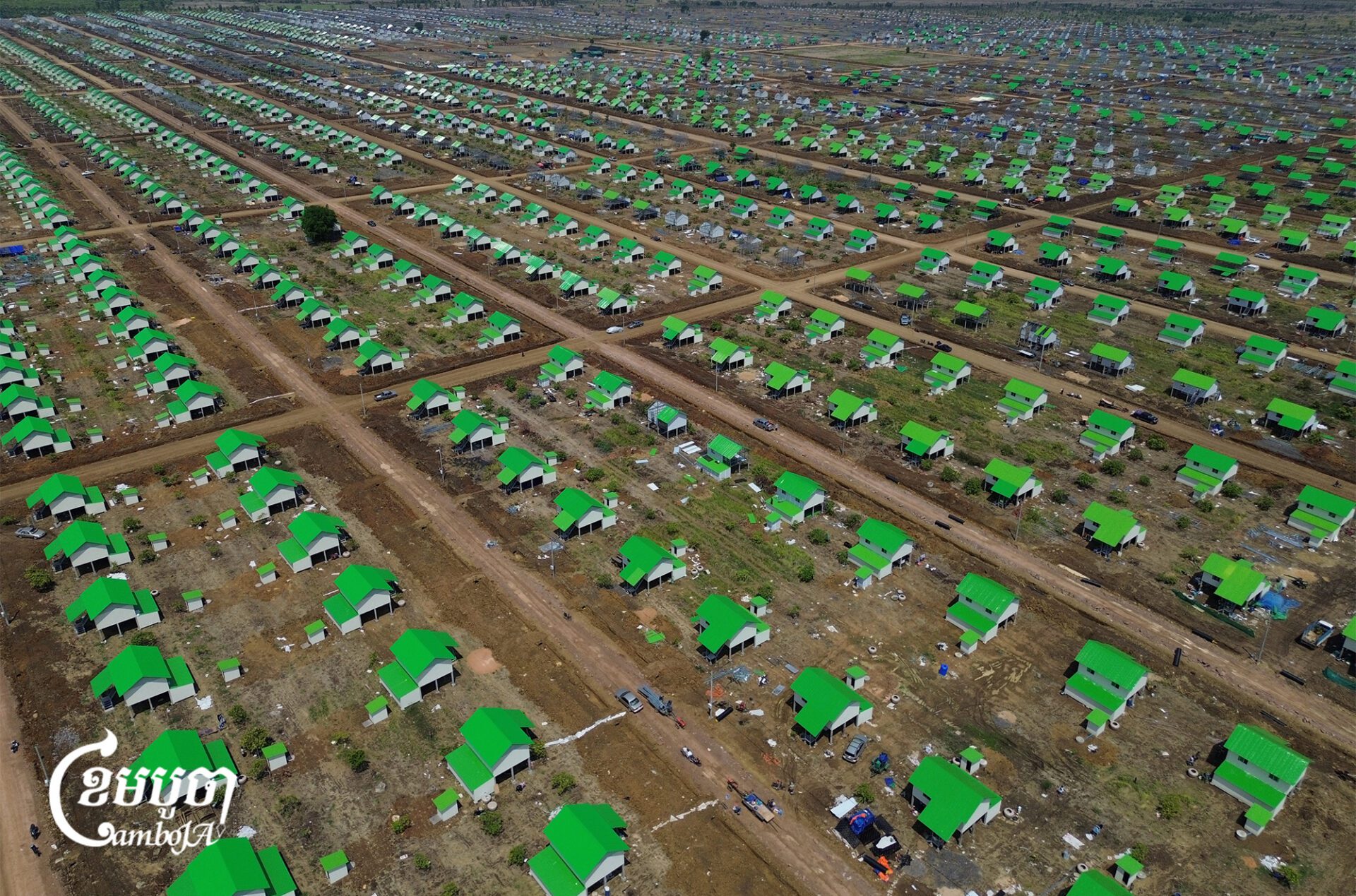
Met Hiet, deputy governor of Thmar Pouk district, said that 800 families have relocated to temporary housing in Slakram commune, Svay Chek district in Banteay Meanchey.
“We sent 800 families [to take up residence first] because [the rest of the] temporary housing is not ready,” he said. Another 800 families wait in Kandorl pagoda and in a new camp, which is on a higher ground, to be relocated once the rest of the temporary housing is fully constructed.
National Committee Disaster Management spokesperson Soth Kimkolmony declined to disclose details of the temporary housing, saying he has yet to receive a report.
As of March 22, 2026, more than 94% of approximately 640,000 displaced people have returned home with 36,320 displaced persons remaining in the shelters, according to the Interior Ministry.
Cluster bomb kills one Cambodian
On March 19, 2026, an unexploded cluster munition in Banteay Meanchey killed a man and seriously injured another.
The explosion was identified as an M46 submunition from a 155mm projectile, believed to be a remnant of past conflict, Heng Ratana, director general of Cambodian Mine Action Center (CMAC), posted last week.
“These remnants of war continue to threaten peace, physical and mental safety, social economic, and the development of Cambodia,” Ratana said.
He urged citizens not to touch suspicious objects and to report them to CMAC or local authorities.
In the border conflict last year, Thailand was accused of using cluster munitions which is banned by many countries as they leave behind unexploded bomblets that pose long-term risks to civilians.
Kin Phea, Director-General of the International Relations Institute at the Royal Academy of Cambodia, said the current situation appears to be a calculated attempt to create “facts on the ground”. He called it a “grave violation” of international law, alleging that Thai forces continue their blatant act of aggression against Cambodia’s sovereignty and territorial integrity.
“By moving military personnel into Cambodian territory post-ceasefire and subsequently settling civilians, Thailand is attempting a gradual annexation,” he said.
“There is no ‘ambiguity’ in the mapping or jurisdiction of these areas. These are not disputed zones,” Phea said.
To prevent further escalation, both sides, particularly Thailand, must return to the framework of existing bilateral mechanisms, he remarked. They need to adhere to the 1904-1907 Franco-Siamese Treaties and the 2000 Memorandum of Understanding on Land Boundary Demarcation.
De-escalation requires a commitment to the “status quo” in undemarcated areas and the immediate cessation of unilateral civilian or military movements.
Rights group Adhoc president Ny Sokha said that the Thai side seems to have “ignored” efforts to address the border dispute, increasing activities such as land clearing and infrastructure construction in areas it occupies.
From a civil society perspective, he said, the government should pursue legal action rather than wait for Thailand to resolve the issue through bilateral mechanisms, which Thailand has repeatedly avoided.
“Cambodia must act promptly by compiling evidence and submitting it to these courts for a decision, as it is difficult to resolve the issue through bilateral channels,” Sokha said.
Cambodia should consider filing complaints through international mechanisms such as the International Court of Justice (ICJ) and the International Criminal Court (ICC), he added.
Thai Defense Ministry spokesperson Surasant Kongsiri did not immediately respond to a request for comment.