
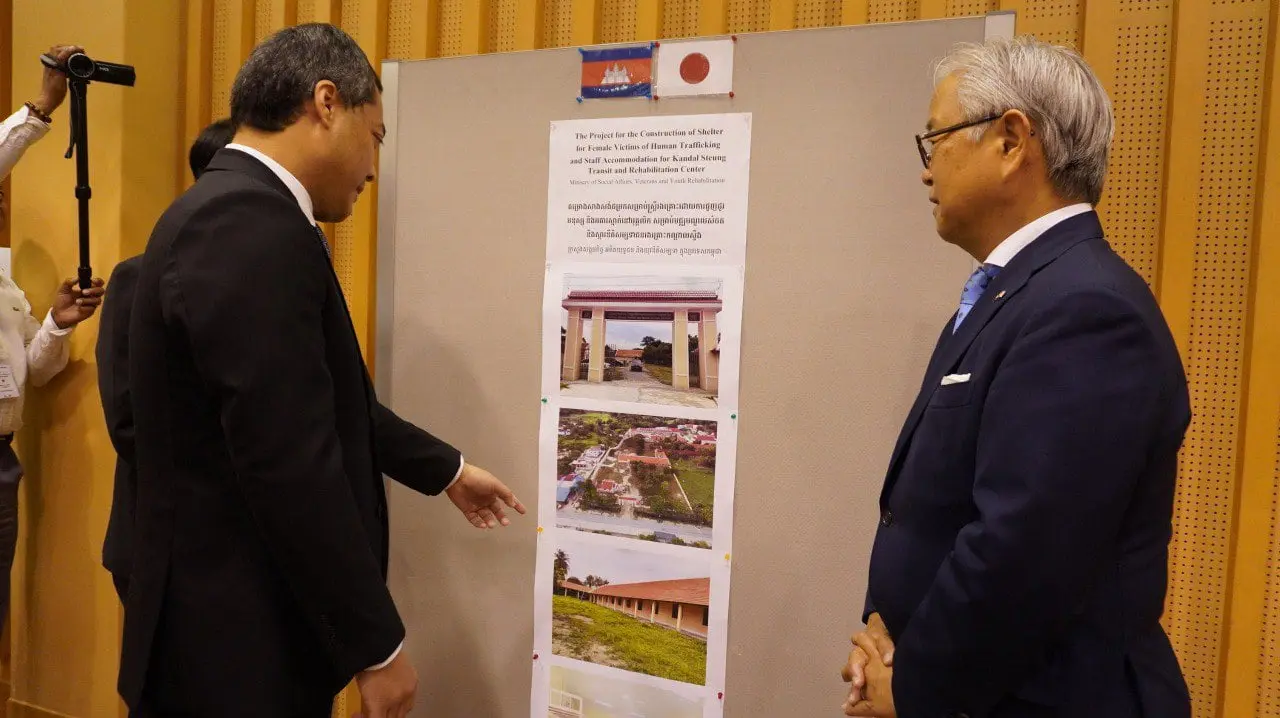
A Japanese-funded shelter and staff housing would be built at the Kandal Steung Transit and Rehabilitation Center in Phnom Penh to provide safety and care, and strengthen physical and psychological recovery for female victims of human trafficking.
The Japanese government has extended a grant of $140,781 to the transit and rehabilitation center under its Grant Assistance for Grassroots Human Security Projects (KUSANONE) framework, according to the Social Affairs, Veterans and Youth Rehabilitation Ministry.
“This facility would keep victims safe and protected and allow staff to deliver appropriate care services. It’ll support victims in vulnerable situations, either physically or mentally, to return to normal lives,” the ministry said.
Ministry spokesperson Touch Channy said this is the first-ever shelter in the capital for people who are affected by human trafficking or labor trafficking. There is one shelter in Poipet, a Cambodian city near the border of Thailand.
“In Phnom Penh, we would have this new shelter with the signing of the agreement with the Japanese government. We hope for more support from other stakeholders,” said Channy.
In the first nine months of 2025, authorities cracked down on 147 cases of human trafficking and sex trafficking, arresting 205 people and sending them to court.
The Trafficking in Persons (TIP) report in 2025 detailed trafficking conditions and response efforts in the U.S. and more than 185 countries.
However, the U.S. criticized Cambodia’s long-documented harboring of the online scam industry and its reliance on forced labor, which researchers and investigators alleged involve complicity by senior officials.
According to the Japanese embassy, the assistance aims to protect those who are vulnerable due to various factors, like poverty and other misfortunes that directly threaten their lives, livelihood, and dignity. They hope that this would promote self-reliance among local communities.
Since 1991, Japan has provided over $72 million to local authorities and non-governmental organizations to implement over 700 KUSANONE projects throughout Cambodia.
Am Sam Ath, operations director of Licadho, told CamboJA News that Cambodia has a transit center at the Cambodia-Thailand border in Poipet province, but one building was not enough. There has to be more space and a clear management and definition of functions to help victims, so as not to turn it into a place with human rights violations like the Prey Speu center, which has been criticized in the past.
He said that there should be a separate center for the rehabilitation of victims of human trafficking and victims of other crimes. In the past, the government had stipulated some procedures, but the implementation was not good enough.
“We should have more centers and clear policies. Some centers have had mixed conditions that did not achieve the desired results,” said Sam Ath.
“This is because Cambodia does not have enough transit centers, a proper vocational training center and rehabilitation center,” he remarked, adding that the procedures in the ones which exist are wrongly applied.