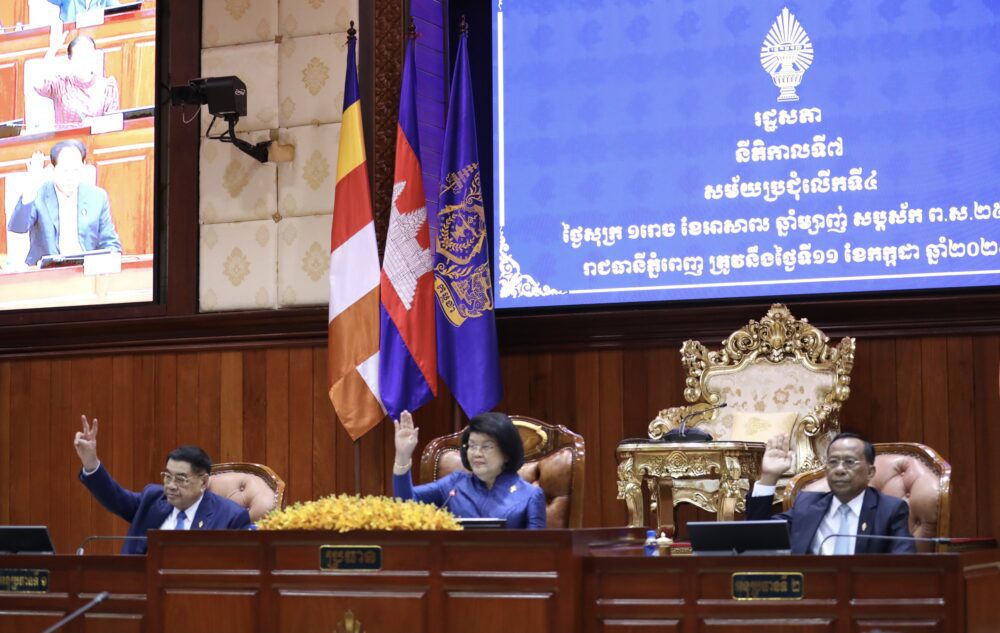
Lawmakers unanimously approved a constitutional change Friday paving the way for Cambodians accused of foreign collusion to be stripped of their citizenship, a move critics say could be used to silence dissent.
The amendment follows a call last month by former Prime Minister and current Senate President Hun Sen for a constitutional change to revoke the citizenship of Cambodians who “side with foreign nations to harm our country.”
He made the appeal, which was quickly sent to the Senate, after exiled opposition figures criticized the government over an ongoing border dispute with Thailand.
All 125 lawmakers, including Prime Minister Hun Manet, who was handed power by his father Hun Sen in 2023, voted to amend Article 33 of the Constitution. Debate in the National Assembly lasted less than two hours before the vote was finalized.
The original clause stated that “Khmer citizens shall not be deprived of their nationality” and guaranteed protection for Cambodians abroad. The revised version reads: “Receiving, losing and revoking Khmer nationality shall be determined by law.”
Amnesty International condemned the amendment shortly after the vote, calling the revocation of Khmer citizenship a “heinous violation of international law.”
“As the proposal moves closer to becoming reality, anyone who speaks out against or opposes the ruling party will be at risk of having their citizenship revoked,” said Amnesty International’s regional research director Montse Ferrer. “We are deeply concerned that the Cambodian government, given the power to strip people of their citizenship, will misuse it to crackdown on its critics and make them stateless.”
Ruling party-aligned lawmakers defended the amendment, framing it as a safeguard for national sovereignty.
Ruling Cambodian People’s Party lawmaker Lork Kheng told parliament the change served the “national interest,” claiming some Khmer extremist groups had colluded with foreigners to spread false information aimed at undermining the country.
Nhoen Raden, a lawmaker from the royalist Funcinpec party, said the amendment was a reminder of the “importance of nationalism,” especially as Cambodia had suffered territorial losses in the past.
“The constitutional amendment is not intended to harm the Cambodian people or pressure any individual or group. Its sole purpose is to protect the nation,” he said.
Justice Minister Koeut Rith echoed the nationalist line pushed by other lawmakers and brushed off concerns about abuse.
“I would like to clarify that this amendment allows for the revocation of Khmer citizenship only in cases where individuals betray their own nation,” he said.
“Those loyal to the nation won’t face revocation,” Koeut Rith added, saying the law targets “citizens who conspire with foreign actors, commit treason or harm the interests of the people and nation.”
Similar to earlier remarks from his ministry’s spokesperson, Koeut Rith deflected criticism by pointing to similar laws in other countries, including Western nations, that allow citizenship revocation for national security reasons.
Citizenship can be revoked on grounds of treason or disloyalty in 15 European Union countries, and only naturalized citizens face revocation in eight of those, according to a European Parliament briefing in February, reported by AFP.
Such revocations are rare and, when attempted, tend to be exceptional, legally complex and often controversial. Notably, U.S. President Donald Trump’s attempt to end birthright citizenship was blocked by a federal judge on Friday.
Political analyst Meas Nee said the risk of abuse with the amendment comes down to Cambodia’s lack of independent courts.
“The concern is whether accusations against individuals will be handled independently by the courts,” he said.
Cambodian courts have long been called out by activists, dissidents and international observers for political capture.
Speaking for the opposition Candlelight Party, which was barred from contesting the 2023 election, Secretary-General Ly Sothearayuth called the amendment “regrettable” and said the party does not support it.
“What benefit is there for the nation in amending the law or constitution when Khmer politicians have yet to achieve unity and solidarity?” he asked.