Listen to the audio version of this article (generated by AI).
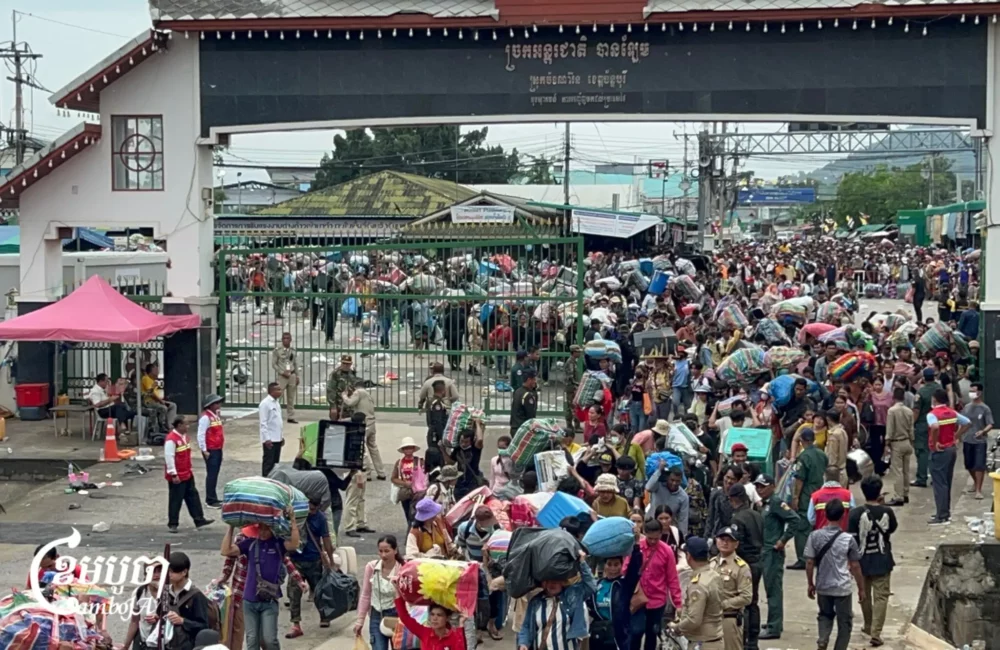
Cambodia marked International Migrants Day on December 18 as thousands of migrant workers who returned from Thailand due to border conflict continue to struggle with debt, unstable jobs, and limited assistance. Renewed calls by civil society were made for stronger government support to help them rebuild their lives and avoid risky re-migration.
According to rights-based NGO CENTRAL, the International Migrants Day events, themed “Promoting Safety, Decent Work, and Social Assistance for Migrant Workers”, are held across several provinces to raise awareness on safe migration and protection during conflict.
It also released survey findings showing that only 31 percent of returned migrant workers received assistance, mostly from the government, while many bore high return costs, averaging $74 for transport, $145 for food, and $56 in unofficial payments.
Debt remains a major factor shaping migrants’ decisions. The survey found that 71 percent of returnees are in debt, and 85 percent of borrowers are not able to keep up with repayments. Debt amounts ranged from $30.80 to as high as $35,000, with an average debt of $5,500 and monthly repayments of $220.
Keng Sokhit, 30, told CamboJA News that she and her husband returned from Thailand after the first border conflict in July, and just got a job in a factory in Kampong Speu province. Although the salary in the garment industry is not as high as when she worked in Thailand, Sokhit said the current situation makes migration difficult and she needs money to support the family and pay off the bank debt.
She added that the combination of her husband and her salary amounted to about $400 a month. If they work overtime, they could earn even more. She is also working to pay off their loans which were taken to buy a motorbike and tractor for farming. She has paid off some of the debt, with only a little left.
Living in Banteay Meanchey province, Sokhit said she hopes the government will help raise garment workers’ wages, and ensure job stability. “I won’t return to Thailand for work. I am in Cambodia, but I want a stable job and a decent salary,” Sokhit said.
Another worker, Yai Rachhan, 41, said he had been working in Thailand for 10 years. When he returned from Thailand, he faced difficulties paying back the bank for a $6,000 loan he took to buy farmland. Due to the war, he has not been able to work on the field.
He took up a construction worker job in Kandal province, earning about $12 per day. However, construction work is irregular compared to work in Thailand where he earned more than $600 per month.
Although he would not return to Thailand, he might consider another country. He said the government should create more job opportunities for Cambodians so that they do not migrate to other countries.
“I also hope for a [permanent] job with a decent salary,” Rachhan said. “We are a developing country, so construction jobs are plentiful, but we need protection because I heard some construction workers are not being paid.”
“Any job that pays [a decent salary], won’t cause people to go back to Thailand because there are many problems there, including racial discrimination, too much red tape and unequal treatment,” Rachhan said.
On December 10, 2025, the National Bank of Cambodia instructed banking and financial institutions to provide loan relief to those affected by the border conflict. Financial institutions were also asked to waive loan-related fees and penalties, suspend interest payments, and defer principal repayments until March 31, 2026 for civilian customers affected by the conflict.
Cambodia Microfinance Association spokesperson Kaing Tongngy told CamboJA News that a loan restructuring policy was implemented from the middle of 2025 to assist migrant workers returning from Thailand, which will be valid until the end of 2025.
Following the second round of border dispute, the association will discuss with other stakeholders to do more to help workers and refugees, as microfinance institutions extend the deadline until March 31, 2026.
For refugees, Tongngy said, they need not worry about loans or documents as financial institutions would waive the payment of the principal and interest till March 31, 2026. The important thing is to maintain physical and mental safety. “Business people want to make a profit, but in this difficult situation, we have to help each other.”
As of August 31, 2025, 920,000 Cambodian migrant workers have returned from Thailand, with tens of thousands assisted with local jobs, the Ministry of Labor and Vocational Training stated. However, civil society and experts warn that many returnees face risks of unemployment.
Responding to CENTRAL’s findings, Labor Ministry spokesperson Sun Mesa told CamboJA News that the government has been paying attention to these issues, evidenced by nearly half a million workers finding jobs through the ministry’s mechanisms and relevant parties.
Mesa said that the labor market is safe and benefits are reasonable, comparable to Thailand’s, and that Cambodia has implemented the National Social Security Fund protection system. He expects workers, who have just returned from Thailand, to work in Cambodia and not migrate to work in dangerous areas.
“We urge those who are in debt to look for job opportunities in Cambodia. If you are unemployed, please contact the Ministry of Labor to find jobs locally because regardless of your skills, our working conditions and benefits are better, and salaries are not inferior to Thailand,” said Mesa.
Moeun Tola, executive director of CENTRAL, said many Cambodian migrant workers were left without sufficient support at a critical time.
“They returned at their own expense and received little assistance, while debt continues to shape decisions to re-migrate,” he said. “Respondents are calling for decent jobs, temporary loan relief, food support, and better access to social protection to support safe reintegration.”
According to CENTRAL, the workers who returned asked for stable and decent employment, including opportunities for those over the age of 40, as well as start-up capital for small businesses. They also urged the government to increase rice purchase prices and ensure fair market access to strengthen local agricultural livelihoods.
Meanwhile, CENTRAL urged the government, development partners, and financial institutions to strengthen collaboration and translate these findings into concrete, timely support for returned migrant workers facing ongoing economic insecurity.
Separately, the Mekong Migration Network (MMN) has called on stakeholders to jointly counter rising xenophobia and discrimination, and strengthen policies to protect migrant workers’ rights. The network said Thailand’s economy has long depended on migrant labour, yet work is temporary and unprotected due to complex registration procedures, insecure legal status, and exclusion from social security, problems worsened by document losses during recent floods.