Thai authorities claimed that about 200 Cambodian households, who fled the civil war decades ago, are “living within Thai territory” according to their map. While Thai officials say there are no plans to evict them, it is unclear why the issue has been raised now, with a political analyst suggesting it may be “an attempt to provoke tensions”.
Last week, Thai soldiers entered Cambodian territory in O’Beichoan commune, O’Chrov district, Banteay Meanchey province, ordering residents who had lived there for more than 20 years to leave their homes, before they started erecting fences.
A spokesperson for the Royal Thai Army said Monday the area lies “entirely within Thai jurisdiction”, adding that the barbed wire fence was not meant to demarcate the border but to serve as a temporary security barrier for Thai personnel, although Cambodia and Thailand have not agreed on boundary markers yet.
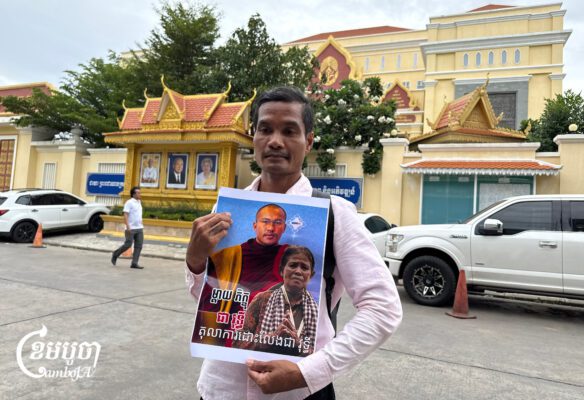
Cambodian residents, however, questioned why Thailand was raising these claims now after they had lived there for decades. “If Cambodians have lived on this land for years, why didn’t they ask us to move out at the time? Why only now?” asked Hul Malis, a resident of Prey Chan village whose house was fenced off by Thai troops.
“When there was no conflict, they never made a claim. I’ve lived here for more than 20 years without any problems,” she added. “Since they cannot seize our temples, they are starting to hurt Cambodians here.”
Malis and five other families affected by the Thai military action are now living in makeshift tents near the barrier. They refuse to leave the site, fearing the Thai army, who are stationed nearby, will destroy their homes.
Ly Sovannarith, Banteay Meanchey deputy governor and spokesperson, said Thai troops laid barbed wire around 12 families’ homes—six in Prey Chan village and six in Chok Chey village—and installed CCTV cameras.
The affected residents are staying next to the fence to keep watch on their houses. “We have told them to remain calm and not resort to violence,” he added.
Earlier today, the Thai army alleged that Cambodians encroached Thai territory, referring to about 200 houses in O’Beichoan commune, but said they had no plans to evict them. They added that the issue will be addressed in the next General Border Committee meeting on September 7 and 8 in Siem Reap.
Arnaud Darc, CEO of Thalias Hospitality Group and an advocate of Cambodia’s cultural and economic interests, questioned why Thailand is raising this matter after “decades of silence”. Seeing that there are no credible answers, he said, the military action suggests that it is more about political positions than an issue of sovereignty.
Government spokesperson Pen Bona said Cambodia’s stance is to resolve the issue peacefully through technical mechanisms and international law to determine the border between the two countries.
“We need to work with technical experts from both sides and use internationally-recognized maps as the basis. If bilateral solutions fail, we will bring the case to a third party—the International Court of Justice,” he said, adding that border claims must be based on evidence, not mere assertions.
Meas Nee, a political analyst, told CamboJA News that the Thai armed forces’ action seem to be directed at their citizens, to show that Thailand is reclaiming its territory, and if they do not carry out the act, “they would have no evidence to present domestically”.
He added that these moves indicate an intention to break the ceasefire. “It seems Thailand is intent on starting a war again.”
Meas Nee urged Cambodia to be cautious and alert, and ensure that citizens remain near the fence.
“If civilians are involved, Thailand is unlikely to open fire,” he said. “We need to maintain calm. Border demarcation should be the final step. First, we must avoid another clash.”
On August 20, Cambodian civil society groups will deliver a petition to the embassies of the signatories of the 1991 Paris Peace Agreements, urging coordinated action to protect Cambodia’s sovereignty and peace.
“The petition calls on these signatories to urgently uphold their commitments to protect Cambodia’s sovereignty, territorial integrity, and peace,” it said.
Earlier today, Thai media reported that a Cambodian soldier objected loudly, initially blocking an inspection by the Interim Observer Team (IOT), which was led by the Thai Armed Forces through the Directorate of Military Intelligence.

The team, comprising defense attachés from eight countries in ASEAN, were visiting a border site called Chong An Ma in Thailand, but known as An Ses in Cambodia, to investigate the Thai army’s claims that Cambodian troops cut the barbed wire, which “violated the ceasefire agreement”. Despite the objection, the attachés managed to spend about an hour at the site.
The barbed wire had been laid by Thai troops in An Ses on August 4 with the help of heavy machinery, which Cambodia said is a breach of the ceasefire.
Meanwhile, Malaysian Prime Minister Anwar Ibrahim posted on his Facebook that he discussed the latest developments in the ceasefire between Cambodia and Thailand with Prime Minister Hun Manet today.
“We also touched on the IOT which has been carefully monitoring the border areas of both countries. We discussed further about other steps that can be taken to streamline the effectiveness of IOT’s operations,” he said.
However, the Second Thai Army Region Commander said this afternoon that the border peace situation is still “50-50” and if clashes occur, the Thai army is “ready to fight”.
Acting Thai Prime Minister Phumtham Wechayachai said the National Security Council has instructed the Royal Thai Police and Attorney-General to pursue civil and criminal lawsuits against Cambodian leaders in Thai courts, warning they would be arrested immediately if found in Thailand.
Cambodia’s Foreign Affairs and International Cooperation Ministry stated that Thailand’s legal threat violates Cambodia’s sovereignty and the UN Charter’s principles of equality and mutual respect. The move could also seriously harm bilateral relations.
“The intended legal action would undermine all endeavors to restore trust and confidence that are much needed to effectively implement the ceasefire agreed by Cambodia and Thailand,” it stated.