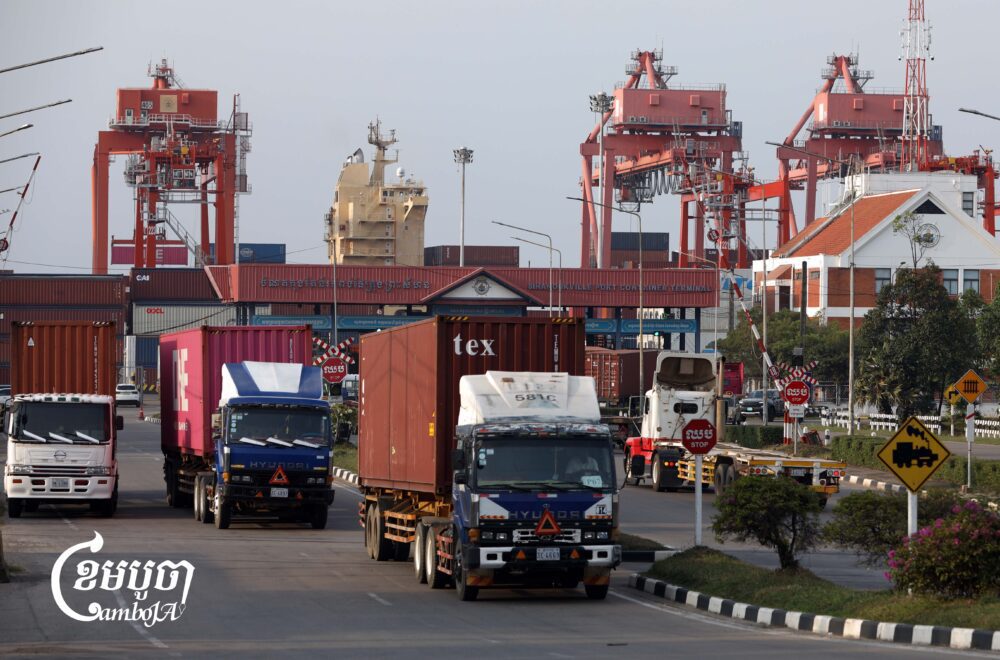
The United States has announced a new trade deal imposing a 19% tariff on Cambodian exports, while American goods can now enter Cambodia tariff-free. Cambodian officials said the new rate remains favorable to existing factories, and will be able to attract new investment, and support future expansion.
President Donald Trump announced a 19% tariff on Cambodian imports, according to the White House this morning. This number was reduced after four rounds of trade negotiations with the U.S. Previously, Cambodia faced a 36% tariff, reduced from an earlier proposal of 49%.
Prime Minister Hun Manet thanked Trump for reducing the tariff on Cambodian exports to 19 percent. He also expressed appreciation to the U.S. for its role in initiating a ceasefire between Cambodian and Thai forces, and to continue monitoring its implementation until “lasting peace and normalized relations are achieved”.
Hun Manet said that during a phone call with Trump on July 26 and 28, he emphasized the importance of peace and development for Cambodia, which has emerged from centuries of conflict. He asked Trump to consider lowering tariffs to support Cambodia’s economic growth and improve people’s livelihoods.
“To my request regarding the tariff rate, His Excellency the President told me on July 28 that he would review and decide. His Excellency told me that [U.S.] will make Cambodia happy,” he said.
“This is good news for Cambodian people and the Cambodian economy to continue developing.”
At a press conference, Sun Chanthol, first vice president of the Council for the Development of Cambodia (CDC), said that the reduction in US tariffs is a result of Cambodia’s honest and sincere negotiations with the U.S., which yielded acceptable results.
Within ASEAN, Cambodia’s new rate is relatively moderate. Singapore faces a 10% tariff, while Thailand, the Philippines, Malaysia, and Indonesia have been imposed with a 19% tax, respectively. Vietnam’s rate is 20%, Brunei (25%), and Laos and Myanmar are subject to the highest rate in the region at 40%.
Chanthol added that compared to neighboring countries, the tariff will allow Cambodia to compete with neighboring countries.
“We will be able to maintain or increase factories in Cambodia and attract investors to our country, which will benefit our nation,” he said.
“It will create jobs for our people, so we ask Cambodian citizens who have migrated to work abroad to come back because we can create tens of thousands of jobs.”
As of July 25, CDC approved 426 investment projects, where 90% of those are in the industrial sector. It is expected to create over 300,000 jobs.
Chanthol explained that to attain a 19% tariff rate from the U.S., Cambodia agreed to impose zero tariffs on US goods.
“Cambodia played the zero tariff card during the negotiations with the US to reduce the tariff on US goods [imposed] before July 7 to zero. So, all the U.S. goods imported by Cambodia are not subjected to tariff,”he said.
He said import tariffs on 11,414 lines of goods from the US ranged from 5% to 35% previously, but have been reduced to zero now. The product lines include second hand cars.

Part of the deal with the U.S. also includes negotiations by Air Cambodia with the U.S. to buy 10 Boeing 737 Max 8 aircrafts.
Having said that, Chanthol stressed that Cambodia will continue to find ways to reduce costs to attract investors, despite the comparatively low tariff.
Stephen Higgins, managing partner of Phnom Penh-based Mekong Strategic Capital, said that the 19% tariff is unlikely to push U.S. importers to shift away from Cambodian products, as the rate is similar to or even lower than those faced by Cambodia’s key competitors.
He noted that while the tariff may raise consumer prices in the U.S. by around 5% over the next one to two years, much of the cost will likely be absorbed along the supply chain in the short term. He does not expect the increase to have a significant impact on overall consumer demand.
“The 19% tariff is dramatically better than the 49% initially announced, or the 36% proposed in Trump’s letter last month,” he said. “It is not often I have been celebrating US importers facing 19% additional tax on goods exported from Cambodia to the U.S. So, from a tariff perspective, there’s no longer an incentive for manufacturers to shift production away from Cambodia.”
He added that it is also worth remembering that tariffs apply to the import cost, not the retail price.
“This new tariff level is unlikely to meaningfully dent Cambodia’s exports to the U.S. It’s simply a regressive tax on American consumers — wrapped in populist packaging,” he added.
Kong Malis, a garment factory worker in Phnom Penh, said that the reduction in tariff is good news for factory workers.
“I think we can accept this number and the factories will continue to operate in Cambodia and have more workers. Cambodian people will be happy,” she said.

Ath Thon, Vice President of the Coalition of Cambodian Apparel Workers’ Democratic Union (CCAWDU) said that it is good that the U.S. reduced the tariff to 19%, which is lower than Vietnam, Bangladesh, Myanmar and Laos.
In the past four years, the U.S. has been Cambodia’s number one export market for garment products, followed by the European Union.
According to the General Department of Customs and Excise, the U.S. remained Cambodia’s top export destination, with exports from January to May 2025 reaching $4.35 billion — a 27% increase compared to the same period in 2024. For 2024, total exports stood close to $10 billion.
“A 19% tariff is still good because it is higher in other countries,” Thon said, however, adding that Cambodia needs to do more, such as strengthening its capacity to be more clear about global economic policies, market economies, and socio-politics, including democracy and human rights.
“Cambodia should look into this because the U.S. requires some of the conditions to be met.”