

Listen to the audio version of this article (generated by AI).
Casinos and alleged scam compounds along Cambodia’s border with Thailand, many tied to politically connected elites, have been hit in renewed fighting between the two countries, raising alarm among experts over the fate of trafficking victims reported to be working at the sites.
Since clashes flared again in early December, at least six casinos and suspected online scamming complexes in Oddar Meanchey, Preah Vihear and Pursat provinces have been struck by Thai aircraft, artillery and drones, according to reports published by Thai authorities and local media.
The border areas are widely reported to host scam operations that rely on forced labor involving people trafficked from dozens of countries. Bangkok said the sites were targeted after Cambodian forces began operating from the locations and that no civilians were inside.
Cambodia has denied the claims. Some local officials have also denied the presence of scam operations in their jurisdictions. Transnational crime experts have challenged Thailand’s assertion that no civilians were harmed in the strikes.
On Thursday, the Thai army released a more detailed account of its targeting of alleged scam complexes and, for the first time, appeared to address the role of transnational crime in the conflict, even as Thai politicians have been linked to alleged crime networks in Cambodia.
Thai media quoted the army as saying it was not expanding the conflict but “dismantling transnational criminal networks and protecting people worldwide from scam syndicates.”
The Cambodian government, meanwhile, accused Thailand’s military of aggression and alleged that caretaker Prime Minister Anutin Charnvirakul had sought to reignite the conflict to boost his prospects ahead of the next general election.
At least two of the targeted casinos and complexes are owned by Cambodian elites sanctioned by the U.S. over alleged roles in online scam and human trafficking networks, and who were also targeted by Thai law enforcement shortly before the fighting reignited.
These include O’Smach Casino, on the border of Oddar Meanchey and Thailand’s Surin province, owned by U.S.-sanctioned Cambodian tycoon and Senator Ly Yong Phat. Thai forces said it was bombed on Dec. 9. A security guard was reportedly killed, and five people, including Chinese and Myanmar nationals, were injured.
Thai forces said last week they also deployed Saab JAS 39 Gripen aircraft to strike the nearby Royal Hill Resort, identified in May by the Global Initiative Against Transnational Organized Crime as a suspected scam center.
Other reported targets included the Sai Taku Resort at Chob Kokir Khang Lich in Oddar Meanchey, a casino in the Thmor Da area of Pursat Province linked to U.S.-sanctioned tycoon Try Pheap, and a casino near the Chong An Ma border crossing in Preah Vihear Province. No official casualty reports from these strikes have been released.
Most of these sites have been documented as hosting scam operations by Cyber Scam Monitor, an international group tracking transnational crime in the region.
A senior police official in Oddar Meanchey, who declined to be named because he was not authorized to speak to the media, said there were two additional bombings on Tuesday at Sai Taku Resort.
“Until now, no one dares to enter the casinos where Thai forces bombed,” the official said, adding that he could not confirm whether anyone was inside at the time.
Theang Leng, Veal Veng district governor in Pursat province, said the Thai army bombed a building complex in the Thmor Da Special Economic Zone where suspected scam operations have previously been reported by local journalists, though he denied the area was a scam site.
“[Thai forces] attacked casino complexes, but I can’t provide exact figures for the buildings or confirm if people were inside at the time,” he said.
The Thai military also said Friday that its F-16s “bombed five spots in Cambodia’s Poipet district in order to destroy the scam centers and Cambodian military resources […].”
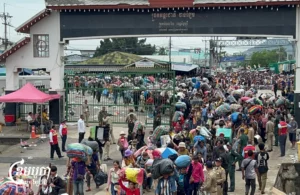
Shortly after, Cambodia said Serei Sophoan district, about 47 km from Poipet and where many people displaced by fighting closer to the border had fled, was also bombed. Fighting was reported in several other locations along the frontier as the conflict neared its second week.
CamboJA News could not independently verify whether any alleged scam compounds in the municipality were struck on Friday.
Eyewitness Project, an organization that investigates conflict, corruption, and war crimes globally, said it visited the O’Smach area when clashes resumed. Most locations appeared to be operating as normal, it said, adding that sources in the conflict zone told the group that many people were still trapped inside during the bombing campaigns.
“After the operation, smoke was also seen billowing from a nearby complex believed to house thousands of trafficking victims,” the organization said in a social media post.
Videos circulated online showed what appears to be dozens of foreign nationals evacuating the O’Smach area in Oddar Meanchey following Thai bombardment.
The police official in Oddar Meanchey could not provide information on the fleeing group’s whereabouts.
The uncertainty has left many experts fearful for those trafficked into hundreds of scam compounds reportedly across Cambodia, which are conjured up along the border and estimated to rely on over a 100,000 forced laborers held against their will or trapped in debt bondage, according to Amnesty International and other international agencies.
“From what we know now, it appears highly likely that victims were present in these compounds at the time of the attack,” said Jacob Sims, a visiting fellow at Harvard University’s Asia Center and an analyst on transnational crime in the region.
“However, getting absolute confirmation on this is difficult for a variety of reasons,” he added, noting that, depending on various factors, the strikes could amount to war crimes.
U.N. High Commissioner for Human Rights Volker Turk also raised concern over Thai strikes on casinos and alleged scam centers as hostilities deepen.
“Trafficked individuals of various nationalities are forced to carry out fraud at scam centres in Southeast Asia, including in Cambodia, and are now exposed to further risk by the fighting,” he said, calling for the evacuation of those held there.
A spokesperson for Thailand’s defense ministry, Surasant Kongsiri, did not immediately respond to a request for comment on the strikes or reports that trafficking victims may have been present at the targeted locations.
Several Cambodian officials, including government spokesperson Pen Bona and Preah Vihear provincial deputy governor Kim Chanphana, declined to comment or did not respond to requests for comment.
Other Cambodian authorities previously said they arrested more than 180 foreign nationals this month during a prolonged crackdown on scam operations, which has drawn criticism for failing to target networks linked to politically connected elites.
Sok Phal, Cambodia’s Interior Ministry Secretary of State and chairman of the Task Force to Suppress Online Fraud, declined to comment, referring requests to Interior Ministry and National Police spokespersons Touch Sokhak and Chhay Kim Khoeun, who could not immediately be reached.
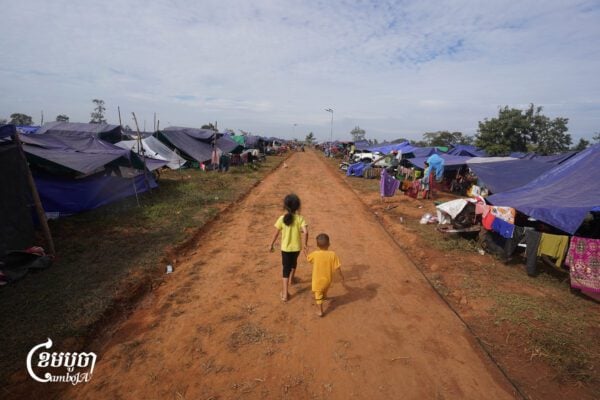
As more than half a million have already fled border regions on both sides to displacement camps, those forced or coerced to work in scam compounds remain without support, according to Sims.
“It is also important to note that the only legitimate shelter in the country willing to help trafficking victims coming out of these compounds is entirely overwhelmed,” he said, referring to the Caritas shelter on the outskirts of Phnom Penh, which previously received funding from USAID before the contract was cut.