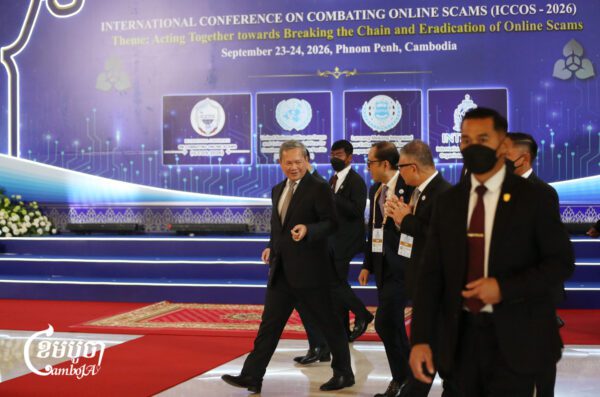
A blistering report by a prominent U.S. crime expert, disallowed from returning to Cambodia by his employer in 2023 over alleged threats, has triggered a wave of condemnation from Cambodian officials after calling for expanded U.S. sanctions on elites linked to the country’s online scam industry, including a cousin of the prime minister.
The report, titled “Policies and Patterns: State-Abetted Transnational Crime in Cambodia as a Global Security Threat,” was authored by Jacob Sims, a visiting fellow at Harvard University’s Asia Center and analyst of transnational crime networks.
Funded in part by the U.S. government, the report draws on open-source investigations, literature reviews and more than 50 in-depth interviews with diplomats, experts, academics, civil society actors and journalists. Sims accuses Cambodia’s ruling party of actively fuelling a multibillion-dollar online scam industry built on human trafficking and protected by the state.
It was officially launched on May 16 at the Foreign Correspondents Club of Thailand in Bangkok, where Sims appeared alongside a panel of fellow researchers.
The Cambodian government has since strongly rejected the findings, calling them politically motivated and claiming the report ignores ongoing efforts to combat such crimes. Officials offered limited counterclaims to specific examples raised in the report, including alleged links to politically connected elites.
Interviewees for the study recommended indictments, sanctions, visa bans and other accountability measures for 28 government officials and businesspeople, including Prime Minister Hun Manet’s cousin Hun To and his advisor Chen Zhi, who chairs Prince Group Holdings, a conglomerate at the center of investigations into links to organized crime.
Prince Group has rejected the report’s findings, calling them false and defamatory in a statement

“The report makes grave accusations that do not reflect reality,” said government spokesperson Pen Bona. He acknowledged the presence of scam centers in the country but argued authorities had taken steps to combat the illicit industry, including the creation of an inter-ministerial committee led by the prime minister to crack down on scam rings.
Sims, both in his remarks and the report, dismissed government references to occasional raids and the creation of an inter-ministerial committee as “rhetorical and performative,” arguing the actions shield perpetrators, deflect scrutiny and fall short of meaningful reform.
Chea Thyrith, spokesperson for the ruling Cambodian People’s Party, dismissed the report’s findings as politically driven and accused its authors of trying to damage Cambodia’s reputation. He pointed to U.S. government funding behind the research and denied any links between the party and transnational crime.
Sims said the report’s core findings – that Cambodia’s ruling party is a key co-perpetrator in trafficking-fuelled fraud – certainly carry political implications, but were based on scholarly inquiry and rigorous research, not political motive. He said U.S. funding did not influence the work.
The researcher, who onced faced credible threats of detention in Cambodia, defended the report’s independence and methodology.
Thyrith also emphasized that the online scam industry is a regional problem, a point frequently made by government officials. “Preventing it [scams] is no easy task and cannot fall solely on the shoulders of one government. It requires international cooperation, and each country must educate its people about the risks to support prevention efforts,” he added.
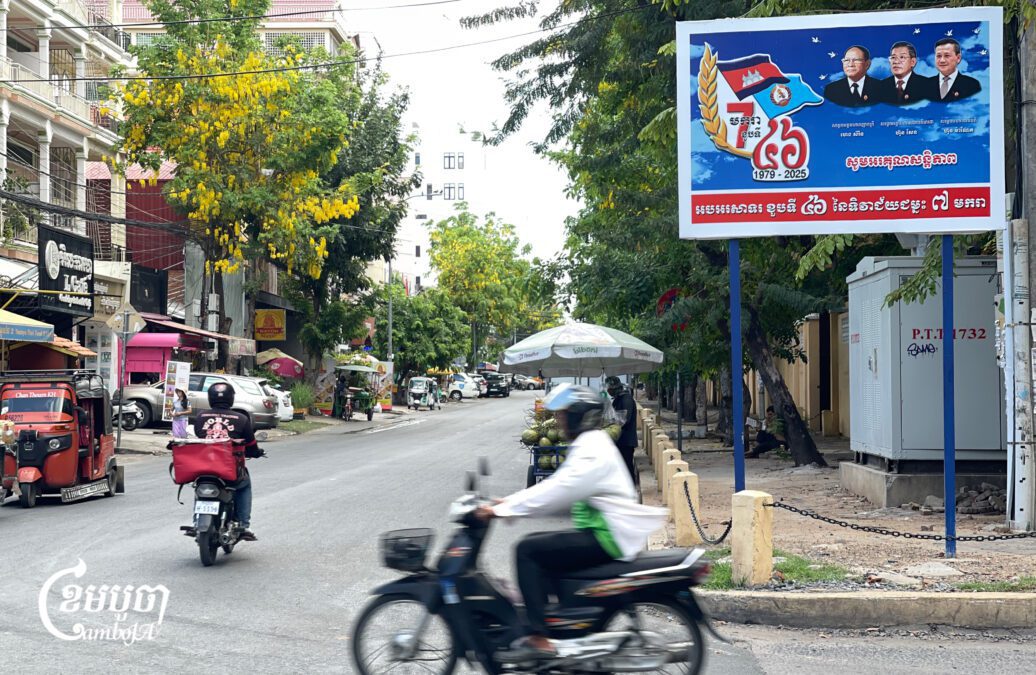
The Cambodia Counter Trafficking in Persons Project estimates at least 350 scam compounds are operating nationwide, exploiting around 150,000 foreign workers.
Scamming has emerged as one of Cambodia’s most lucrative industries, with annual revenues estimated at $12.5 billion to $19 billion – up to 60% of GDP – far exceeding the garment sector, according to Sims’ report. The figures draw on research by institutions including the United States Institute of Peace and the United Nations Office on Drugs and Crime.
Despite data pointing to a growing scam economy, the National Police, in a statement posted by Deputy Prime Minister and Interior Minister Sar Sokha on Facebook, denied claims of state protection for scam operations. The statement said authorities had raided 18 scam centers, expelled more than 3,700 foreigners from 16 countries and sent 76 suspected ringleaders to court since 2024
Sokha is among the 28 individuals named in the report for possible sanctions and other accountability measures.
Meanwhile, concerns have previously been raised over a lack of trafficking victim screening during raids on scam compounds – a point echoed in the report.
Sims also criticized officials for downplaying trafficking as “labor disputes” and dismissing victims as “liars” or “attention seekers.”
“The government is certainly active – but primarily in protecting the industry and deflecting international pressure,” he said.
“There have been no meaningful reforms. The government’s actions to date make the strongest case for one of the report’s central arguments: Cambodia’s scam industry is now too big to fail, and the state-party is too deeply invested to change course—unless profound shifts in incentives occur.”
Note: This article was updated on May 22, 2025, to clarify that Sims was disallowed by his employer from returning to Cambodia in 2023 after it alleged receiving threats about his detention, and that he did not flee. The update also clarifies that Sims did not declare his research was formally peer reviewed.