Listen to the audio version of this article (generated by AI).
Cybersecurity experts called for greater investment in digital, AI and cybersecurity skills among young Cambodians, warning that strengthening their knowledge and skills is important as cybercrimes increase and young people face rising risks of online attacks.
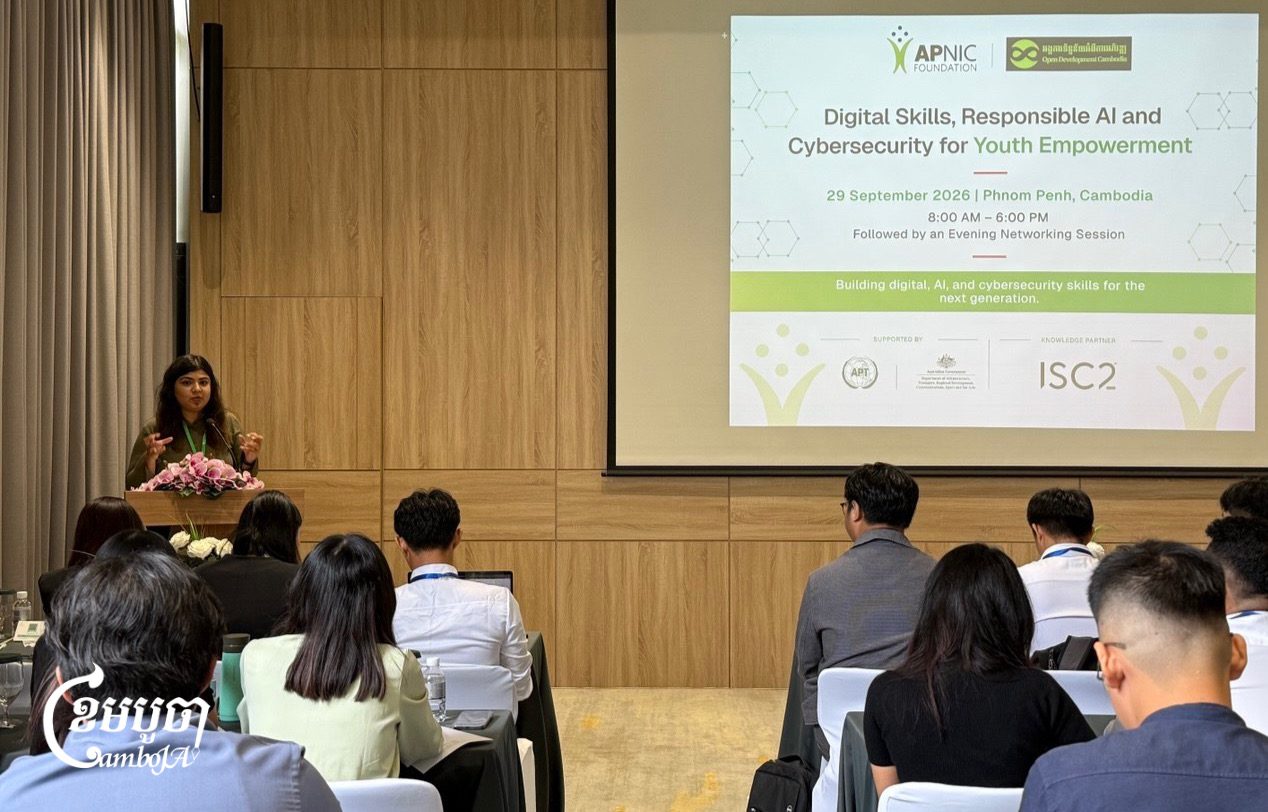
Around 50 university students, fresh graduates and early-career professionals participated in a workshop on “Digital Skills, Responsible AI and Cybersecurity for Youth Empowerment” on Tuesday.
The workshop was hosted by the APNIC Foundation and Open Development Cambodia (ODC), which is being held under the Asia-Pacific Telecommunity Young Professionals and Students Programme (APTYPS). It provides young people with opportunities to develop ICT knowledge and skills for their everyday digital lives.
Joveria Zahid, Strategic Partnerships Advisor at the APNIC Foundation, said Cambodia’s digital transformation is creating opportunities for young people in how they learn, communicate and access services, but having access to technology does not necessarily mean having the skills to use it safely and effectively.
“Access to technology alone is not enough,” she said. “To really benefit from these technologies, people also need the skills, people also need the knowledge and confidence to use them effectively, safely, and responsibly.”
Aftab Siddiqui, Head of Stakeholder Relations at the APNIC Foundation, said in the press release that AI literacy goes beyond knowing how to use generative AI tools, requiring young people to understand their limitations, verify information and use AI responsibly.
“AI literacy now requires more than familiarity with generative tools. Young people need to understand how systems such as large language models produce outputs, where those outputs can fail, and how issues such as bias, misinformation, privacy and over-reliance affect their use,” he said.
“Building that capability means combining effective use of AI with verification, critical evaluation and appropriate human oversight, so that these technologies can be applied responsibly in education, work and wider society.”
Meanwhile, Zahid of APNIC Foundation, warned that as more aspects of daily life move online – from email and social media to bank accounts, photos and financial information – cybersecurity risks are also growing. She said AI is making scams more sophisticated, with convincing messages that can appear authentic and trick people into clicking malicious links.
In mid-2026, government crackdown on online scams exposed weaknesses in Cambodia’s mobile phone registration and banking verification systems. In one case, an unknown person allegedly used another individual’s identity card to register three Metfone SIM cards and was later found to be linked to financial fraud.
Cambodians also lost more than $45 million to online scams in 2025, according to Interior Ministry data, while authorities recovered less than $20 million.
“At the same time as our lives are becoming more digital, the next problem is cybersecurity. Cybersecurity becomes everyone’s responsibility. Cybersecurity is no longer something that only IT professionals need to understand,” Zahid said.
Young participants at the workshop said the issue was particularly relevant to Cambodian youth, including those studying technology-related subjects who can still fall victim to scams involving requests for bank account information or invitations to fraudulent investment groups.
They also raised concerns about the growing amount of AI-generated content on social media, which can make it difficult for young people to distinguish reliable information from misleading content.
“I see this workshop as really important! Because when it comes to AI and Cyber Safety, it’s something that most youth do not pay clear attention to until they actually face a problem themselves,” said Vuthoeun Korngbormey, a grade 10 student at AUPP Liger Leadership Academy.
Taem Marina, a recent IT engineering graduate, said young people may have some technical knowledge but can still be vulnerable when scammers exploit their emotions.
“Speaking for myself, since I studied in this field, sometimes I can protect myself. But there are still areas where we fall short, especially when it comes to fear, as attackers heavily target our emotions,” she said.
Korngbormey and Marina said digital and cybersecurity education should be integrated into school and university courses.
Ministry of Education spokesperson Khuon Vichheka and Ministry of Posts and Telecommunications spokesperson Liv Sophanarith did not respond to CamboJA News’ requests for comment.
Cambodia has nearly 19 million internet subscribers, but according to UNESCO, only 32% of the population has basic digital skills.
Barry O’Callaghan, a cybersecurity professional working in the consulting field and an ISC2-authorized instructor, said in a press release that investing in digital, AI and cybersecurity skills among young Cambodians is important to securing their future and that of the region.
During the workshop, he warned that students in Cambodia and around the world are increasingly being targeted by scammers through fake jobs, scholarships and phishing schemes.
He told CamboJA News that scammers do not always seek money directly. In some cases, they target young people’s account details so they can use them to scam others.
“I think the younger generation, they do not have much experience with the scam, so they are more likely to take action very quickly, so they are more likely to get scammed,” he said.
O’Callaghan suggested that Cambodian companies use free cybersecurity and data-privacy frameworks, while the government provides more information to help citizens recognize scams and protect their privacy. He also encouraged young Cambodians to consider cybersecurity as a career as demand for professionals grows.