Listen to the audio version of this article (generated by AI).
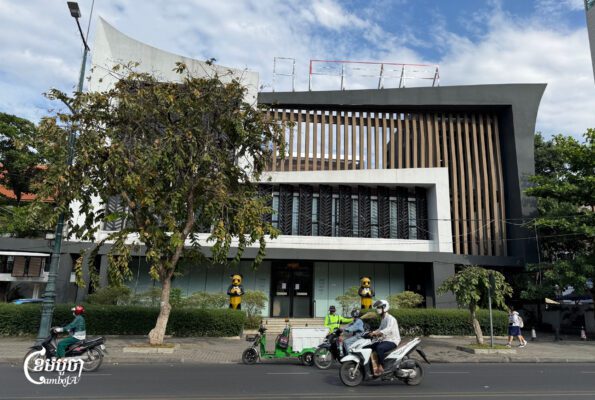
Around 40 Asia-Pacific Development Bank (APD Bank) customers gathered at its headquarters in Boeung Kak area in Phnom Penh on Monday, demanding solutions to withdrawal restrictions they have faced since March, as the bank prepares to close three branches from November 1 onwards without providing specific answers.
The bank would be closing the Norodom, Mao Tse Tung and Olympia branches, according to a notification sent to customers recently.
APD Bank customers told CamboJA News that they want clear answers from the bank and the central bank, National Bank of Cambodia, (NBC), warning that prolonged uncertainty over access to their deposits is undermining their confidence in the bank and the banking sector.
A woman in her 40s, who asked to remain anonymous for security reasons, said she has about $400,000 deposited with APD Bank and had been struggling to access her money for around six months.
When problems first emerged, the bank initially allowed customers to withdraw up to $500 a day. About two months later, withdrawals and bank transfers were suspended, she said.
“The bank has frozen our accounts and won’t let us withdraw our money,” she said.
“Customers put in blood, sweat and tears to earn the money which has been deposited in the bank. We thought we could earn a little interest and save up for our children’s education. But now the bank has frozen everything. We can only view the balance on our phones.”
She recalled the bank offering an annual interest rate of 7%, which was higher than those offered by other banks.
In March, the bank briefly suspended services and capped daily transfers at $300, prompting customers to queue up at its headquarters to withdraw their money. In July, the bank lifted its $500 daily Bakong KHQR transfer limit and $10,000 withdrawal cap on matured fixed deposits, allowing primary customers to withdraw up to $20,000 based on the consolidated balance of all their accounts.

She has several times visited the bank to seek clarification but received no concrete answer. The staff told her that they were only following instructions from higher management, but did not name the person who issued them.
The impending closure of three branches has only heightened her concerns. “I’m extremely worried, and I have lost the motivation to run my business,” she said.
She called on the NBC to explain the situation and urged APD Bank to state how much money it expects to release to customers over the next year, saying greater transparency would ease their anxiety.
“Since Prince Bank and several other banks closed, I have become afraid. I feel deeply discouraged and don’t want to deposit money in banks anymore. I have lost confidence [in them].”
Another customer, who said he has been banking with APD for four years now and holds about $500,000 in deposits, stressed that the bank and the regulator should provide answers rather than keeping them in the dark.
“[They] keep making promises, but these are empty promises. They say they have several plans to resolve the issue, but to this day, there has been no concrete solution,” he said.
He said the bank presented two proposed repayment plans to customers in September, depending on the amount of their deposits.
For customers with deposits below $500,000, the proposed schedule would allow them to withdraw 15% of their funds in the first installment, another 15% after six months to one year, and the remaining 70% over two years.
For customers with deposits exceeding $500,000, the bank proposed offering a condominium unit, allowing them to withdraw 20% of their deposits, and releasing the remaining 60% over two years, he said.
But customers have not received any other updates on the proposals since then.
The man also expressed concern that not having access to his deposits could affect his business, as some of the money is used for working capital.
APD Bank, NBC and the Association of Banks in Cambodia did not respond to requests for comment.
Ngeth Chou, an economist and investment expert at F.I. Vision Capital, told CamboJA News that NBC should clarify APD Bank’s financial position, particularly its liquidity and ability to meet customers’ withdrawal demands.
According to its 2024 annual report, APD Bank holds more than $1 billion in deposits. Its chairman, Wang Dong, who obtained Cambodian citizenship in 2015 and took the name Vong Pech, owns 99% of the bank’s shares, an ownership structure that industry experts have described as “unusual”.
The bank’s service disruptions have fueled speculation amid a crackdown on financial institutions accused of links to scam networks. The U.S. and other authorities have taken action against several firms, including Prince Bank and Huione Pay, now known as H-Pay. The firms and their parent companies have denied involvement in scams or money laundering.
Other Cambodian financial institutions, including Panda Bank, CCU Bank, HH Bank and Heng Feng Bank, have also faced liquidation.
Cambodia remains among the few ASEAN countries without a national deposit insurance scheme to protect depositors if a financial institution fails. This, despite international financial institutions and the NBC discussing such a scheme for more than a decade.