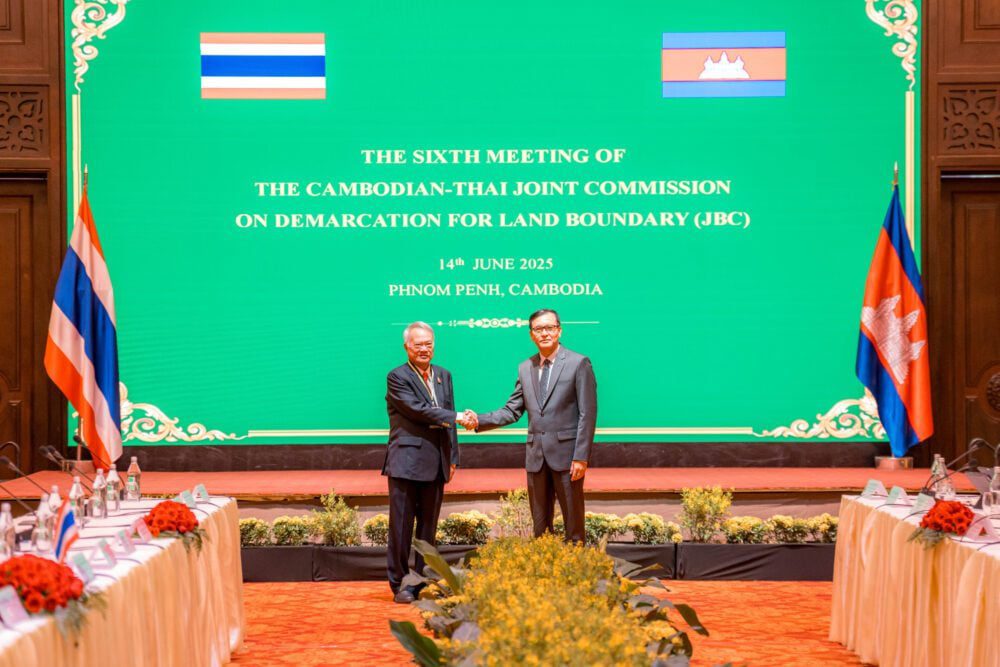
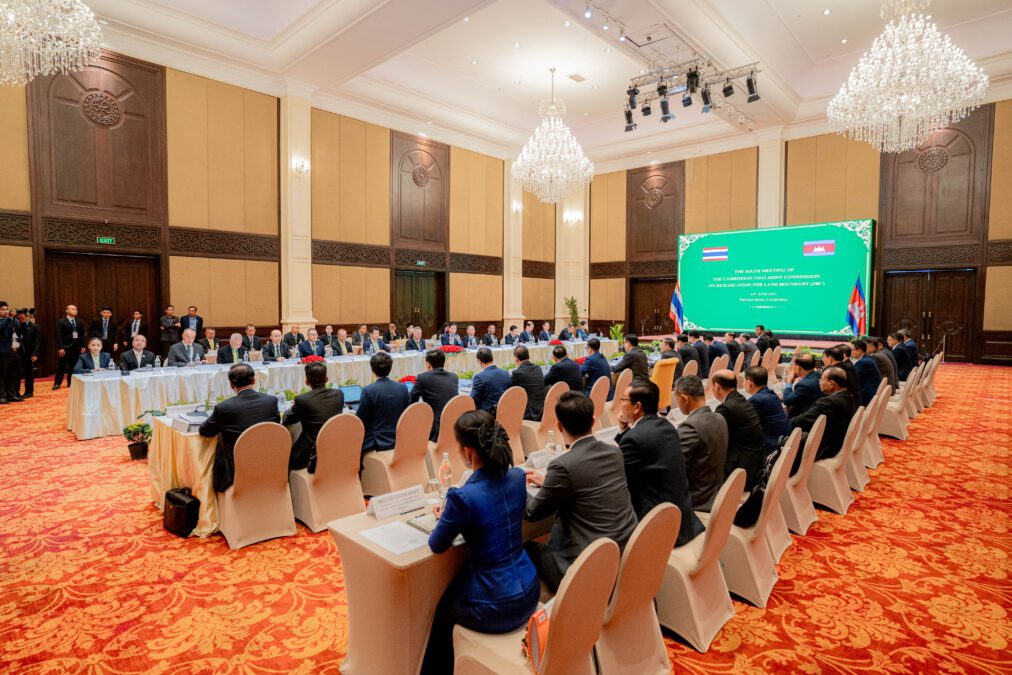
The Thai-Cambodian Joint Boundary Committee meeting in Phnom Penh on Saturday, the first since a fatal border clash ignited tensions, was extended by a day, with few details on progress and after Prime Minister Hun Manet issued late-night demands on the eve of talks outlining what was off-limits.
The long-awaited meeting followed a flurry of retaliatory steps from Cambodia a day earlier, including a border gate closure, internet cuts and bans on Thai films and boxing matches, along with threats of trade restrictions.
The session opened with a brief preliminary meeting between Cambodian border affairs minister Lam Chea and Thai foreign ministry advisor Prasas Prasasvinitchai.
Talks continued into the afternoon, with the only public comment coming from Chea, who told reporters the meeting went “smoothly” but declined to share details. The discussions were held at the Sofitel Phnom Penh Phokeethra Hotel.
He said the next meeting is scheduled for 9 a.m. on Sunday.
Foreign Ministry spokesperson Chum Sounry was not available for comment.
On the eve of the meeting, Hun Manet posted on Facebook reaffirming Cambodia’s plan to take border dispute claims over four contested areas – including Ta Moan Thom, Ta Moan Tauch, Ta Krabey temples and the Mom Bei area, also known as Preah Vihear temple – to the International Court of Justice (ICJ) on Sunday.
The May 28 clash near Preah Vihear temple triggered the current tensions. Thailand opposes involving the ICJ and does not recognize its jurisdiction.
The UN court usually requires both nations to file jointly to resolve border disputes. Thailand has done so before in the Preah Vihear temple case, which ruled in Cambodia’s favor in 1962 and 2013.
These announcements and demands carry clear political weight and have shaped the tense atmosphere surrounding the Joint Boundary Committee (JBC) talks, with Hun Manet saying the disputed areas would not be discussed as they are being taken to the ICJ, and that the committee is not mandated to address current border restrictions.
“I want to clarify that Cambodia is not the one who initiated this issue. Therefore, Cambodia should not be the one to end this issue first either. What was started unilaterally must be ended unilaterally. There is no need for negotiations. Whoever started it first, that party should end it first,” he wrote on Facebook.
Midway through Saturday’s talks, Hun Manet also ordered ministries and armed forces in provinces bordering Thailand to prepare for a “large-scale” return of Cambodian migrant workers “due to any reason”, and called on microfinance institutions – long criticized for predatory lending – to ease borrowers’ financial burdens.
Hun Sen, who handed power to his son in 2023 and now serves as Senate president, also weighed in – taking a sharper tone and calling on migrant workers to come home.
“I ask our fellow workers to return to the motherland before Thai authorities expel them with humiliation,” he wrote on Facebook.
Government spokesperson Pen Bona confirmed the remarks, saying authorities were preparing to coordinate a mass return.
“Thailand’s army, especially extremist groups, will provoke the situation or disturb Cambodian migrant workers,” he said, adding that the situation at the border remains calm.
Thai media offered few details on the meeting, quoting Thai officials, who said discussions focused mainly on technical matters, including terrain survey technology.
Political analyst Meas Nee said the first day of the meeting focused mainly on exchanging views. He noted that the JBC is not the “decision-making” body for recent border issues.
He expressed support for Cambodia’s decision to refer the four disputed areas to the ICJ.
“If these cases continue to be addressed at the JBC level, it won’t work because the Thai side still insists the land belongs to them. So, the only solution is to involve a third party to resolve the issue,” he asserted.