Listen to the audio version of this article (generated by AI).
Cambodian farmers are calling for stronger government policies, more financing and technical help as they struggle with climate change, rising costs for seed and fertilizer and limited access to markets.
This year, farmers in Cambodia and across the region have been squeezed by higher fuel and fertilizer prices linked to the U.S.-Israeli war with Iran. Forecasters are also predicting a strong El Niño, which could bring extreme heat and drought.
ActionAid Cambodia (AAC), an anti-poverty group that works with the country’s poorest communities, released a declaration on climate justice Tuesday with more than a dozen local partners. The groups called for expanding agroecology, an approach that applies ecological principles to farming and food production, to help the country’s small-scale farmers. They also urged the government to increase investment in the sector.
The declaration targets Pursat, Kampong Thom, Kampot, Oddar Meanchey and Koh Kong provinces. AAC surveyed 256 farmers and 51 local officials about their needs, then reviewed the results with 38 farmers and officials. About 62% of the farmers surveyed said they face problems with weather, water, soil and seeds, and lack technical knowledge, market access and financing.
“This work aims primarily to reduce reliance on imported inputs, promote food safety, ensure sustainable management of natural resources and strengthen community resilience to climate change,” said Kimsan Chantara, AAC’s interim country director.
The approach has gained popularity among farmers who have gone into debt to pay for chemical pesticides and fertilizers
Hok Laikheang, a farmer in Pursat province’s Kampong Lou commune, said she used to rely on farming methods passed down from her parents. She grew vegetables for her family’s meals without thinking about what the market wanted. Heavy rains often rotted her crops, dry-season water shortages made vegetables hard to grow and pests did more damage.
She said training in agroecology from aid organizations improved her harvests and brought in income for her family.
“With agroecological methods, we use net houses to reduce the effects of heat and heavy rain,” she said. “We grow vegetables that require less water, and for some crops, we no longer need to buy seeds.”
But Laikheang said she wants support extended to other areas, especially to women farmers, so they can learn the skills needed to grow vegetables.
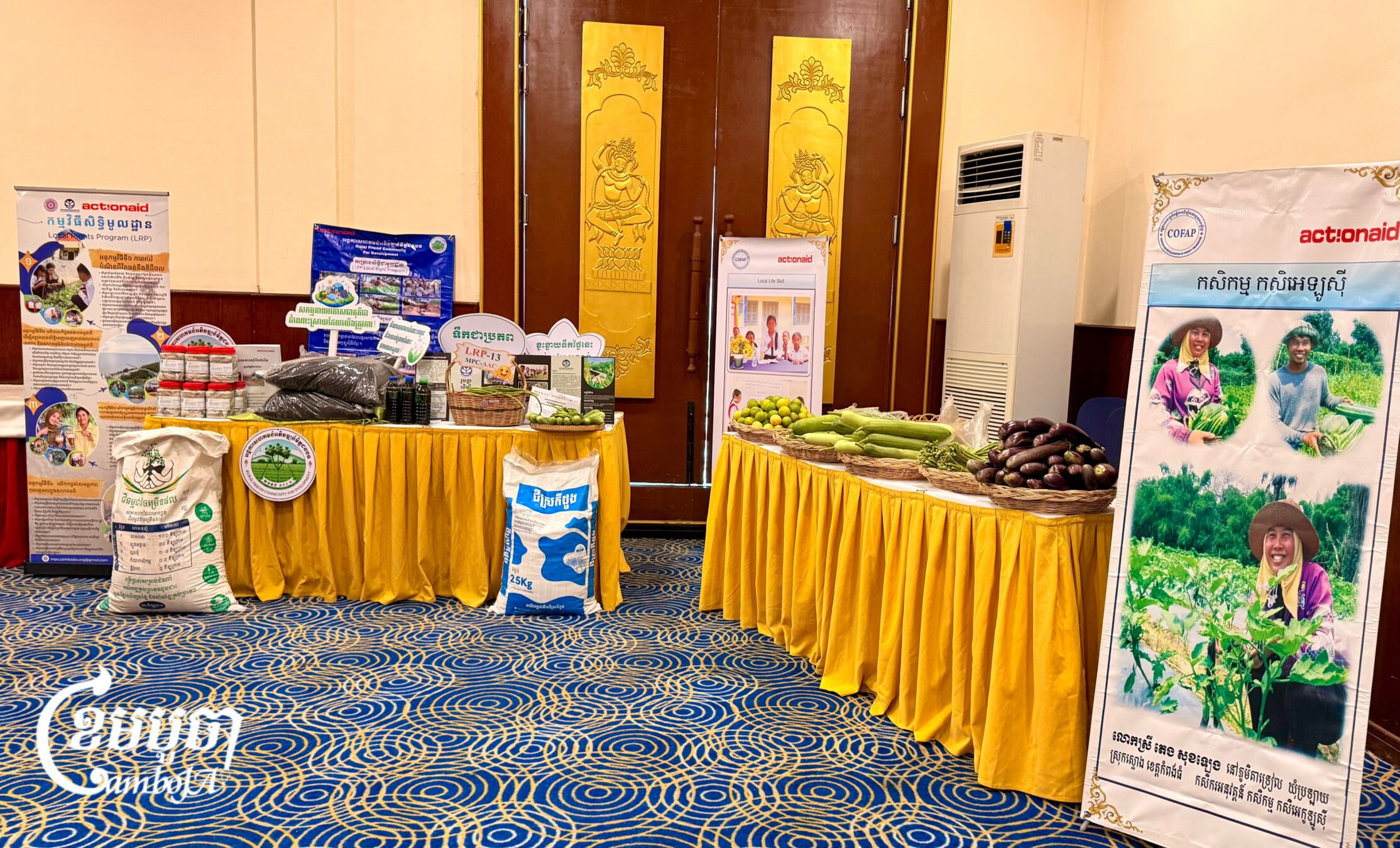
Sao Sreypov, who heads the farmers’ group in Trapeang Phleang commune in Kampot province, said farmers there lack irrigation water and face more pests in the dry season. In the wet season, heavy rain can rot vegetables and other crops.
“We will lose income,” Sreypov said. She added that farmers would have to work harder and would become more vulnerable, and household livelihoods would suffer.
Although farmers in her community have learned some agroecology, Sreypov said the government and development partners should not stop supporting them. She called for policy and financial help from the government and other organizations.
“We still need partner organizations and the government to provide new technical support and irrigation systems because the community still does not have enough water for the entire year,” she said.
Im Monichoth, an official with the Ministry of Water Resources and Meteorology, said small-scale and vulnerable farmers receive only a small share of available funding. He urged NGOs and other government partners to increase financial support.
“Private lenders should also consider offering lower interest rates to farmers,” he said.
Keo Vannary, a member of the Pralay commune council in Kampong Thom province and a women’s rights activist, said local authorities should build their knowledge and take a bigger role in developing agroecology in their communities rather than relying entirely on aid groups.
“Each commune has an annual budget for development, including agriculture, but the challenge is whether local officials know how to allocate those funds to support agroecology,” she said.
The government, meanwhile, has pointed to infrastructure development as a way to help farmers.
Van Promloma, a deputy director of planning and public relations at the Ministry of Rural Development, said the ministry’s priorities include building roads, which he called a “lifeline” for farmers, and providing clean water and sanitation.
The ministry also supports communities through programs such as agricultural cooperatives, he said. Cambodia legalized these farmer-run groups in 2001, and farmers use them to pool money and resources.
“The ministry is already working on resilient rural roads, but financing is one of the challenges in expanding their coverage,” Promloma said.
He added that flooding makes planning difficult. “We cannot predict exactly where water will come from or where it will flow,” he said. ” If we have satellite technology it could be predicted, but disasters cannot be fully predicted.”