Listen to the audio version of this article (generated by AI).
Simple solar-powered systems can ease the burden of water collection, particularly for women and girls. But expanding these initiatives remains a challenge, leaving many households dependent on costly purchased water.
Stung Treng — In 2024, some households in Koh Snaeng village, Koh Snaeng commune, in Cambodia’s northern Stung Treng province, started to experience relief from the daily burden of collecting water.
The change came after a solar-powered underground water pumping system was installed with funding from a REDD+ project, led by a non-profit organization, Culture and Environment Preservation Association and partners, which generates funding from carbon credits from 14 community forest sites in Stung Treng Province.
Women and girls, who are often responsible for household water collection, had to walk for one kilometer to reach the Mekong River to fetch water. Although the community has four borewells, only one is currently functional and equipped with a hand pump.
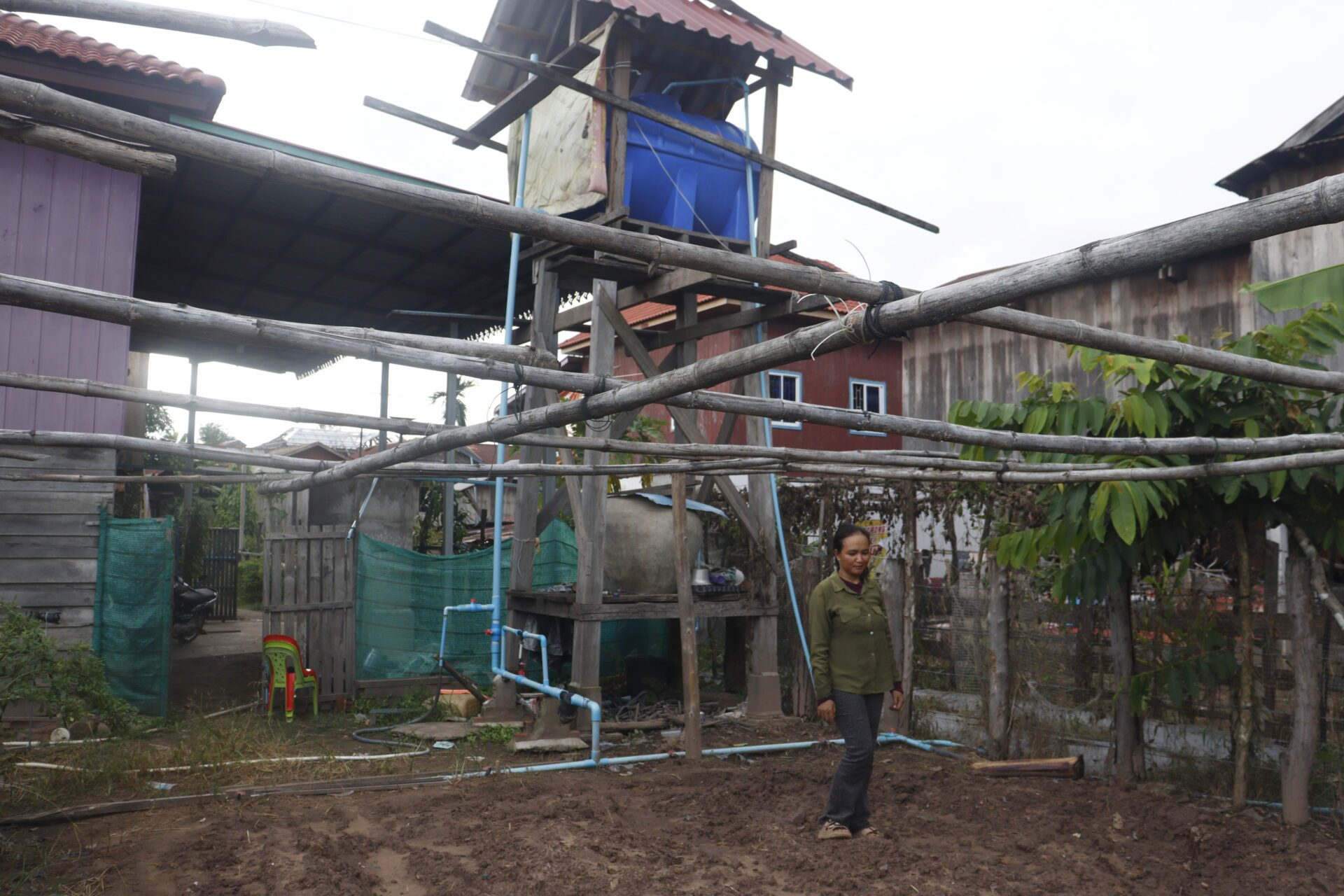
Korn Somdorn, 28, a women’s committee leader in Koh Snaeng village, said the installation of a solar power pumping system draws groundwater and distributes it through a network of pipelines, allowing connected households to access water simply by turning on a tap.
“When we have this water system, it can reduce a lot of time for women from collecting water,” she said.
However, the beneficiaries of this pilot project are still limited to 50 of 400 households in the village, leaving many carrying the hard work to secure water from either the river or hand-pump borewells.
Despite progress in expanding water access, Cambodia continues to face significant challenges in providing water access to rural communities.
A 2024 United Nations assessment, based on 2022 data, found that only 29% of the population had access to safely managed drinking water, a 13-percentage-point increase since 2000.
The situation is particularly challenging in rural areas, where fewer than 20% of the population had access to safely managed drinking water in 2022, with only marginal improvement over the previous decade.
The rate had risen to 25% by mid-2026, according to Pit Karuna, spokesperson for Cambodia’s Ministry of Rural Development.

Meanwhile, the Cambodian government has committed to achieving universal access to basic clean water by 2030. However, substantial investment will be needed to meet this target and tap the country’s abundant water resources.
As Cambodia works towards this target, decentralized technologies such as solar-powered water pumping systems could help rural communities secure water not only for household consumption but also for livelihoods.
However, expanding these initiatives remains challenging, with barriers including funding and infrastructure.
Building Livelihoods Around Water Access
Pete Ford, a clean-energy consultant, said solar-powered water systems offer an effective way for farmers and remote communities in Cambodia to access water for agriculture and daily use. Unlike diesel-powered pumps, they do not require regular deliveries of costly imported fuel.
Once installed, solar panels can provide electricity for daytime pumping for around 20 years.
“This frees up time and money for communities to divert elsewhere – childcare, farming, education and other important time-consuming tasks,” he said.
However, communities need the skills and resources to maintain the systems, particularly as many are more accustomed to using diesel pumps. He added that the technology could also protect communities from fluctuations in diesel prices and fuel availability.
In Koh Snaeng village, access to a solar-powered pumping system is helping some households expand their agricultural activities and generate additional income.
They received additional support from the NGO Oxfam Cambodia, which introduced three solar-powered irrigation systems to the community in 2024. The systems pump water from underground for crop irrigation, helping farmers from 20 households cultivate vegetables without relying entirely on rainfall.

Phong Thanin, 38, a smallholder farmer, said her family had previously relied on diesel pumps to draw water from the Mekong River. Operating the pumps meant spending money on fuel and carrying the equipment, adding to the costs and labour involved in farming. Her family of four, including two school-aged children, also faced financial uncertainty.
Now she can use water from the tank to irrigate her farms, allowing her to grow a variety of vegetables, including cabbage, cucumbers, eggplant and morning glory.
With water available closer to her garden, she said, her agricultural production has improved, allowing her to earn more income while her husband is away working as a migrant laborer.
“This water system helps us improve our livelihood because I can irrigate my vegetables without spending additional money on petrol to pump water from the river,” she said. “It helps me generate more income so that I can send my children to school.”
Costly Water Access for Many
While small-scale solar-powered initiatives offer some relief, they cannot be scaled up to serve all communities. Expanding water access across rural Cambodia will require substantial investment from the government and its partners.
Pit Karuna from the Ministry of Rural Development said her agency is working with multiple partners, including institutions, subnational authorities, development partners, non-governmental organizations, the private sector and philanthropists, to implement the government’s Strategic Plan for Rural Water Supply and Sanitation (2026–2033).
The plan aims to achieve universal basic access to water, sanitation and hygiene in rural areas by 2030, and safely managed access by 2033
Some major partners have already supported the government. In 2024, the Asian Development Bank (ADB) approved a US$93.6 million project to improve rural water supply, sanitation and hygiene services for 88,000 households in 400 villages across nine provinces.
A year earlier, the World Bank approved a US$163 million project to strengthen water and sanitation services for more than 175,000 people in four provinces.
This investment comes amid the intensifying impacts of climate change. Unpredictable floods and prolonged droughts can disrupt water supplies, making it harder for rural households to secure reliable water throughout the year.
According to Cambodia’s Ministry of Environment, climate change could reduce Cambodia’s gross domestic product by 2.5% by 2030 and as much as 9.8% by 2050.
This will significantly affect women and girls, as prolonged water shortages can add to the time, labor and financial pressures of managing household needs.
Hiem Sao, who lives in Tonsaong village in Stung Treng province, said her family relies on water delivered by small tractors, known locally as Koyun, during the dry season.
The vehicles transport 2,000-liter tanks of river water to households, while community members have to ration and share what is available.
“It costs me from 20,000 riels to 25,000 riels ($5-7.50) for around 1,000 liters,” she said. “It is quite expensive for me.”
Only a small number of households in Tonsaong village can afford bottled drinking water, which costs around$0.50 for a 20-liter container.

While water remains inaccessible to many households, Tum Kheum, 70, from Ou Lang village, which is two kilometers from the Mekong River, faces even greater difficulties accessing water after losing one leg due to Cambodia’s civil war back in the 1970s.
He has to buy water from delivery trucks, but the cost places a financial burden on him, while the amount he can afford to buy remains limited.
He added that support from outside organizations is needed to expand water access, and that this should be a priority for the government and its partners.
Some households have found ways to pump river water into storage jars, he said, but many others remain dependent on costly water deliveries.
Reporting for this story was supported by Informed Earth and edited by Mekong Eye.