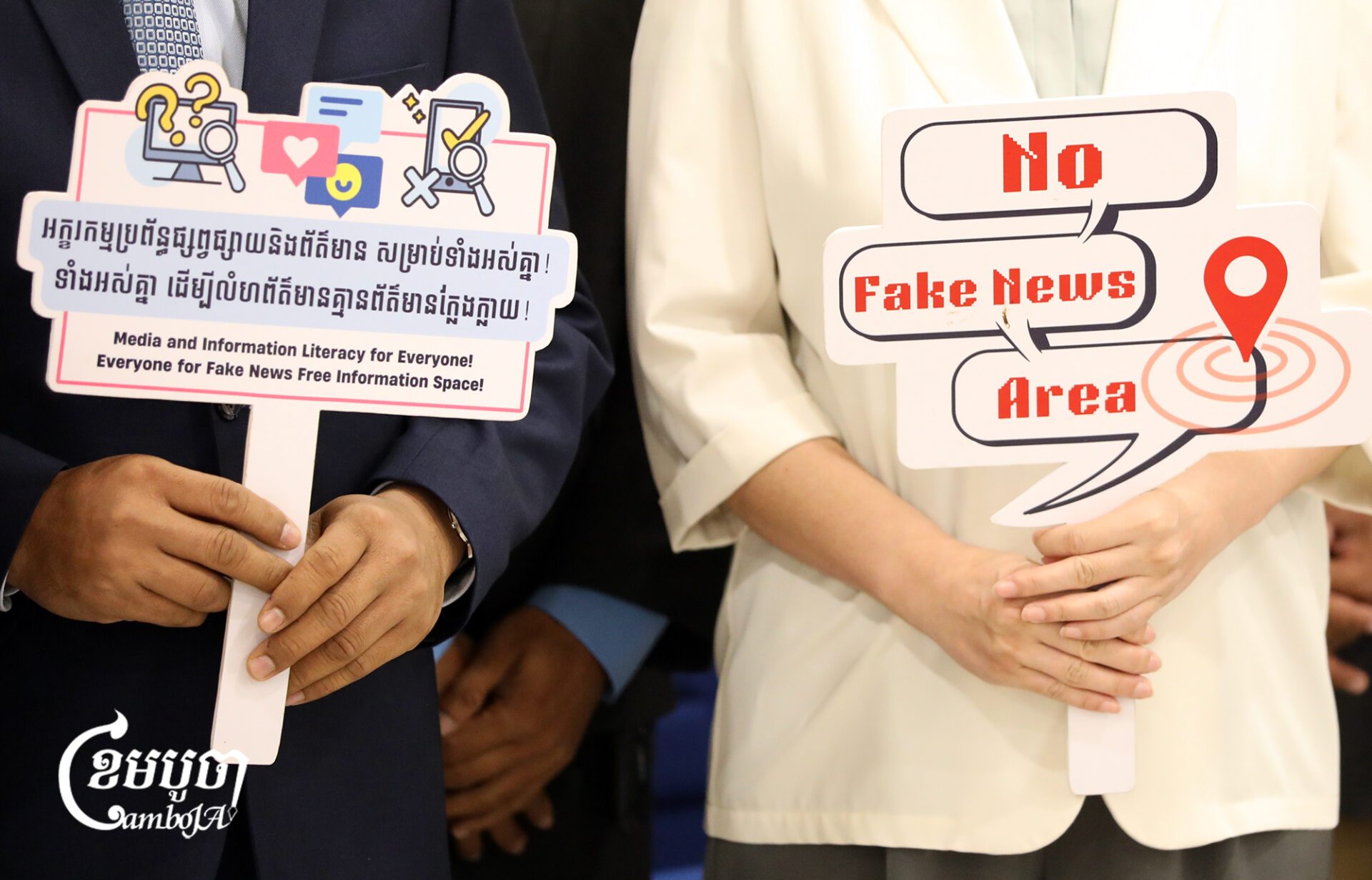
The Ministry of Information has launched Phase 2 of “Zero Fake News”, an initiative supported by China following the completion of the first phase, which cost $1.7 million, with an analyst saying that the initiative reflects China’s reach in Cambodia’s digital media environment.
The China-funded program, developed under the Mekong–Lancang Cooperation (MLC) over the past five years with five projects completed from 2018 to 2024, is in support of the ministry’s effort to combat fake news and strengthen the capacity of journalists through training and exchange visits.
China has provided another $270,000 for Phase II in 2026 “Zero Fake News” campaign, according to Ministry Undersecretary of State Prak Thav Amida.
The Lancang–Mekong Cooperation Special Fund is a China-led regional initiative established in 2026 involving six countries, including Cambodia, Laos, Myanmar, Thailand and Vietnam.
Information Minister Neth Pheaktra said the initiative is aimed to safeguard the “reputation” of the Mekong–Lancang Cooperation between Cambodia and China, particularly through the coordination of his ministry, the Foreign Affairs Ministry and the Chinese Embassy.
He said that the campaign aims to raise awareness about the risks of fake news, whether it is written, via audio or video.
Sophal Ear, a Cambodian-American political economy expert and professor at Arizona State University, said the Mekong-Lancang Cooperation framework is “explicitly regional”, and is presented as a cross-border cooperation.
“It does both, but the soft-power dimension is hard to ignore,” he said, adding that China’s support for media training could create long-term influence over digital information in Cambodia and other Mekong countries. “Especially if this support is sustained over years and embedded in official institutions.”
Sophal said that influence does not always mean direct control over media content and that it could operate more subtly through journalist training, professional networks, partnerships and shared narratives about fake news and responsible media.
He explained that when Beijing funds journalist exchanges, training, and anti-disinformation projects, “it is not just helping solve a technical problem”. He said it is also “cultivating influence over how governments and media actors define responsible journalism, harmful speech, and state authority in the digital space”.
Pheaktra said that he talked to Chen Cong, Minister-Counsellor of the Chinese Embassy of the People’s Republic of China to Cambodia, regarding cooperation between the Ministry of Information and the Chinese Embassy to prevent fake news about China and “misleading information” about Cambodia–China relations on social media.
He said Cambodia has about 14 million Facebook accounts and around 10 million TikTok accounts in a population of about 17 million. In total, there are roughly 24 million social media accounts, meaning each Facebook or TikTok user can act as a broadcaster.
Meanwhile, there are about 1,500 registered media outlets with the Ministry of Information, and around 8,000 journalists holding press identification cards.
Pheaktra claimed that Thailand created fake news during the Cambodia–Thailand border clashes, with the alleged intention of damaging Cambodia’s reputation and economic interests, including claims about a Cambodian incursion related to landmine explosions.
“We have identified fake news cases that involved sensitive social issues, national security, and political stability, or allegedly created to incite unrest or overthrow the leadership,” he added.
A representative of the Chinese Embassy said some media have repeatedly fabricated and spread false narratives and deliberately distorted the truth to harm China-Cambodia relations, and mutual beneficial cooperation and managed fake news about Cambodia and China on social media nowadays.
“We hope Cambodia and China will work closely together to strengthen efforts against disinformation, refute rumors in an objective manner, and safeguard a healthy information environment to support bilateral friendship and practical cooperation,” he said.
The Ministry of Information, which has been monitoring fake news over the past three years noted that in 2023, the anti–fake news committee identified more than 3,200 cases. The number rose to about 3,600 in 2024, and nearly 4,000 in 2025.
Media associations and analysts viewed the anti-fake news campaign as a tool to control journalism, including dissenting voices online, although it was denied by the ministry.
“Yes, that risk is real,” Sophal said, adding that while countering disinformation is a legitimate public goal, the Ministry of Information has publicly tied the campaign to “media integrity” and public awareness.
“But in practice, in a system with weak safeguards for press freedom, ‘fake news’ can become an elastic label that is used not only against fabricated content but also against inconvenient reporting, criticism, or dissenting speech online,” Sophal said.
However, Pheaktra denied those concerns, saying that the initiative is aimed at protecting misinformation.
“I would like to clarify that combating fake news does not restrict freedom of expression or violate press freedom and the right to publish but rather guarantees the citizen’s right to accurate information,” he said.
Chhan Sokunthea, executive director of Cambodia Center for Independent Media (CCIM), said there must be clear principles and definitions, not simply suppressing or restricting those who express their opinion or those who write constructive articles.
“I believe that any funder, whether Chinese or from any other country, should respect the principles of human rights and democracy,” she said.
“In general, funders must not interfere in the policies of the institutions they fund,” Sokunthea added.