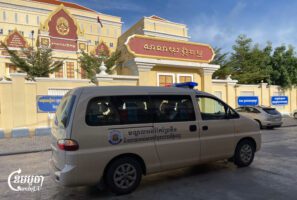
Phnom Penh Municipal Court on Friday denied bail to eight activists, including an outspoken Paris Peace Agreement Srun Srorn, charged with incitement to disturb social security order.
Judge Nhim Pisal announced the verdict rejecting the defendants’ request for bail but declined to elaborate the decision, according to the defense lawyers.
“The verdict was announced in a very rushed [manner] without mentioning the reason, and the judge immediately rejected the lawyer’s request,” said defense lawyer Son Chum Choun. “We regret this decision.”
The Paris Peace Agreement activists were arrested in July last year after posting live videos on Facebook expressing their opinions on the alleged ceding of Cambodia’s northeastern provinces to Vietnam under the Cambodia-Laos-Vietnam Development Triangle Area (CLV-DTA) regional cooperation initiative.
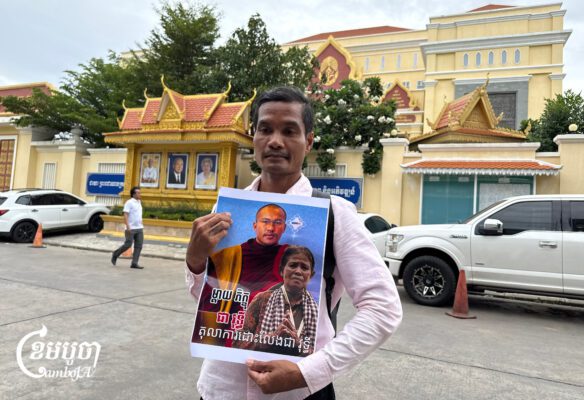
Svay Pov, the wife of defendant San Seth, who attended the courtroom on Friday, expressed disappointment over the bail decision, insisting that he is innocent.
“I am very sad because my children came with me to welcome their father, instead he remains in custody,” she said, adding that she will discuss with the lawyers to file an appeal in the Court of Appeal.
“He is a good husband. What he has done was a contribution to society, and to help the community, especially in agriculture,” Pov said.
She stressed that the Cambodian Constitution guarantees the right to freedom of expression and participation, which allows Khmer citizens to engage in society and political activities.
Yi Soksan, a senior investigator with rights group Adhoc, said their continued detention is “unjust,” describing the prosecution as a form of punishment against those who dare to express opinions critical of the government.
He pointed out that the maximum penalty for incitement charges is six months to two years, yet the defendants have been behind bars for over a year already without a full trial on their cases, which he described as a de facto sentence without due process.