Listen to the audio version of this article (generated by AI).
Cambodia remained on the lowest Tier 3 ranking in the U.S. State Department’s human trafficking report released Friday, which found the government had failed to meet minimum standards for eliminating trafficking and was not making significant efforts to address the problem.
The report focused largely on Cambodia’s online scam industry, saying some senior government officials, advisers and law enforcement officers profited from trafficking victims in scam centers and interfered to protect the operations and intimidate victims and civil society groups.
It repeated last year’s finding that while Cambodia had no explicit policy of human trafficking, there was “a government pattern of human trafficking involving scam centers.” That finding led the State Department in 2025 to label Cambodia a state sponsor of trafficking for the first time. Cambodia has been ranked Tier 3 since 2022.
Government spokesperson Pen Bona and Interior Ministry spokesperson Touch Sokhak declined to comment and referred questions to Chou Bun Eng, permanent vice chair of the National Committee for Counter Trafficking. She did not immediately respond to a request for comment.
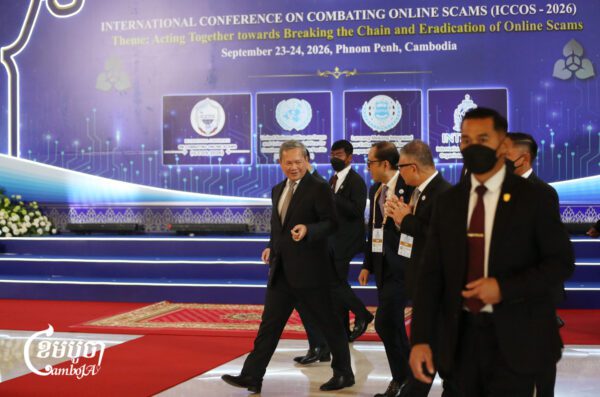
The report comes after a yearlong crackdown that the government says has eliminated all large-scale scam compounds in the country, capped by an international anti-scam conference in Phnom Penh last month. Authorities say they have raided more than 600 sites since July 2025 and detained nearly 30,000 suspects of 39 nationalities, while more than 240,000 foreigners left the country voluntarily between mid-January and April alone. The U.N. human rights office estimated in 2023 that at least 100,000 people were being forced to work in scam operations in Cambodia.
The State Department credited the crackdown with closing hundreds of suspected scam centers, freeing thousands of potential trafficking victims and netting high-profile arrests, including Prince Group chairman Chen Zhi, who was extradited to China in January. But it said residents and survivors reported that compounds began emptying before police arrived, and that nearby scam centers kept operating.
“The government did not prosecute any traffickers related to scam center activity, and detained tens of thousands of former scam workers in immigration detention facilities, reportedly with minimal or no screening to determine their potential status as trafficking victims or to refer them to adequate services,” the report said.
The report, which covers April 2025 through March 2026, said the government demoted eight officials allegedly involved in scam crimes but reported no investigations, prosecutions or convictions of government employees. It said authorities also took no action against two U.S.-sanctioned senators, Kok An and Ly Yong Phat, despite evidence linking scam centers to companies they own or control. Both senators have denied involvement in scam operations.
Chhay Sinarith, head of the Commission for Combating Online Scams, said in August that the Anti-Corruption Unit had since arrested 15 high-ranking officials and law enforcement officers in four scam-related cases. He told Nikkei Asia last month that the government was investigating the two senators’ properties.
Mark Taylor, an anti-trafficking consultant and former chief of party for the U.S.-funded Cambodia Counter Trafficking in Persons project, said the crackdown had focused on closing compound buildings rather than targeting the criminal networks behind them, and that authorities treated workers removed from the compounds as offenders and deported them instead of using them as sources of intelligence.
“From a human trafficking perspective, this situation is an unmitigated disaster,” Taylor said. “The largest population of transnational trafficking victims Cambodia has ever seen has been further punished by the state while the actual traffickers remain immune from any enforcement threat.”
Taylor said the government also discouraged aid groups from helping foreign victims and responded slowly to embassies seeking to repatriate their citizens. Pressure through regional forums such as ASEAN and the Bali Process could push for a stronger response, he said, but closing compounds without pursuing traffickers, money laundering and criminal networks would not deliver lasting results.
Beyond the scam industry, the report cited debt bondage at brick kilns affecting more than 10,000 people, including nearly 4,000 children; the re-recruitment of Cambodian men and boys who fled Thailand during last year’s border conflict for forced labor on Thai fishing vessels; and women and girls trafficked to China for forced marriages. It said labor traffickers typically received fines or jail terms of a month or less.
(Additional reporting by Coby Hobbs)