Listen to the audio version of this article (generated by AI).
Fuel prices in Cambodia have continued to increase significantly—a spike that is particularly worrying for durian and rice farmers who rely on diesel to power irrigation pumps after costs nearly doubled, with the government coordinating efforts to address these challenges.
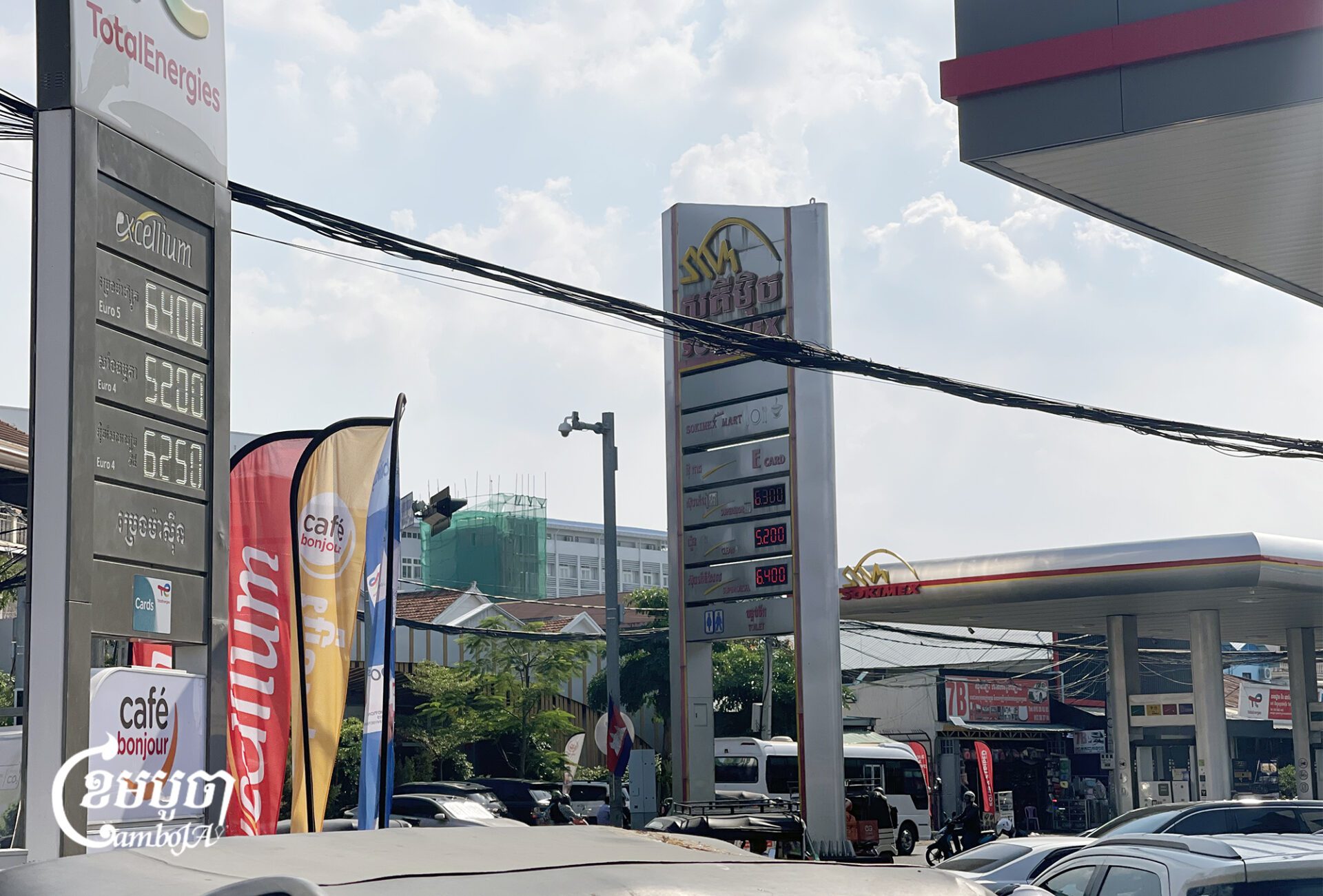
Gasoline prices between March 14 and 16 rose 800 riel to 5200 riel per liter, while diesel prices climbed to 6,400 riel per liter, up from 6,050 riel previously, according to a statement by the Ministry of Commerce last week.
U.S. President Donald Trump on Sunday urged the United Kingdom, China, France, Japan, South Korea, and others to escort ships passing through the Strait of Hormuz, one of the busiest commercial routes in the world, after it was blocked by Iran.
Brent crude, a significant crude oil benchmark, increased three percent on Sunday to $106 per barrel before declining slightly early Monday. Since the start of the conflict, oil prices have increased by more than 40% worldwide, pushing up gasoline costs and raising fears of a global economic slowdown.
Foreign analysts said rising fuel prices might not abate even with the release of 400 barrels of oil by the International Energy Agency into the market.
A durian farm owner in Ratanakiri province, Hok Met, said the price of diesel has nearly doubled compared to about 3,000 riel per liter before the Middle East war broke out.
He uses more than 30 liters of diesel per day to pump water during the planting season, spending up to 120 liters per week. He owns five hectares of durian plantation.
“The hike in diesel prices is affecting our expenditure. I am worried that if it continues to increase, we will experience a heavy burden [on our expenses] and may lose profit,” he said.
He shared that there might not be much profit from durian yields this year due to the hot weather but coupled with the rise in diesel price, the impact on farmers’ livelihoods could be more.
“We heard that [although] fuel prices have decreased, they remain high,” he said, adding that he would continue growing durian, having invested a lot. Thus, it would be difficult to switch to other crops.
However, he is thankful that the price of fertilizer remains stable for now—between 100,000 riel and 200,000 riel per bag—depending on the type of fertilizer.
A rice farmer in Battambang province, Hok Tha, 42, had similar concerns about rising diesel costs, and plans to not invest in short-term rice cultivation (Sre Nge) due to the high fuel cost and low market price of rice.
“When fuel prices rise, we lose profit. Sometimes we don’t have enough money to buy fuel. [It doesn’t help that] the price of rice is low, only 700 riel [per kilo]. So, if diesel prices continue to increase, we will stop cultivating short-term rice,” he said.

Agriculture Ministry spokesperson Khim Finan declined to provide details on the measures to prevent the rise of fuel price, referring the press to their official statement.
According to the ministry, coordination with relevant ministries and provincial departments to monitor fuel prices is ongoing.
It is also working with the Ministry of Mines and Energy and the Ministry of Commerce to resolve issues quickly seeing that farmers or agricultural communities are facing issues obtaining fuel.
Hong Vannak, economics researcher with the Royal Academy of Cambodia, said the surge in fuel prices is creating a serious crisis, especially for farmers who are experiencing rising production costs.
“When the price of a key product like fuel keeps climbing, many won’t be able to afford it. There is simply no fuel available for sale at times,” he said.
He urged farmers to carefully plan production and be prudent with fuel consumption, suggesting the use of renewable energy sources such as solar and bioenergy.
He said efforts should be made by the government and the private sector to produce local agricultural products to help reduce costs.
Commerce Ministry spokesperson Pen Sovicheat could not be reached for comment.