Listen to the audio version of this article (generated by AI).
The government on Wednesday approved a $2 increase in the minimum monthly wage for garment, footwear and travel goods workers, bringing the base wage to $212 for 2027, with workers and unions saying the amount would not be sufficient to cover their living costs.
The current base wage of $210, even when combined with a $2.50 transportation allowance, is not enough, they said, citing an average monthly household expenditure of $504 among garment workers’ families.
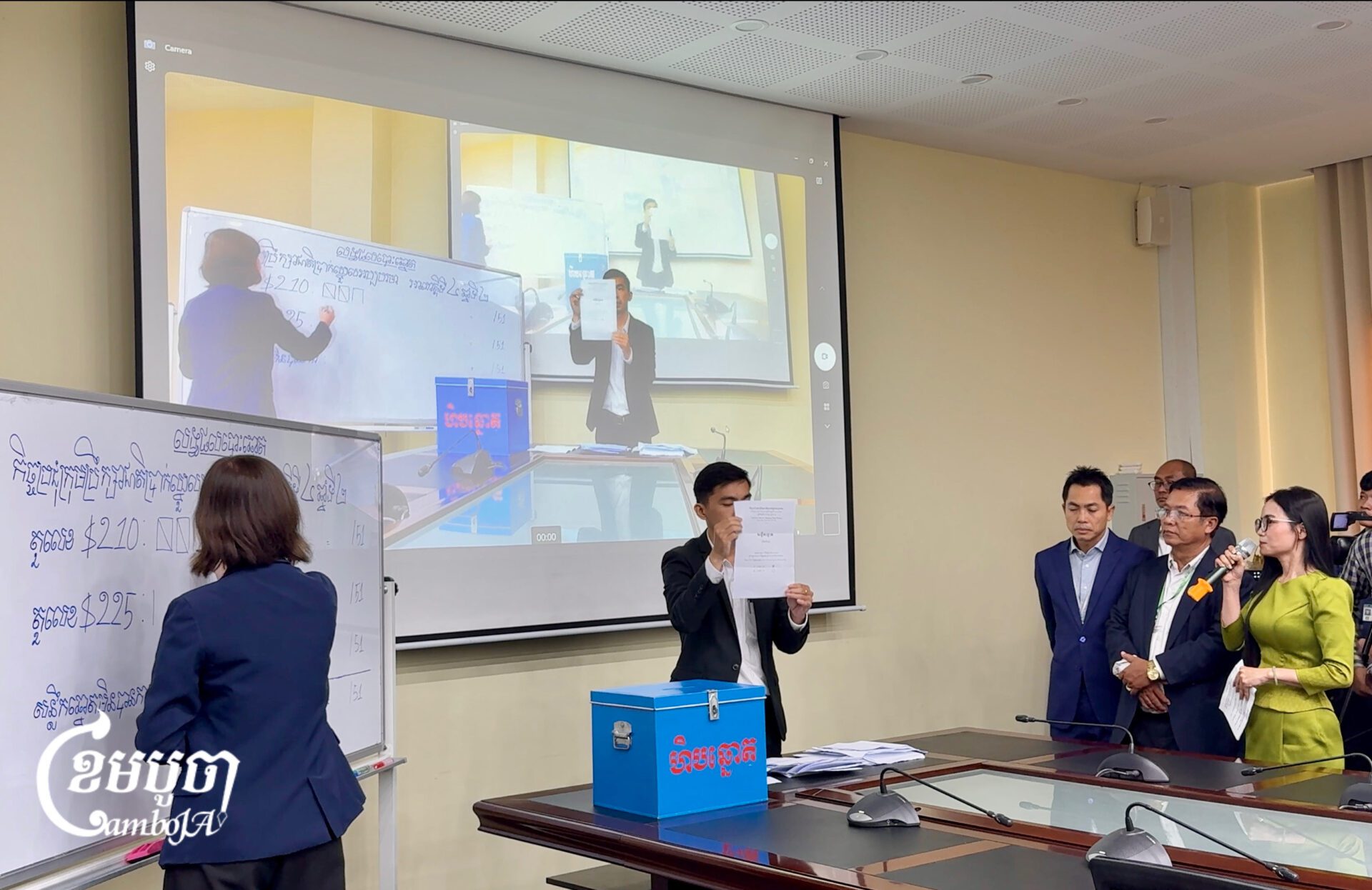
At the final meeting of the tripartite National Council on Minimum Wage on September 30, a majority of the 51 council members voted in favor of a $210 minimum wage. Forty-seven members voted for $210, while three supported the unions’ proposed $225 figure, and one abstained.
After the vote, Prime Minister Hun Manet intervened by adding $2 to the council’s $210 figure, bringing the 2027 minimum wage to $212 which was approved by the National Council on Minimum Wage, Labor Minister Heng Sour told reporters. Existing benefits remain unchanged.
Sour said some economists and other groups who discuss economics might not understand Cambodia’s wage structure and focus only on the minimum wage when comparing Cambodia with other countries, without taking additional allowances into account.
“Whenever we talk about the minimum wage, please don’t forget to add the benefits worth $19.50. In general, workers receive at least $231.50 a month, even without overtime. It is not just $212 a month,” Sour said.
He added that the government and relevant parties would work to improve the investment environment for industrial development while taking other measures to reduce the daily living costs of people, particularly workers.
Nang Sothy, vice president of the Federation of Employers and Business Associations of Cambodia, representing employers, said employers agreed with the government’s decision and urged people not to view the $2 increase as “too small”, citing Cambodia’s economy, border issues and uncertainty in the global economy as current challenges affecting the manufacturing industry.
He said declining exports and rising international transportation costs could increase the burden on employers and affect the competitiveness of the garment sector.
“Please don’t judge the additional $2 as too little because we are facing an economic crisis, border issues and problems in the global economy,” Sothy said.
He said employers are facing additional transportation costs because of the crisis and that the actual cost of employing a worker is more than the announced base wage.
According to Sothy, the mandatory $19.50 benefits provided by employers, includes a $10 regular attendance bonus, $7 for housing and transportation, and $2.50 to cover increased transportation costs related to the Suez Canal crisis.
Taken together, the total cost to employers per worker could reach about $231.50, he said. “In reality, it is not just $212.”
Sothy said Cambodia is not a fully industrialized country but relies heavily on processing and exports. The sector therefore depends on international markets and the transportation of goods overseas.
“Our country is not an industrial country. In general, we are a processing country, and all these goods need to be exported,” he said.
He added that economic uncertainty and conflicts in different parts of the world could affect Cambodia’s markets and exports.
According to CENTRAL, 75% of garment workers’ families are in debt and 56% of workers rely on overtime work. As a result, workers’ families have been forced to reduce spending on food and education to cover their living expenses.
Civil society groups have repeatedly urged the National Council on Minimum Wage to consider the findings from a recently released 2026 survey on household consumption among Cambodian workers, while calling for an increase in the minimum wage to $250.66.

Sok Kanh, a factory worker in Phnom Penh, said the base wage is separate from overtime pay and other benefits, meaning a $2 increase would not be enough to cover workers’ living costs.
“The base wage is separate from overtime and other benefits,” she said. “If the base wage increases by only $2, I don’t think that is enough for workers to live reasonably.”
Kanh said rising prices for goods and rent would further reduce the impact of any wage increase.
“If wages increase but market prices are stable, we would have no problem. But prices and rent are also increasing, and that puts an additional burden on workers,” she said.
She called on the government, businesses and landlords to keep prices and rents affordable for workers.
“The current $210 base wage is not enough, especially for workers with children,” Kanh said. “For example, a worker with two children pays $30 or $40 in school fees for each child, which could already cost $80. They still have to pay for school supplies, food and other daily expenses.”
Yang Sophorn, president of the Cambodian Alliance of Trade Unions, expressed disappointment with the minimum wage negotiations, saying the increase would not allow workers to achieve a better standard of living.
She said inflation had reached 3.8%, equivalent to about $8 in additional costs, while market prices continued to rise. The figure also does not include increases in electricity, water and rental costs for workers, she said.
Sophorn also rejected claims that demands for higher wages would cause factory owners to move their operations to countries with lower wages.
She said businesses have a social responsibility to workers, including paying wages and respecting human rights, and they must comply with the law in the country they operate in. She also said it was unlikely that factories would close because of wage increases, arguing that there is sufficient labor force in Cambodia and that it remains favorable for businesses.
“Workers need to receive between $250 and $300 to meet their basic needs and ensure a decent standard of living. But the 2027 wage negotiations resulted in only a $2 increase. I don’t think they can meet their daily living expenses,” she said.