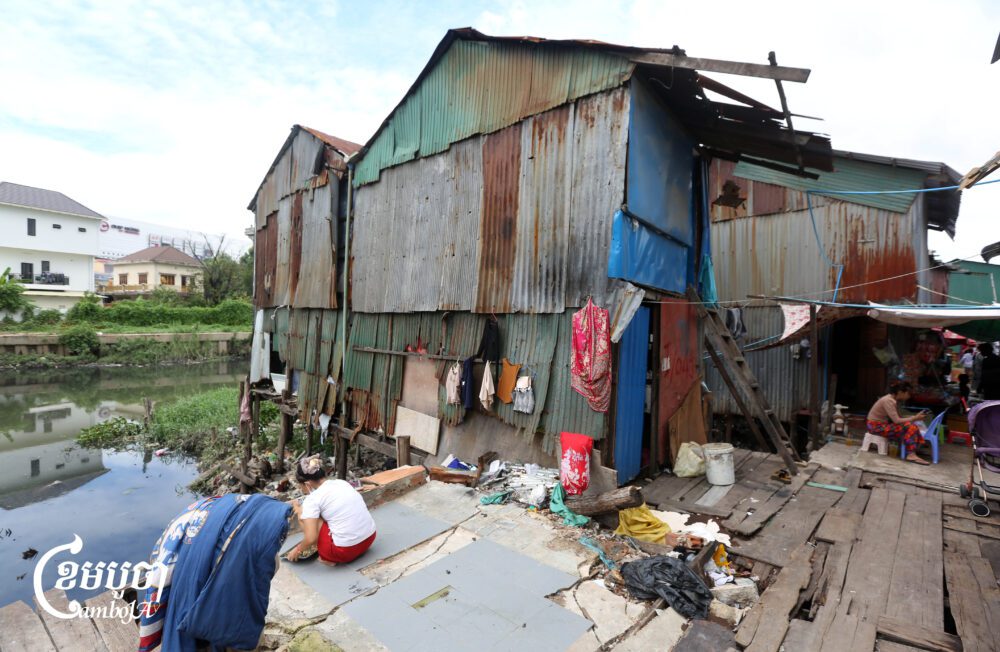
The Chamkar Mon district authority has extended the deadline for 12 households in the Samaki Rong Roeurng community to look for rental homes or new locations before eviction takes place. However, the residents insist that they will not leave as the compensation of $1,000 to $4,000 is not adequate.
Over 90% of the sewerage and flood prevention project running through the community in Phnom Penh, is complete, the Chamkar Mon district authority said on June 13, 2025, but the construction is stalled because 12 families have not accepted compensation.
The improvement of the drainage system in the capital is part of a flood mitigation that includes a sewage and water discharge system. There are 50 flood mitigation projects in Phnom Penh, where 23 are being implemented, and 13 under construction now.
The households were initially asked to leave by June 22, with a warning by the authority that the area will be cleared and it will not be responsible for any damage to their property. The villagers lamented that the compensation is low, pleading for more equitable assistance or alternative land.
Nou Him, 47, a potato seller, told CamboJA News that the Chamkar Mon district notified them of the June 22 deadline, asking them to demolish their houses and accept the compensation allocated in accordance with the size of their house as stipulated by the regulation.
But, as of June 23 (Monday), the authority did not come to the village to demolish their houses despite the end of the deadline. She is still concerned about the compensation by the authorities, saying it is the “smallest ever” as she will not be able to find a proper shelter. The authorities should consider providing a location for the residents to move to.
“We did not see anything different on Monday morning, however, the district governor told us that in two weeks’ time, he would bring us to see the houses built by the authorities near Chouk Va pagoda. We have not decided to go yet,” Him said.
“I want a small piece of land to build a house on, with a title deed because it’s easier for me in the future,” said Him.
Another villager, Chreung Mom, 59, who has been living in the area since 1999, said she has a family book, identity card, and voter registration card, which are recognized by the authorities. Therefore, when the authority needs land and houses for development, the authority should provide compensation and a proper shelter for people, she added.
Although she supports development for the beauty and common good of Phnom Penh, the development should consider the impact on poor people like her and other villagers.
According to Mom, the Chamkar Mon district authority issued a letter to residents to demolish their houses and receive compensation by June 22 but on June 20, the district governor told them to meet at the Phsar Deum Thkov commune where they were informed about the extension of the deadline to demolish their houses.
The authority also told them that they will provide the residents a site measuring 4.5 meters by six meters to build a house in Kok Roka, and that her compensation was about $4,000 only.
“I haven’t seen any demolition yet, but the authorities asked us to settle in the commune and that they would let us move to a new location, but I have to go and see the location before I can decide whether to go or not.”
“I am also worried that I will not be able to continue my small business in the new location. In addition, the location is small for my family of seven members,” Mom said.
Chamkar Mon district governor Keang Lak told CamboJA News that only 12 households in Village 5, Phsar Deum Thkov commune have yet to demolish their houses and accept compensation, despite the authorities giving them time and “pleading many times” to move.
Keang Lak said compensation and technical issues are handled by the inter-ministerial committee, while the administrative part is carried out by the Chamkar Mon district authority. It facilitates the compensation process for residents and helps them relocate away from the sewerage and drainage project.
Despite the June 22 deadline, the authorities have given them more time to find houses. “We are still waiting for the residents to secure housing because the resolution of the impact is based on technical issues. We will compensate them based on their current house size,” said Keang Lak.
When asked if the authorities considered providing shelter to the Samaki Rong Roeurng community, such as land and houses, Keang Lak said they are not considered a community, as no community leader has come forward so far.
His administration cannot provide land and build houses for them, he mentioned, but residents were informed that there were houses in the Kok Rokar area which they could rent temporarily. In other words, the authority has had no policy to provide compensation from the beginning.
“The Phnom Penh governor is trying to look into the possibility [of providing land and houses] as long as the residents are truly homeless. We will continue to discuss with them, but we don’t dare say what the possibilities are [at the moment],” said Keang Lak.
Am Sam Ath, operations director of Licadho, told CamboJA News that the government should provide suitable compensation to the vulnerable people since they have been living there for a long time. They also deserve better living conditions and compensation due to the development project.
The government should also stop evicting people and solve the problem using peaceful methods, he stressed. To date, Phnom Penh city hall has resolved problems along the railway and other locations by providing land or funds for people to start a new life.
“I think it is good for people to discuss and negotiate with the authorities to ensure they leave for a new place where they can live comfortably”, he said. “It is better not to force people to accept compensation as they can’t find a new place to live. People never reject development, so [the authorities] should guarantee that people receive reasonable compensation or a new place to live in,” Sam Ath said.